
Venus of Savignano
Venus of Savignano is a Paleolithic female figurine discovered in Italy. Made of yellow-green serpentinite, it measures 22.5 cm long, 4.8 cm wide, and 5.2 cm thick. The sculpture shows a schematic female form with clearly marked breasts, belly, and buttocks, delicately indicated arms, and no feet; its head is replaced by a conical end. It was found in 1925 in Savignano sul Panaro, in the province of Modena, by Olindo Zambelli while digging foundations for an outbuilding. Later purchased by Giuseppe Graziosi, it is now in the collections of the Museo nazionale preistorico etnografico Luigi Pigorini in Rome. Its exact date is unknown, but it is attributed to the Gravettian or Epi-Gravettian culture.
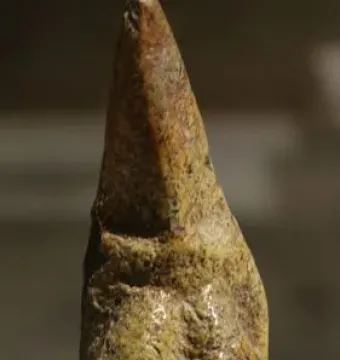
February 2025 © Francesco Bini · CC BY-SA 4.0
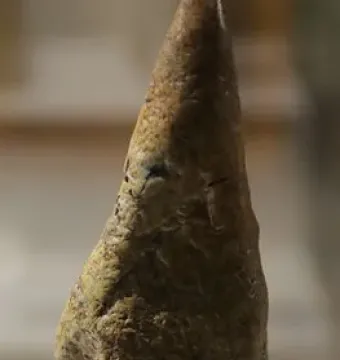
February 2025 © Francesco Bini · CC BY-SA 4.0
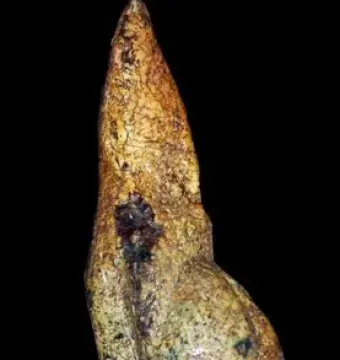
© 120 · CC BY-SA 3.0
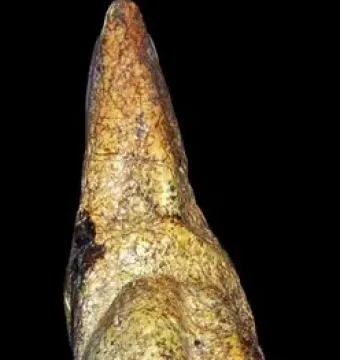
© 120 / Vincent Mourre · CC BY-SA 3.0
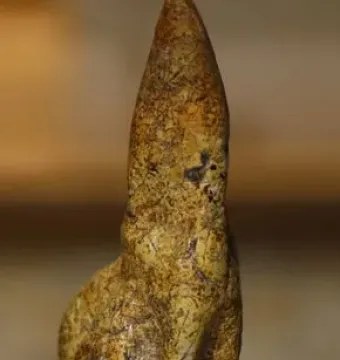
February 2025 © Francesco Bini · CC BY-SA 4.0
Identification | |
| Title | Venus of Savignano |
| Original name | Venere di Savignano |
| Type | Paleolithic Venus figurine |
Historical context | |
| Period | Upper Paleolithic |
| Cultural attribution | Gravettian or Epigravettian |
| Estimated date | Probably 25,000–20,000 years ago; some scholars have dated it to about 29,000 years ago |
Discovery and provenance | |
| Discovery date | 1925 |
| Discovery location | Pra’ Martino, near Mulino, Savignano sul Panaro, Province of Modena, Italy |
| Discoverer | Olindo Zambelli |
| Discovery context | Found during construction work for a rural building, about 1 meter below ground in alluvial/clayey deposits with no archaeological context |
| Initial treatment after discovery | Zambelli cleaned and kept the statuette despite his wife's advice to throw it away |
| Acquired by | Giuseppe Graziosi |
| Acquisition details | Graziosi obtained it from Zambelli in exchange for two hundred kilograms of grapes |
| Donation | Donated by Giuseppe Graziosi to the Pigorini Museum in 1926 |
| Findspot interpretation | Probably the original place of deposition; no traces of river transport were observed |
Physical characteristics | |
| Weight | 586.5 g |
| Dimensions | Height 22.5 cm; width 4.8 cm; depth/thickness 5.2 cm |
Materials | |
| Material | Serpentinite (serpentine/greenstone) |
Appearance | |
| Depicted figure | Stylized female figure |
| Features | Clearly marked breasts, belly, buttocks, and thighs; lightly outlined arms; no feet; cone-shaped termination instead of a head |
| Modeling | Strong sculptural modeling |
Location and ownership | |
| Current location | Museo Nazionale Preistorico Etnografico "Luigi Pigorini", Rome |
| Inventory number | 106610 |
| Temporary loan | Loaned to Savignano sul Panaro from 5 April to 4 May 2014 for the project "Savignano, Città dell'Archeologia" |
| Replica location | Museo della Venere e dell'Elefante, Savignano sul Panaro |
History and restoration | |
| Dating history | The dating was disputed from the beginning; it was first considered Neolithic, then later attributed to the Upper Paleolithic on stylistic grounds |
| Basis for later dating | Stylistic comparisons with other Venus figurines, especially those from Balzi Rossi and other Gravettian examples |
| Early studies | Studied by Paolo Graziosi and Ugo Antonielli; early publications appeared between 1925 and 1928 |
Significance | |
| Importance | One of the largest known Venus figurines; considered one of the earliest expressions of art in Italy |
| Comparative context | Among about 190 Venus figurines from the Upper Paleolithic of Europe and Siberia |
Other | |
| Associated note | The figurine was cleaned after discovery, which destroyed organic traces that could have supported standard dating methods |