
Venus of Hohle Fels
Venus of Hohle Fels is a small human figurine found in an excavation in September 2008 inside one of the Hohle Fels caves in the Ach Valley, Swabian Jura, near Schelklingen, Germany. Carved from mammoth ivory, it is about 6 centimeters high and was found broken into six fragments. The figure shows a highly emphasized female body, with prominent breasts, hips, and vulva, as well as detailed hands and fingers. The left shoulder and arm are missing, and a perforated projection in place of the head suggests it was worn as a hanging amulet. Radiocarbon dating places it at a minimum age of 35,000 years, possibly up to 40,000, making it one of the earliest known figurative human sculptures.
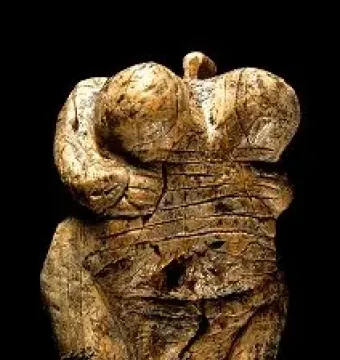
February 2018 © Nina Paley · CC0
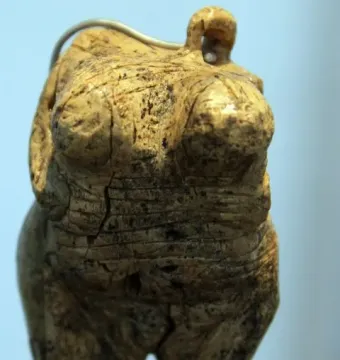
May 2013 © Anagoria · CC BY 3.0
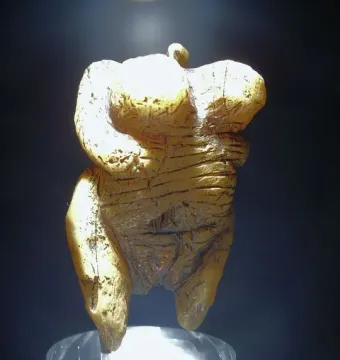
October 2009 © Gerbil · CC BY-SA 3.0
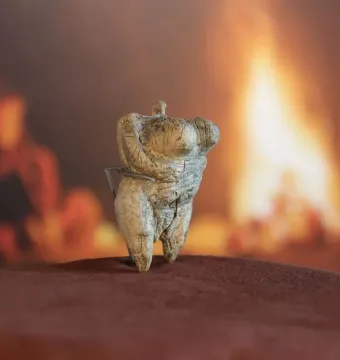
October 2014 © Hannes Wiedmann · CC BY-SA 4.0
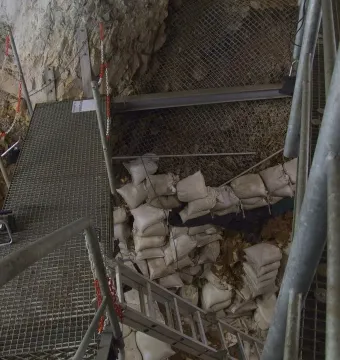
May 2010 © Thilo Parg · CC BY-SA 3.0
Identification | |
| Title | Venus of Hohle Fels |
| Type | Paleolithic Venus figurine |
| Alternative names | Venus of Schelklingen; Venus of Swabia; Venus vom Hohle Fels; Venus vom Hohlefels; Swabian Venus |
Historical context | |
| Cultural period | Aurignacian, Upper Paleolithic |
| Date | about 35,000–40,000 years ago |
| Dating method | radiocarbon dating |
| Radiocarbon age | at least 31,000–35,000 14C years; another estimate gives up to 40,000 years old |
| Historical context | at the beginning of the Upper Paleolithic, with early modern humans (Cro-Magnons/Homo sapiens) present in Europe |
Creator | |
| Excavation leadership | Nicholas Conard |
Discovery and provenance | |
| Find condition | found broken into six fragments |
| Associated finds | a vulture-bone flute found 70 cm away; flint-knapping debris; worked bone; carved ivory; animal remains including steppe horses, reindeer, cave bears, woolly mammoths, and Alpine ibex |
| Fragment distribution | the fragments were found close together over about one quarter of a square meter, with about 10 centimeters vertical difference |
| Discovery location | Hohle Fels cave near Schelklingen, Baden-Württemberg, Germany, about 20 meters inside the cave |
| Excavated by | a team from the University of Tübingen on behalf of the State Office for Monument Preservation Baden-Württemberg |
| Discovery context | found during excavations in archaeological layers Va and Vb |
| Discovery date | September 2008 |
Physical characteristics | |
| Height | about 6 cm |
| Width | 3.5 cm |
| Depth | 3 cm |
| Weight | 33 g |
| Condition | left shoulder and left arm are missing; left arm and clavicle are missing; the head is represented by a perforated protrusion, though one source suggests the head may also be missing |
Materials | |
| Material | carved mammoth ivory |
| Ivory source | mammoth tusk; one source specifies a female mammoth |
Appearance | |
| Depicted figure | female figure |
| Stylistic features | breasts, hips, vulva, belly, thighs, and hands/fingers are emphasized in detail |
| Head feature | a perforated protrusion or small button with a hole in place of the head |
Iconography and meaning | |
| Interpretation | possibly a fertility symbol |
| Probable use | possibly worn as a hanging amulet or pendant |
Location and ownership | |
| Current location | Urgeschichtliches Museum Blaubeuren (Prehistoric Museum of Blaubeuren) |
| Examination location | University of Tübingen, Germany |
History and restoration | |
| Exhibition history | first publicly displayed in 2009 at the State exhibition of Baden-Württemberg 'Ice Age – Art and Culture' at the Kunstgebäude Stuttgart; later displayed at the Urgeschichtliches Museum Blaubeuren, the Landesmuseum Württemberg in Stuttgart, and the Martin-Gropius-Bau in Berlin in the exhibition 'Bewegte Zeiten. Archaeology in Germany' (21 September 2018 to 6 January 2019) |
| Publication date | 14 May 2009 in Nature |
| Press presentation date | 13 May 2009 |
| Restoration | the fragments were restored and assembled before presentation to the press |
Significance | |
| Significance | described as the oldest known figurative human sculpture and the oldest recognized work of Upper Paleolithic and prehistoric figurative art; one source says it is among the world's oldest depictions of the human body, with only the Lion-Man figurine possibly older in figurative art |
| Comparative dating | about 5,000 years older than Gravettian Venus figurines; older abstract human representations are known from South Africa, about 75,000 years old |
| Archaeological significance | evidence from the Swabian Jura is described as a unique concentration of behavioral modernity, including figurative art and instrumental music, and has been linked by Nicholas Conard to possible early religious practices |
Other | |
| Associated cultural attribution | Aurignacian culture; one source also mentions Proto-Gravettian |
| Archaeological region | Swabian Jura / Swabian Alb, Baden-Württemberg, Germany |
| Site meaning | Hohle Fels means 'hollow rock' in Swabian German |
| Site status | part of the Caves and Ice Age Art in the Swabian Jura UNESCO World Heritage Site |
| Related artifacts | Löwenmensch figurine; ivory flute from Geißenklösterle dated to about 42,000 years ago; mammoth-bone flute dated to about 36,000 BCE |
| Associated human species mentioned | Australopithecus; Pithecanthropus erectus; Sinanthropus pekinensis; Paleanthropes; Homo heidelbergensis; Javanthropus; Homo neanderthalensis |