
Statue of Horemheb and Amenia
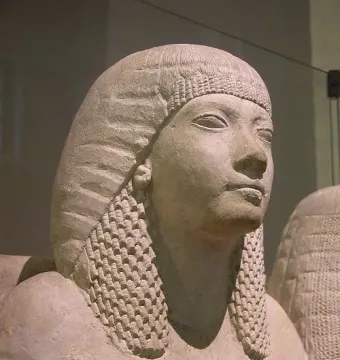
The Statue of Horemheb and Amenia is a large double sculpture of the future pharaoh Horemheb and his wife Amenia, who was not destined to become queen. It was found at Saqqarah in Lower Egypt and is now conserved in London at the British Museum. The identities of the two figures remained unknown for more than a century. In 1976, a team of Dutch and British archaeologists discovered a missing fragment in Horemheb’s tomb at Saqqarah: a piece showing the couple’s joined hands. The find clarified the identity of the sculpture and linked it to Horemheb’s burial place from his earlier career as a military commander.
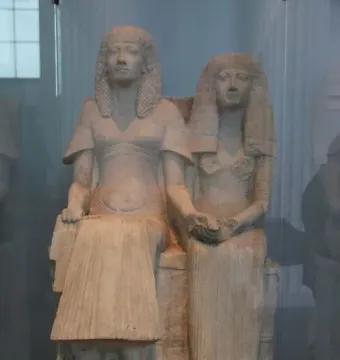
July 2017 © Gary Todd · CC0
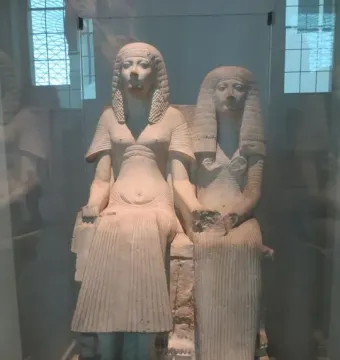
March 2014 © Jononmac46 · CC BY-SA 3.0
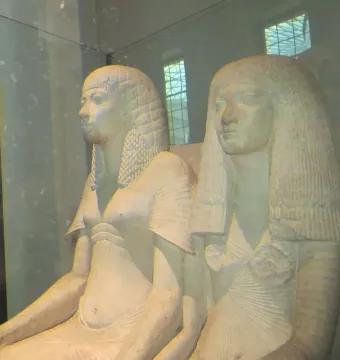
March 2014 © Jononmac46 · CC BY-SA 3.0
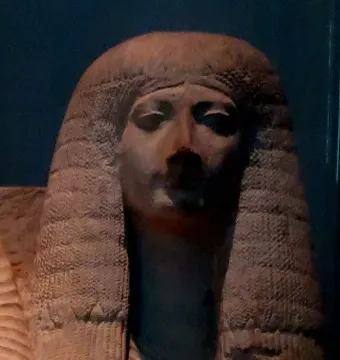
March 2014 © Jononmac46 · CC BY-SA 3.0
© Jon Bodsworth · Public domain
Identification | |
| Title | Statue of Horemheb and Amenia |
| Type | Double statue |
| Inventory number | EA36 |
Iconography and meaning | |
| Depicted figures | Horemheb and his wife Amenia |
| Relationship of depicted figures | Husband and wife |
Historical context | |
| Horemheb's status | General-in-chief of the king's armies when the tomb was built; later pharaoh |
| Amenia's status | Wife of Horemheb, intended not to become queen |
| Historical period | Late Eighteenth Dynasty of Egypt |
| Chronological context | Era of the successors of Akhenaten: Smenkhkare, Tutankhamun, Ay, and Horemheb |
Creator | |
| Creator | Unknown |
Discovery and provenance | |
| Evidence for identification | A 2009 plaster cast of the fragment matched Amenia's two hands and Horemheb's left hand |
| Identification history | The figures were unidentified for more than a century until the 1976 discovery of a missing fragment and its 2009 plaster cast confirmed the identification beyond reasonable doubt |
| Supporting fragment discovered | 1976 by a team of Dutch and British archaeologists |
| Findspot of supporting fragment | Horemheb's tomb at Saqqara |
| Previous owner | Collection of the merchant Giovanni Anastasi |
| Acquired by | British Museum |
| Acquisition date | 1839 |
| Current location | British Museum, London |
| Original provenance | Horemheb's tomb at Saqqara; initially thought to be from Thebes or Saqqara |
| Discovery site | Saqqara, Lower Egypt |
Physical characteristics | |
| Pose | The couple is seated upright side by side on a large throne with lion legs |
| Gesture | Amenia holds Horemheb's left hand with both of her hands |
| Clothing | Both figures wear long pleated tunics and wigs typical of the Eighteenth Dynasty; Horemheb also wears sandals and wide sleeves |
| Coloration | Originally painted in vivid colors, now mostly lost |
| Condition | Generally in very good condition, with minor damage |
Materials | |
| Materials | Not stated |
Technique | |
| Technique | Painted sculpture |
Appearance | |
| Style impression | Conveys the serene elegance of the Egyptian high aristocracy in the New Kingdom |
Significance | |
| Influence | Inspired Henry Moore, who used it as a model for many bronze works |
| Comparative example | The double statue of Maia and Meryt in Leiden |