
Golden Rider
Golden Rider is an equestrian statue of Augustus the Strong, Elector of Saxony and King of Poland, in Dresden, the capital of Saxony. It stands on the right bank of the Elbe, opposite the historic city center, along the central axis between Augustus Bridge, Hauptstrasse, and Neustädter Markt, in front of the New Guardhouse. The monument is considered one of Dresden’s most famous landmarks and one of the most important sculptures of the Dresden Baroque period. It shows Augustus in the guise of a Roman emperor on a rearing horse. The statue was created after a design by sculptor Jean Joseph Vinache and installed in 1736.
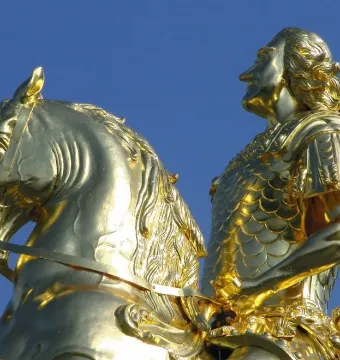
June 2003 © Jörg Blobelt · CC BY-SA 4.0
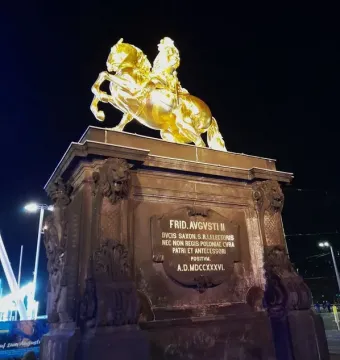
January 2025 © Aagnverglaser · CC BY 4.0
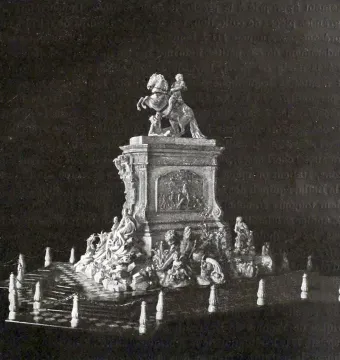
1911 © Georges Servières · Public domain
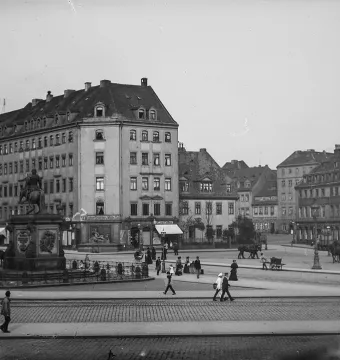
© Ermenegildo Antonio Donadini · CC0
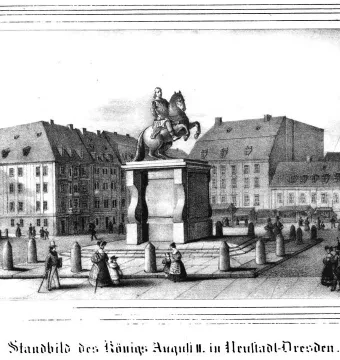
1836 © Eduard Sommer · Public domain
Identification | |
| Title | Golden Rider |
| German name | Der Goldene Reiter |
| Polish name | Złoty Jeździec |
| Type | Equestrian statue |
| Original title | "Золотой всадник"; "Золотий вершник в Дрездені" |
Historical context | |
| Reason for site selection | Longuelune proposed it as a dignified location because the design of the Inner New Town belonged to Augustus the Strong's lasting achievements |
| Historical note | The monument was the first free-standing equestrian statue in Saxony |
| Unveiling condition | The monument was unveiled while the pedestal remained unfinished |
| Installation date | 1736 |
| Patron's death | Augustus the Strong died on 1 February 1733 |
| Unveiling date | 26 November 1736 |
| Final site selection | Neustädter Markt, in front of Longuelune's Blockhaus ("Neustädter Wache") of 1730 |
| Temporary installation | 1730 on the newly designed Augustus Bridge |
| Original intended location | The central cour d'honneur of the new Baroque residence planned next to the Zwinger |
| Commissioned design by | Balthasar Permoser |
| Commissioner | Augustus the Strong |
| Commission date | 1704 |
Creator | |
| Pedestal designer | Zacharias Longuelune |
| Fabricator | Ludwig Wiedemann |
| Bronze cast maker | Johann Michael Weinhold |
| Other contributors | François Coudray, Paul Heermann, Johann Christian Kirchner |
| Designer | Jean Joseph Vinache |
Discovery and provenance | |
| Workshop location | A site on the area of today's Menageriegärten allotment gardens in Dresden-Friedrichstadt |
| Workshop remains found | Fragments of clay pipes and abundant slag |
| Trial installation | A model was provisionally installed on the newly designed Augustus Bridge in 1730 |
| Commissioned model purpose | Probably a competition or work sample for Zacharias Longuelune's appointment at the Oberbauamt |
Physical characteristics | |
| Pedestal decoration | Coat of arms of Poland from the Wettin period, the king's monogram, and Latin inscriptions |
| Orientation | Facing northeast toward Poland |
| Armor | Scale armor |
| Horse breed | Lipizzan horse |
| Pose | Riding a rearing horse |
| Depicted as | A Roman emperor / Caesar |
| Depicted person | Augustus the Strong (1670–1733), Elector of Saxony and King of Poland |
Materials | |
| Statue material | Copper |
| Original intended casting material | Bronze |
| Surface finish | Gold leaf gilding |
| Restoration gilding material | Gold leaf |
Technique | |
| Gilding technique | Fire-gilded originally; regilded with gold leaf in later restorations |
| Manufacture period | 1732–1734 |
| Fabrication method | Hammered and chased; originally intended for bronze casting but ultimately made in copper |
Appearance | |
| Style | Baroque |
| Depiction | Augustus the Strong portrayed as a Roman emperor on a rearing stallion |
| Stylistic reference | Planned as a posata figure rather than a courbette riding-school pose |
| Prototypes or inspiration | Marcus Aurelius's equestrian statue on the Capitoline Hill in Rome and Donatello's design for an equestrian statue of Alfonso of Aragon in Castel Nuovo, Naples |
History and restoration | |
| Reinstallation | 1956, for Dresden's 750th anniversary celebrations |
| Pedestal inscriptions | East side: 'Frid(ericus) Augustus I. dux saxoniae s.(acri) r.(omani) i.(mperii) princeps elector archimareschalcus idemque rex poloniae Augustus II'; west side: 'Frid(ericus) Augusti II. ducis saxon(iae) s.(acri) r.(omani) i.(mperii) electoris nec non regis poloniae cura patri et antecessori positum A.(nno) D.(omini) MDCCXXXVI' |
| Vandalism | Repeated damage in summer 2011, including the scabbard being broken off; vandalism became more frequent after 2011 |
| Latest restoration | 2001–2003; after a red lead primer, it was oil-gilded with a total of 500 grams of gold leaf |
| Regilding | 1965, with 187 grams of gold leaf |
| Pedestal foundation date | 1735 |
| Postwar restoration | 1953–1956, by Walter Flemming, who reassembled and restored the statue |
| World War II removal | Dismantled and moved to Pillnitz Castle for storage in 1943–1944 |
| Pedestal completion | 1885, by Constantin Lipsius, who completed the pedestal with Latin inscriptions |
| First restoration | 1884, by Constantin Lipsius |
| Pedestal status at unveiling | Unfinished |
Location and ownership | |
| Current location | Neustädter Markt, Dresden, Saxony, Germany, on the right bank of the Elbe opposite the historic city center, along the central axis between Augustus Bridge and Hauptstrasse, in front of the New Guardhouse |
Significance | |
| Art historical significance | One of the most famous monuments in Dresden and one of the most important sculptures of the Dresden Baroque period |
| Cultural significance | One of the landmarks of Dresden; a prize of the Dresden Film Festival and a scout troop were named after it; it appears on a quality seal for Dresden Christstollen; a beer brand was named after it |