
Ivriz Relief
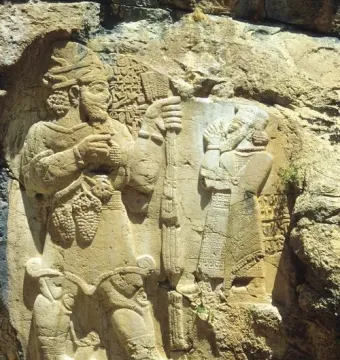
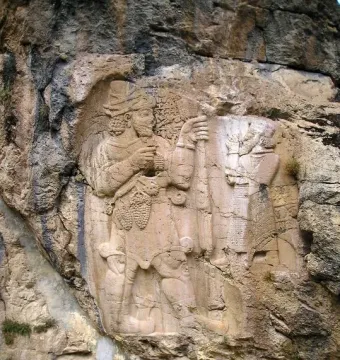
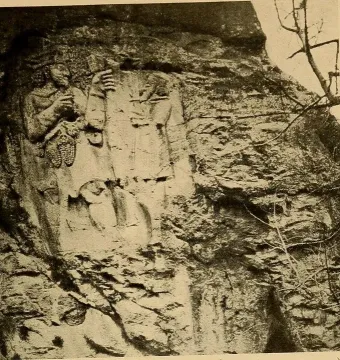
The Ivriz relief is a well-preserved Hittite rock carving near the former village of İvriz, now Aydınkent, about 17 km southeast of Ereğli in southern Turkey. Carved on a steep rock face beside the source of the İvriz Suyu, it dates to the second half of the 8th century BC, during the late Hittite-Aramaean period. The scene shows King Warpalawa of Tuwana on the right and, much larger, the storm and weather god Tarhunza on the left with sheaves of grain and grapevines, symbols of fertility. Three inscriptions in Luwian hieroglyphs are preserved on the relief. Finds from 1986 suggest the site may have been part of a richly furnished sanctuary dedicated to Tarhunza.
August 2001 © Klaus-Peter Simon · CC BY 3.0
September 2008 © Verity Cridland · CC BY 2.0
1917 © Internet Archive Book Images · No restrictions
May 1993 © Mark Landon · CC BY 4.0
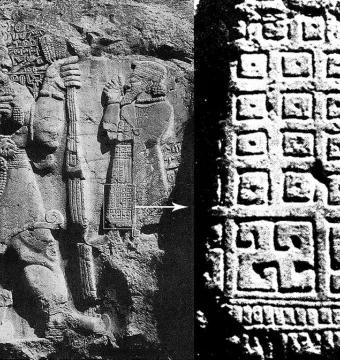
August 2013 © Rug tracker archive, 2012/05/01 · Public domain
Identification | |
| Title | Ivriz relief |
| Type | Hittite rock relief |
| Also known as | İvriz 1; the primary rock relief |
| Part of | the İvriz monuments |
Historical context | |
| Date | Second half of the 8th century BC |
| Historical period | Late Hittite-Aramaean principalities |
| Cultural affiliation | Neo-Hittite |
Creator | |
| Depicted deity | Tarhunza (Tarhunzas), the storm and weather god |
| Depicted ruler | King Warpalawa of Tuwana |
Physical characteristics | |
| Dimensions | 4.2 × 2.4 m |
| Condition | The best-preserved of the numerous Hittite rock images, but damaged in modern times by water from the İvriz Suyu |
| Third isolated relief carving depth | About 1 cm deep |
| Second relief size | Approximately the same size as the main relief |
Materials | |
| Material | Rock face |
Technique | |
| Technique | Carved in the cliff face |
Location and ownership | |
| Location relative to Halkapınar | 3 km southwest |
| Third isolated relief current location | Ereğli Museum |
| Country | Turkey |
| Location relative to Ereğli | about 17 km southeast |
| Region | south-central Anatolia |
| Current site | İvriz archaeological area |
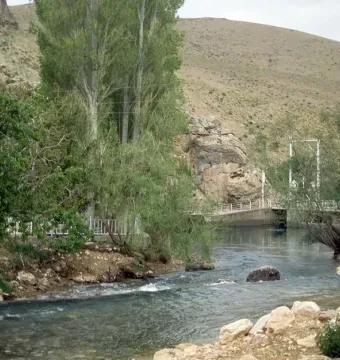
| Site setting | On a steep cliff at a spring; the water in the area has been impounded in modern times |
| Original location | Near the former village of İvriz (today Aydınkent), about 17 km southeast of Ereğli, Konya Province, south-central Anatolia, Turkey, on the cliff face at the source of the İvriz Suyu |
| Current location of finds | Konya Ereğli Museum |
Appearance | |
| Main scene | King Warpalawa stands on the right, much smaller than Tarhunza on the left |
| King depiction | Standing on a rock block or stone platform with hands raised in greeting, prayer, or worship |
| Deity depiction | Shown much larger than the king, holding ears of grain and grapes, with stalks and vines reaching down to his feet |
| Weapon detail | A bird-headed, probably vulture-shaped weapon pommel at the god's hip |
| Third isolated relief subject | A man in a short skirt leading an animal to his right while following another person in a long robe; the upper part and front of the person in the long garment are missing |
Iconography and meaning | |
| Fertility interpretation | The relief may refer to water flowing almost year-round from the spring rather than to rare rain |
| Possible function | May have been part of a spring sanctuary or local spring cult |
| Historical place name | The İvriz spring was called Salusa in Warpalawa's time |
| Third isolated relief interpretation | Thought to be a sacrifice scene; the carved holes on the surface may indicate a ritual place |
Inscriptions | |
| Inscription 3 interpretation | Probably the inscription of the scribe |
| Inscription 1 text | "This is the great Tarhunza of Warpalawa. For him they left it. They placed it long (?) Sahana (?)" |
| Inscription 3 text | "Tiyamartu, Warpalawa beloved? ... carved ..." |
| Inscription 3 location | Several meters below the relief, at the bottom of the rock |
| Inscriptions | Three Luwian hieroglyphic inscriptions |
| Inscription 1 location | Directly in front of the god's face |
| Inscription 3 condition | Heavily weathered and sometimes underwater |
| Inscription 2 location | Behind the king's back |
| Inscription 2 text | "This is the image of Warpalawa the hero ..." |
Discovery and provenance | |
| First confirmed European visitor | Major von Fischer in 1837 |
| Historical reception | Mentioned by Kâtip Çelebi in his 17th-century geography and described by Jean Otter in 1748, but Otter apparently relied on Kâtip Çelebi and did not see it himself |
| Second relief relation | A copy of the Ivriz relief |
| Second relief location | South of the main relief, higher up in the Ambar Deresi mountains near Kızlar Sarayı |
| Third isolated relief location | In a stream about 25–30 m from the Ivriz relief and about 10 m from the road |
| Additional finds in 1986 | During construction work in 1986, a fragment of a stele and a head fragment of a large statue were found about 75 m upstream from İvriz 1 |
| Third isolated relief discovery | Discovered by villagers in 1972 |
| Further related finds | At least three other inscribed rock fragments were found nearby and appear to belong to other monuments |
| Statue head fragment identification | A head fragment of a larger-than-life statue, probably of Tarhunza |
| Stele text | Erected by Warpalawa; the text also mentions King Warpalawa |
| Stele inscription | Luwian hieroglyphic inscription on the back and right side; Phoenician inscription on the left side |
| Stele decoration | A relief on one side |
| Stele condition | Only the lower part survives |
| Stele identification | İvriz 2, an inscribed stele fragment |
History and restoration | |
| Second relief condition | Less detailed, not so well carved, and probably never fully finished; the hieroglyphs are missing |
Other | |
| Source | Dinçol, Belkis (1994), "New archaeological and epigraphical finds from Ivriz. A preliminary report," Tel Aviv Journal of Archaeology 21, 117–128 |