
Farnese Bull
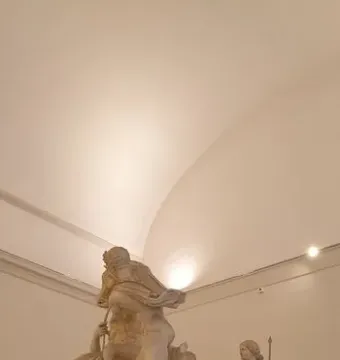
The Farnese Bull is a massive Roman marble copy of a Hellenistic sculpture, and the largest single sculpture yet recovered from antiquity. Dating to the Severan period (A.D. 222–235), it depicts the mythological death of Dirce, who was tied to a wild bull by Amphion and Zethus. The sculpture is much restored and includes additional figures around the base, such as a child, a dog, and other animals. Formerly in the Farnese collection in Rome, it has been in the Museo Archeologico Nazionale Napoli since 1826, though it is sometimes displayed at the Museo di Capodimonte.
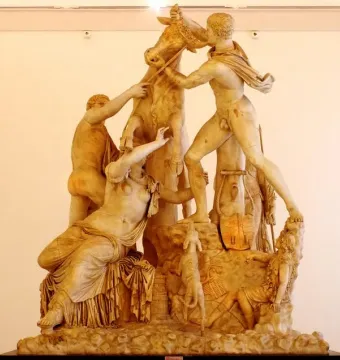
October 2024 © Paolo Villa · CC BY 4.0
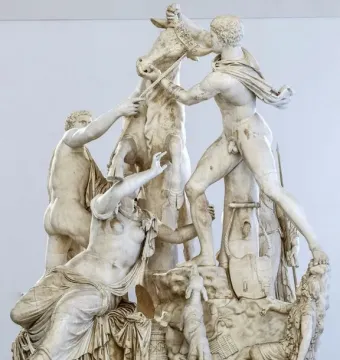
· CC BY 2.5
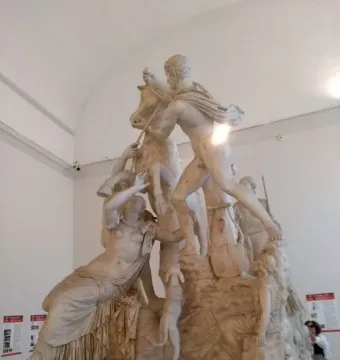
© patrick janicek · CC BY 2.0
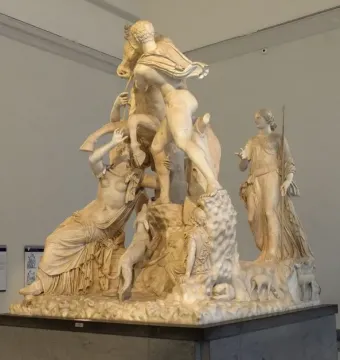
June 2014 © Amphipolis · CC BY-SA 2.0
October 2019 © Jamie Heath · CC BY-SA 2.0
Identification | |
| Title | Farnese Bull |
| Alternative names | Touro Farnésio; Touro Farnese; Byk Farnezyjski; Byk Farnese; Toro Farnesio; The Punishment of Dirce |
| Type | Large free-standing marble sculptural group |
Historical context | |
| Art period | Hellenistic period; Roman Imperial copy |
| Date | Late 2nd century BC original; Severan period copy (AD 222–235) is also proposed |
| Historical designation | Historiographical name |
Creator | |
| Original artists | Apollonius of Tralles and his brother Tauriscus |
| Ancient source | Pliny the Elder |
Discovery and provenance | |
| Possible ancient location mentioned in scholarship | Horti Asiniani (Asinian Gardens), near the Baths of Caracalla |
| Original location | Rhodes |
| Associated owner of ancient setting | The Asinii family |
| Associated collector | Gaius Asinius Pollio |
| Former collection | Farnese Collection in Rome |
| Provenance | Originally from Rhodes; later moved to Rome in antiquity |
| Initial condition when found | Found broken into pieces |
| Discovery context | Found during excavations ordered by Pope Paul III to find sculptures for the Palazzo Farnese |
| Discovery site | Baths of Caracalla, Rome |
| Discovery date | 1546 |
Physical characteristics | |
| Height | More than 4 m |
| Base dimensions | More than 3 m on a side |
| Weight | About 21.8 tonnes |
| Scale | Colossal; described as the largest free-standing sculpture from classical antiquity to survive and the largest single sculpture recovered from antiquity |
Materials | |
| Material | Marble |
| Original construction material | Carved from a single large block of marble |
Technique | |
| Technique | Roman copy of a Hellenistic sculpture |
Appearance | |
| Composition | The scene is arranged in a pyramidal composition and is dynamic, with strong pathos |
Condition | |
| Condition | Much restored; severely damaged after long outdoor exposure |
History and restoration | |
| Restorers | Guglielmo della Porta and Giovanni Battista Bianchi; later Andrea Cali; later Angelo Brunelli; later Angelo Solari |
| Restoration supervision | Restored under the supervision of Michelangelo |
| Michelangelo's proposal | He proposed using it in a fountain |
| Possible early use | It may have been adapted for fountain use soon after discovery |
| Supporting evidence | Renaissance descriptions and a 1595 engraving by Etienne du Perac |
| Added restoration elements | An infant/child, a dog, other animals, a shepherd, and parts of Dirce, Antiope, the bull, and the sons of Antiope were added in restoration; modern scholars think the figure of Antiope with a spear was not original |
| Restoration date of added elements | Some added elements were introduced in the 16th century; others in 1848 |
| Restoration history | Substantially restored in the 16th century, with further restorations in 1579, the 18th and 19th centuries, including work in 1848 |
Location and ownership | |
| Associated palace | Palazzo Farnese |
| Ancient setting | The courtyard of the southeastern palaestra of the Baths of Caracalla |
| Installation location in Rome | Inner courtyard of Palazzo Farnese |
| Fountain location | Villa Giulia |
| Former location | Palazzo Farnese in Rome; later moved to Naples in 1787 |
| Transfer to Naples | Moved in 1787 as part of the Farnese family inheritance |
| Occasional display location | Museo di Capodimonte, Naples |
| Since | 1826 |
| Inventory number | 6002 |
| Current location | National Archaeological Museum of Naples, Italy |
Iconography and meaning | |
| Subject | The myth of Dirce |
| Depicted figures | Dirce; Amphion and Zethus, sons of Antiope; Antiope; a wild bull |
| Narrative represented | Dirce, the first wife of Lycus, king of Thebes, is tied to a wild bull by Amphion and Zethus as punishment for mistreating their mother Antiope |
Significance | |
| Ancient fame | Well known in antiquity, with numerous reproductions in wall paintings at Pompeii, gems, and Lydian coins |
| Literary mention | Mentioned by Pliny the Elder in Natural History |
| Scholarly debate | Some scholars argue the surviving sculpture cannot be the work mentioned by Pliny and instead may be a 3rd-century AD Roman version made for the Baths of Caracalla |