
Gniezno Doors
The Gniezno Doors are a pair of bronze doors at the entrance to Gniezno Cathedral in Poland. They are decorated with eighteen low-relief scenes showing the life of Saint Adalbert, whose remains were bought at great expense and brought back to the cathedral, where they were kept. Although the cathedral is a Gothic building, the doors are earlier and were transferred from a previous temple. They were made around 1175, during the reign of Mieszko III the Old, and are regarded as one of the most important Romanesque artworks in Poland.
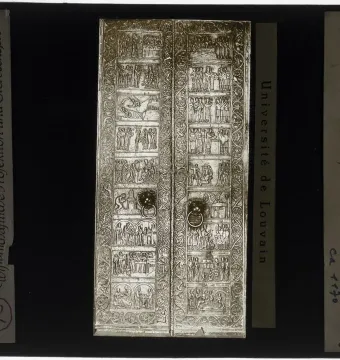
© Unknown · Public domain
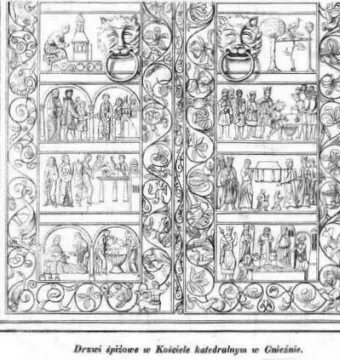
© Unknown authorUnknown author · Public domain

March 2013 © Michał Józefaciuk · CC BY-SA 3.0 pl
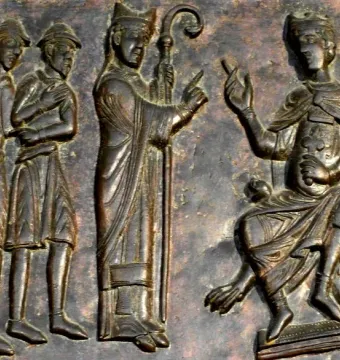
September 2019 © Mathiasrex · CC BY-SA 4.0
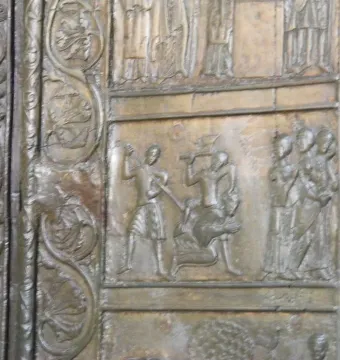
May 2012 © Onazi · CC BY 3.0
Identification | |
| Title | Gniezno Doors |
| Alternative names | Porta Enea; Porta Regia; Porta Aurea; Porta aenea; Doors of Saint Adalbert; Gnesener Bronzetür; Гнезненські ворота; Гнезненские врата |
| Type | Pair of double-leaf bronze church doors with relief decoration |
Historical context | |
| Date of creation | 12th century, probably c. 1175; sources also give 1160–1180, 1170–1190, or 1175–1200 |
| Historical period | Made during the reign of Mieszko III the Old |
| Commissioned by | The archbishop of Gniezno; proposed initiators also include Prince Mieszko III the Old and the then archbishop of Gniezno |
| Made for | A Romanesque building consecrated in 1097 |
Creator | |
| Possible makers | Masters from the Meuse region; alternative proposals include craftsmen from Hildesheim or Magdeburg |
| Production hypothesis | The design and wax model may have come from Liège, while casting may have been done in Gniezno; another hypothesis suggests artists and craftsmen were brought from western Europe |
| Place of creation | Disputed; proposed locations include Gniezno, Hildesheim, Magdeburg, Bohemia, or Flanders (possibly Liège), with some proposals involving craftsmen from the Meuse region |
Discovery and provenance | |
| Provenance | The doors predate the present cathedral and were transferred from an earlier Romanesque church |
Location and ownership | |
| Current location | Gniezno Cathedral, Gniezno, Poland |
| Placement history | Set in the inner portal of the south porch of the primatial basilica in Gniezno; from the end of the 14th century to the 18th century they were in the doorway to the eastern bay of the south aisle, and after 1784 in the entrance to the western bay of the south aisle in a Classical portal jamb |
| Associated building | Primatial Basilica of the Assumption of the Blessed Virgin Mary, the archcathedral church of Gniezno |
Physical characteristics | |
| Dimensions | Left leaf 328 × 84 cm; right leaf 323 × 83 cm |
| Thickness | 1.5–2.5 cm |
| Construction | Left leaf cast in one piece; right leaf assembled from 24 cast sections |
| Handles | Lion-head knockers cast separately and soldered on |
Materials | |
| Material | Bronze |
| Metal composition | Copper, tin, and a small amount of lead |
Technique | |
| Casting technique | Lost-wax casting |
| Surface finishing | Some fine detail was added after casting by engraving |
| Mounting method | Holes for pegs indicate the metal leaves were originally attached to wooden doors |
Appearance | |
| Decoration | Eighteen bas-relief scenes in nine panels on each leaf, with a decorative vegetal rinceau border and small figures of people, animals, and astrological personifications |
| Relief depth | Much higher on the left leaf, reaching up to 75% on some figures; on the right leaf few figures reach 25% |
Iconography and meaning | |
| Scene sequence | The cycle begins at the lower left, runs upward on the left leaf, and on the right leaf runs in the opposite direction from top to bottom |
| Right leaf scenes | Arrival by ship in Prussia; baptism of pagans; preaching before the hostile Prussians; last mass; martyrdom; body laid out with Adalbert's head impaled on a stake; Duke Bolesław buys back the missionary's body; transfer of the body to Gniezno; burial in the cathedral |
| Depicted subject | The life and martyrdom of Saint Adalbert of Prague (Wojciech), including his mission to the pagan Prussians and the translation and burial of his relics in Gniezno |
| Left leaf scenes | Birth of Adalbert; healing of a sick boy on the altar in Libice; arrival at the cathedral school in Magdeburg; prayer at the grave of the martyrs; investiture by Otto II in Verona; healing of a possessed man; a dream in which Christ appears to the bishop; liberation of Christian slaves; miracle scene in the Roman monastery on the Aventine |
| Iconographic concept | A visual cycle of the life, martyrdom, and cult of Saint Adalbert, probably created within the Gniezno cathedral clergy |
| Sources and influences | The scenes follow legends of Saint Adalbert, especially the Vita by Johannes Canaparius, and likely adapt compositions from Christological and other early medieval models; no illuminated source has survived to confirm a manuscript model |
History and restoration | |
| Condition and repairs | Cracks, welds, and repair overlays are visible; the doors were highly valued, protected, repaired, and moved during later cathedral reconstructions |
| Restoration discoveries | During restoration in 1956, partly erased inscriptions were discovered |
| Inscriptions | The inscriptions read 'me fecit me...us', 'petrus', and 'bovo luitinius/latinus' |
| Use and opening | After installation the doors were used mainly for display and were opened only on major church feasts, coronations, ceremonial entrances of archbishops, assemblies of princes, visits of important rulers, and funeral processions for members of the Piast dynasty |
| Dating hypotheses | A minority view by Swartzenski dates the doors soon after 1127, linking this to the recovery of Saint Adalbert's head; this is now generally considered unlikely |
| Inscription interpretation | They probably record the name of the craftsman in charge of the casting; one reading suggests 'made by ... Peter ... of ? [place]', while another possible reading is 'Peter the Latin made me' |
Other | |
| Historical status of origin | The origin of the doors remains disputed among historians |
Significance | |
| Art historical significance | One of the most important Romanesque artworks in Poland and one of the most significant works of Romanesque art in medieval Polish culture; unusually, they are the only Romanesque doors in Europe with a monumental single-saint narrative program |
| Stylistic affiliation | Romanesque art with strong Mosan influence |
| Comparative context | The left leaf follows the Hildesheim tradition of casting a large relief-covered door in a single piece; the doors also resemble the Magdeburg Doors in Veliky Novgorod |