
Treblinka
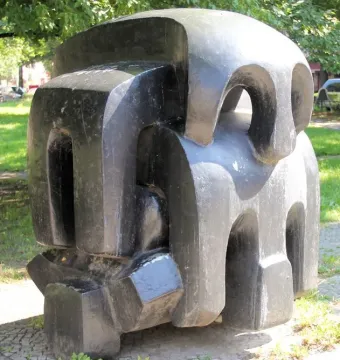
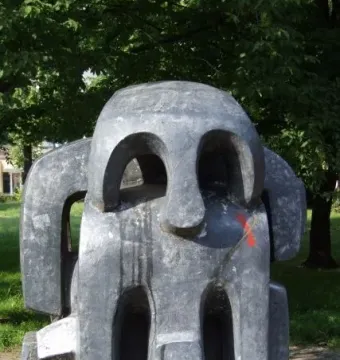
Treblinka is a memorial sculpture dedicated to the Jews murdered by Nazi Germany at the Treblinka extermination camp in occupied Poland during the Holocaust. It was erected in 1979 in the Charlottenburg district of West Berlin, opposite the district court building where the files of the repressed Jews were kept. The sculpture was created by the Soviet underground artist Vadim Sidur. It is also considered one of the first representations of Holocaust memory in Germany, giving the work particular historical significance beyond its memorial function.
August 2011 © OTFW · CC BY-SA 3.0
© Harald Rossa · CC BY-SA 2.5
July 2022 © OTFW · CC BY-SA 3.0
July 2022 © OTFW · CC BY-SA 3.0
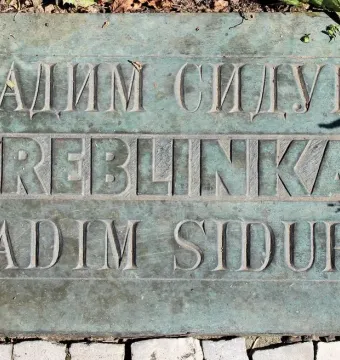
August 2011 © OTFW · CC BY-SA 3.0
Identification | |
| Title | Treblinka |
| Type | Memorial sculpture / monument |
Historical context | |
| Historical context | Holocaust during World War II |
Iconography and meaning | |
| Commemorates | Jews murdered by Nazi Germany at the Treblinka extermination camp in occupied Poland |
| Overall conceptual meaning | An embodiment of the burden of conscience of the living toward the murdered |
| Cross symbolism | Some researchers see an allusion to a cross associated in European culture with death and consolation; some art historians reject this as inappropriate Christian symbolism in a Jewish memorial |
| Holocaust symbolism | The heap of bodies symbolizes a pyre of the remains of Holocaust victims burned without a trace |
| Social meaning | The dead seem to call for justice they did not find and had no chance to find |
| Symbolism | A concentrated visual image of death, suffering, resistance, and destruction |
| Themes | Struggle between life and death, survival versus dying, suffering, resistance, and death |
| Meaning / interpretation | Highly schematic work allowing multiple interpretations |
| Intended subject | The horror of something that is practically impossible to describe |
Creator | |
| Artist background | Sidur was half Jewish on his father's side; his Jewish relatives were killed by the Nazis; he served in the Soviet army during World War II and was severely injured; after the war he became a sculptor, with violence and war becoming central themes in his work |
| Artist | Vadim Sidur |
| Artist description | Soviet underground artist; nonconformist avant-garde sculptor |
| Year created | 1966 |
| Original form | ceramic figurine / small model |
Discovery and provenance | |
| Inspiration | Vasily Grossman's The Hell of Treblinka (1944) |
| Related monument | The first enlarged monument made from his miniature models was To the Victims of Violence, opened in Kassel in 1974 |
| Model collections | Models are held in the Vadim Sidur Museum in Moscow, the State Art Collections in Dresden, Bochum, and Jewish and art museums in Dnipro |
| Expanded copy location | West Berlin |
| Expanded copy maker | a Swiss sculptor (name not given) |
Location and ownership | |
| Location | Amtsgerichtsplatz, Berlin-Charlottenburg, Berlin, Germany |
| Plaque moral message | Those who close their eyes to the past become blind in the present; those who do not want to remember inhumanity will be susceptible to acts of injustice in the future |
| Plaque historical reference | From July 1942 to November 1943, more than 750,000 people were killed in Treblinka II |
| Plaque quotation occasion | The fortieth anniversary of the capitulation of the Nazi regime / the 40th anniversary of the end of the war in Europe and Nazi tyranny |
| Plaque text source | A reworked quotation from a speech by German Federal President Richard von Weizsäcker |
| Plaque with explanatory text | A plaque on the opposite side provides explanatory text |
| Installation context | The courthouse had been the place where Jews deported to Nazi death camps were registered; files of repressed Jews were kept there |
| Placement | Opposite the Charlottenburg district court building, across from the entrance group, in a square park |
| Installed | 14 September 1979 |
Physical characteristics | |
| Side dimensions | Square side faces, 1.5 meters on a side |
| Height | 1.8 meters |
| Overall shape | Nearly cubic mass |
| Base | Stone pedestal about 10 centimeters high |
Materials | |
| Material | Tinted aluminum |
| Technique | Cast bronze |
Appearance | |
| Composition | Four abstract human bodies stacked crosswise on top of one another |
| Lowest figure details | The upper bodies almost crush her, pressing onto her chest and bent knees; her arm stumps are raised toward the sky |
| Top figure | There may be a child's corpse at the top |
| Form | Abstract figural representations |
| View from opposite side | Dangling and overlapping legs resemble the pipes of crematorium furnaces in Nazi death camps |
| View from court side | An abstract image of a human skull |
| Number of figures | Four |
| Lowest figure | A still-living woman, according to some researchers, struggling to rise under the weight of the bodies above her |
| Size progression | The bodies decrease in size from bottom to top |
| Body posture | Arms, legs, and heads hang lifelessly downward |
| Body treatment | The figures are highly schematic, almost two-dimensional, and appear cut out in profile from overlapping layers |
| Body arrangement | Each body is stacked in a cross-like shape |
History and restoration | |
| Opening date | 14 September 1979 |
| Opening coverage | The opening ceremony was covered by German radio and television |
| Additional plaque installation | In 1986, after Vadim Sidur's death, a bronze plate was placed in front of the monument, embedded in the pavement |
| Additional plaque inscription | "Treblinka"; Vadim Sidur, in Cyrillic and Latin script |
| Additional plaque placement | On the side facing the square |
| Additional plaque content | Explains the connection to the Treblinka extermination camp and includes a quotation by Richard von Weizsäcker |
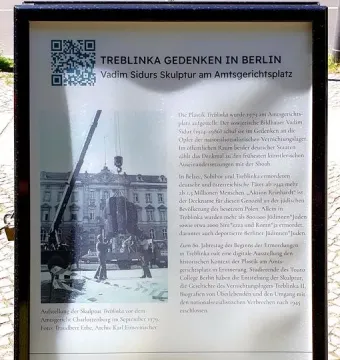
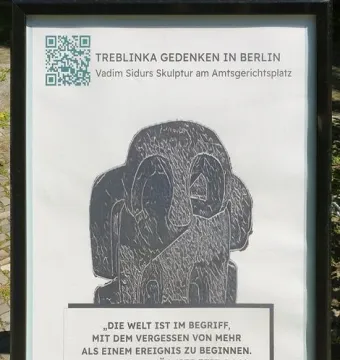
| Information stand | An information stand was installed next to the monument on 27 June 2024 for the centenary of Vadim Sidur's birth |
| Information stand content | It begins with the dedication 'I am the last Jew' by one of the few surviving inmates, then briefly tells the history of Treblinka and the sculptor |
| Artist's view | Sidur was disappointed that the monument was not the three-meter bronze statue he had dreamed of, but he still considered its unveiling a great success |
| Artist quote | His monuments preserve in human memory everything terrible for which no retribution is possible because the crime was too great, and serve as a warning for the future |
| Additional plaque decision | In 1985 the Charlottenburg district council decided to add an explanatory metal plaque |
Significance | |
| Historical significance | One of the first memorials to Holocaust victims in public space in West Germany and East Germany |