
Monument to Prince Józef Poniatowski in Warsaw
The Monument to Prince Józef Poniatowski in Warsaw is an equestrian work by the Danish sculptor Bertel Thorvaldsen, who also created the Warsaw Nicolaus Copernicus Monument. Based on the Marcus Aurelius statue in Rome, it shows Prince Poniatowski in antique-style dress holding a short sword in his right hand. Commissioned in 1817, the full-size plaster model was shown in Warsaw in 1830, though critics expected him to be depicted in armor. The bronze was made in 1832, but it was confiscated by Russian authorities and moved several times before being returned to Poland in 1922. Destroyed in 1944, it was restored in 1948–1951 and has stood since 1965 in front of the Warsaw Presidential Palace.
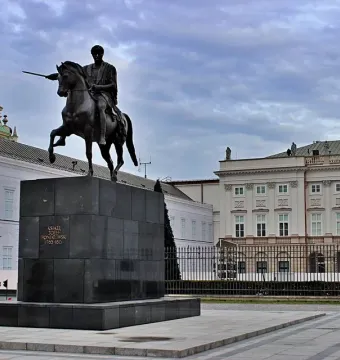
© Txemai Argazki · CC0
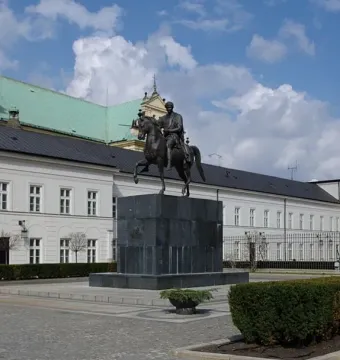
March 2010 © Nemo5576 · CC BY-SA 3.0
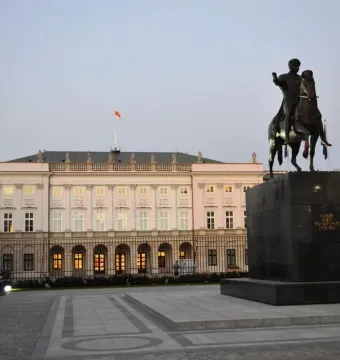
September 2023 © Scotch Mist · CC BY-SA 4.0
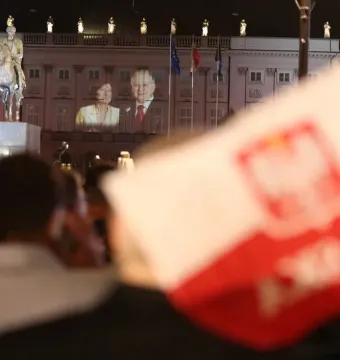
April 2018 © Kancelaria Sejmu / Paweł Kula · CC BY 2.0
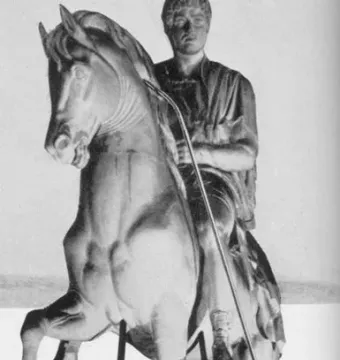
1936 © Nilfisk-Advance · CC BY-SA 3.0
Identification | |
| Title | Monument to Prince Józef Poniatowski in Warsaw |
| Type | Equestrian monument |
| Original title | Das Józef-Poniatowski-Denkmal |
Historical context | |
| Reason the monument was not installed as planned | Repression after the November Uprising |
| Commissioned | 1817 |
| Model shown to the public | 1829 |
| Bronze cast completed | August 1832 |
| Committee chairman | Adam Jerzy Czartoryski |
| Fundraising began | Early 1814, a few months after Poniatowski's death at the Battle of Leipzig |
| Nicholas I order | In October 1834 he ordered the sculpture and plaster model to be taken to Modlin Fortress, the committee to settle accounts with Thorvaldsen and the Gregoires, and remaining funds to be used for charity |
| Final contract signed | July 1820 |
| Permission granted then revoked | Permission to erect the monument in Warsaw was granted in 1834, then revoked after the fall of the uprising |
Creator | |
| Sculptor | Bertel Thorvaldsen |
| Artist nationality | Danish |
| Artist residence at commission time | Rome |
Discovery and provenance | |
| Gifted by Nicholas I to | Ivan Fyodorovich Paskevich |
| Gift of recast | Presented to Warsaw by the Kingdom of Denmark |
| Moved to | Dęblin Fortress, then to the Paskevich Palace in Gomel |
| Gomel display | Installed on the palace terrace beside cannons captured in 1829 during the Russo-Turkish War |
| Original site later occupied by | A monument to Ivan Paskevich, unveiled in July 1870 |
| Attempts to recover from Gomel | 1861, 1905, and 1917, unsuccessful |
| Returned to Poland | 1922 under the Treaty of Riga |
| Initial interpretation at Modlin | It was regarded as a statue of Saint George |
| First post-casting location | Modlin Fortress |
| Original planned location | In front of the Viceroy's Palace in Warsaw |
| Commissioned by | The Polish aristocracy |
| Commissioned from | Bertel Thorvaldsen |
| Approval for Warsaw installation obtained by | Anna Potocka née Tyszkiewicz after negotiations with Tsar Alexander I |
| Alternative proposed location by Thorvaldsen | The extension of Krakowskie Przedmieście in front of the Wasilewski Tenement, near Bednarska Street |
| Location later selected by imperial decision | The forecourt of the Governor's Palace in Warsaw |
| Funds redirected to | Construction of the Orthodox cemetery in Wola |
Physical characteristics | |
| Depicted pose | On horseback, holding a sword in his right hand |
| Depicted subject | Prince Józef Poniatowski (1763–1813) |
| Depicted costume | Roman antique attire |
Appearance | |
| Stylistic reference | The equestrian statue of Marcus Aurelius on the Capitoline Hill in Rome |
| Thorvaldsen's concept | Poniatowski as a hero surrounded by eternal glory |
| Public criticism of the design | Criticized for showing Poniatowski in Roman antique attire rather than armor or Polish national dress; also described as lacking likeness and having a stiff, static character |
Materials | |
| Metal source for recast | Melted remnants of the monument to Wilhelm I in Szczecin |
| Earlier model material | Plaster |
| Sculpture material | Bronze |
| Current pedestal facing material | Sinostal sandstone from Strzegom |
Technique | |
| Casting completed | August 1832 |
| Casting began | August 1830 |
| Casting workshop | Klaudiusz and Emil Gregoire's workshop on Długa Street in Warsaw |
| Casting interrupted by | The outbreak of the November Uprising |
History and restoration | |
| Pedestal destroyed | May 1946, despite opposition from the Ministry of Culture and Art and the press |
| Recast sculptor | Poul Lauritz Rasmussen |
| Recast basis | A model preserved in the Thorvaldsen Museum in Copenhagen |
| Recast made | 1948–1951 |
| Damage from pedestal demolition | Windows broke in the area and the roof of a nearby Zachęta building was damaged |
| 2020 conservation work | A new reinforced-concrete pedestal shaft was installed and an anniversary time capsule was embedded |
| Fragments found | April 1945 in the ruins of the Lilpop, Rau and Loewenstein factory |
| Destroyed | 16 December 1944, blown up by the Germans on the orders of Erich von dem Bach-Zelewski after the Warsaw Uprising |
| German occupation treatment | Covered on 1 September 1940; in January 1941 the Germans ordered its removal from Warsaw, but the order was not carried out |
| 2020 landscaping work | The plant arrangement from the 1920s was restored according to a concept by Łukasz Przybylak |
| Fate of plaster model left in Modlin | Probably destroyed |
| Reassembled in Modlin | 1840 for Tsar Nicholas I's inspection |
| Transported in | 1836, disassembled into 10 crates |
Location and ownership | |
| Current pedestal | A two-tier pedestal with a stone mosaic |
| Current pedestal designer | Zygmunt Stępiński |
| Final Warsaw location before wartime destruction | In front of the Saxon Palace and the Tomb of the Unknown Soldier, in Saxon Square |
| Current location since | 19 October 1965, in the courtyard of the Presidential Palace at 46/48 Krakowskie Przedmieście, Warsaw |
| Installed after recast | 23 February 1952, in front of the Old Orangery in Łazienki Park |
| Pedestal designer | Aleksander Bojemski |
| Unveiling at Saxon Square | 3 May 1923 |
| First provisional location in Warsaw after return | Courtyard of the Royal Castle in Warsaw |
Other | |
| Remains of original sculpture | Exhibited in Freedom Park near the Warsaw Uprising Museum |
Significance | |
| Literary reference | Władysław Mayakovsky dedicated the poem "Cast-Iron Trousers" to the monument |