
General José Gervasio Artigas
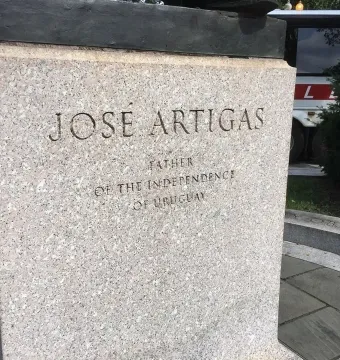
General José Gervasio Artigas is a bronze statue in Washington, DC, at the intersection of Constitution Avenue and Virginia Avenue, at 18th Street. It is part of the set known as the Statues of the Liberators. The work depicts José Artigas, a 19th-century general often called the father of Uruguayan independence, Protector de los Pueblos Libres, or Jefe de los Orientales. The Washington, DC, statue was created before 1948 by Juan Manuel Blanes and bears the inscription: “Liberty of America is my dream and its attainment my only hope.” It is a replica of an original in San José de Mayo, Uruguay, created by Italian sculptor Dante Costa.
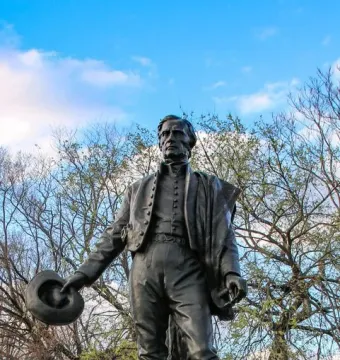
© Victoria Stauffenberg · Public domain
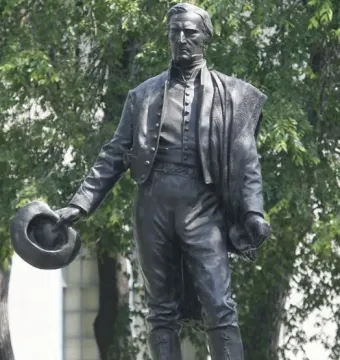
June 2008 © David · CC BY 2.0
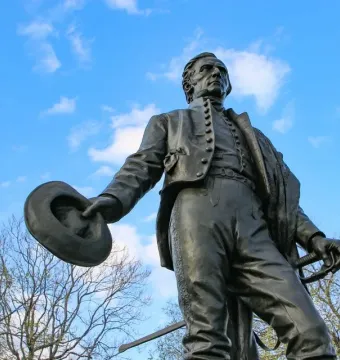
© Victoria Stauffenberg · Public domain
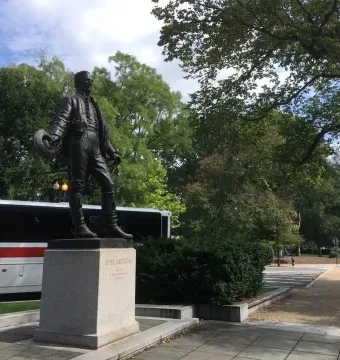
© NPS Photo · Public domain
© NPS Photo · Public domain
Identification | |
| Title | General José Gervasio Artigas |
| Dedication | José Gervasio Artigas |
| Part of series | Statues of the Liberators |
| Type | Bronze statue |
Creator | |
| Designer / artists | Juan Manuel Blanes and Mario Payssé Reyes |
| Model portrait by | Juan Manuel Blanes |
| Replica cast by | Mario Payssé Reyes |
Historical context | |
| Honorific title | Proclaimed the 'protector of the free peoples' |
| Break with the junta | Broke relations with the junta in 1813 |
| Independence movement role | Led the movement for Uruguay's independence |
| Withdrawal | Withdrew to the interior regions of the country |
| Exile | Forced into exile in Paraguay after 1820 |
| Ideological influences | Influenced by the democratic ideas of George Washington, Thomas Jefferson, and Benjamin Franklin |
| Federal League | Created a provisional government in 1815 |
| Defeat in 1820 | Defeated in the struggle against the Portuguese-Brazilian annexation of Uruguay |
| Subsequent action | Briefly besieged Montevideo |
| Historical significance | His initial efforts were partly responsible for Uruguay's eventual independence, which was achieved on 25 August 1825 |
| Political disagreement | Opposed the junta's attempt to impose centralized economic and political control over all reconquered territory, believing each region should be autonomous in every respect |
| Subject military command | Given command of a small army of gauchos and volunteers |
| First victory | Battle of Las Piedras on 18 May 1811 |
| Subject early life | Spent several years as a gaucho, where he gained respect for his courage and strong character despite his young age |
| Subject | José Gervasio Artigas |
| Subject lifespan | 1764–1850 |
| Subject significance | Considered the father of Uruguayan independence |
| Subject family background | Born into a Creole landowning family |
| Subject birthplace | Montevideo |
| Subject military role in 1797 | Became commander of the blandengues corps in the Spanish army |
| Blandengues corps duty | Tasked with clearing colonial territory of criminals and smugglers |
| Subject activity in 1805 and 1807 | Participated in the unsuccessful resistance to the British invasions of the Río de la Plata |
| Subject role in the 1810 revolution | Offered his support and military skills to the junta in Buenos Aires |
| Junta in Buenos Aires | A recently created military government that wanted to free the region from Spanish rule |
Discovery and provenance | |
| Purpose of replica | A goodwill gesture for the United States |
| Additional casts made for | Venezuela, Cuba, Argentina, Peru, and Colombia |
| Sent to the United States by | General Edgardo Ubaldó Genta, without the knowledge of the American embassy |
| Stored in Uruguay until | 16 April 1947 |
| Transport delay | War-related transportation restrictions |
| Intended destination | The United States |
| Original statue location | Montevideo, Uruguay |
| Replica funding | Donations from Uruguayan schoolchildren and an appropriation by the Chamber of Deputies of Uruguay |
| Replica cast in | Montevideo, Uruguay |
| Replica cast | 1942 |
| Original statue cast in | Florence |
| Original statue cast | 1898 |
| Based on | A portrait of Artigas by Juan Manuel Blanes |
Physical characteristics | |
| Dimensions | Statue: 9 feet × 63 inches × 65 inches; pedestal: 58 × 50 × 50 inches |
| Pose | Standing and looking straight ahead, with the left foot extended slightly forward |
| Clothing | Military uniform consisting of a short jacket, a buttoned vest, and high boots with tassels |
| Right hand | Holding his hat |
| Left hand | Holding the hilt of a sword hanging at his side |
Materials | |
| Statue material | Bronze |
| Pedestal material | Granite |
Location and ownership | |
| Series count | One of five statues in the series |
| Erected by | Washington, D.C. Parks Department |
| Relation to nearby building | Matches the design of the Organization of American States building |
| Gifted by | The people of Uruguay |
| Specific location | Triangle at the intersection of Constitution Avenue, Virginia Avenue, and 18th Street, near the Farragut West metro station, Foggy Bottom, northwest Washington, D.C., near the headquarters of the Organization of American States |
| Current location | Washington, D.C., United States |
History and restoration | |
| Permission to erect on federal land | Granted by the Commission of Fine Arts on 29 October 1948 |
| Congress appropriation for pedestal | $23,000 on 25 June 1949 |
| Pedestal designer | Harbeson, Hough, Livingston & Larson Architects and Planners |
| Pedestal builder | Corson and Gruman Company |
| Pedestal stone supplier | John L. Goss Corporation |
| Opening date | 19 June 1950 |
| Base inscription | Liberty of America is my dream and its attainment my only hope. |
| Front inscription | HOSÉ ARTIGAS |
| Front inscription below | From the people of Uruguay to the people of the United States of America |
| Rear inscription | The liberty of America is my design and its attainment my only objective |
| Later description | Later described by Save Outdoor Sculpture! |