
Equestrian Statue of Louis XIV
The Equestrian Statue of Louis XIV was designed, and partly executed, by the Italian artist Gian Lorenzo Bernini. Originally summoned to France to design the new facade of the Louvre, Bernini was then commissioned to create a bust and an equestrian statue for the French sovereign. He first sketched the project in France in the mid-1660s, but did not begin work on it until the following decade, after returning to Rome. The sculpture was completed in 1684 and sent to Paris in 1685. Louis XIV was reportedly dissatisfied with the result and had it placed in a remote corner of the gardens of Versailles. Soon afterward, François Girardon modified the sculpture and transformed it into an equestrian statue of the ancient Roman hero Marcus Curtius.
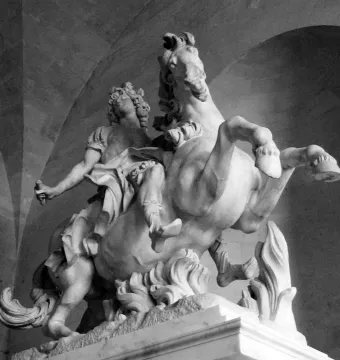
May 2011 © Trizek · CC BY-SA 3.0
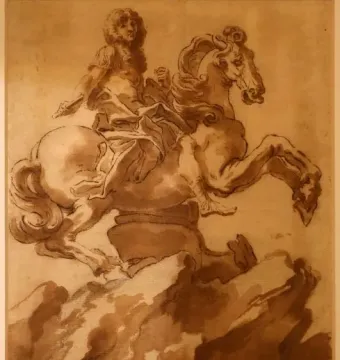
December 2017 © Sailko · CC BY 3.0
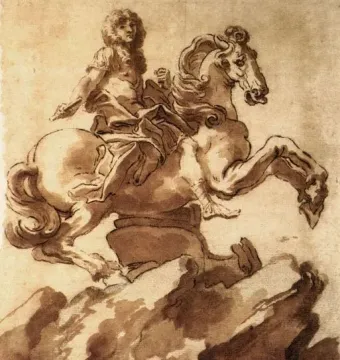
© Gian Lorenzo Bernini · Public domain
Identification | |
| Title | Equestrian Statue of Louis XIV |
| Type | Equestrian statue |
| Subject | Louis XIV of France |
Creator | |
| Artist nationality | Italian |
| Collaborator | François Girardon |
| Artist | Gian Lorenzo Bernini |
Historical context | |
| Work began | After Bernini returned to Rome, later in the decade |
| Historical significance | Bernini's failed Paris stay helped shift French attitudes toward Italian culture and contributed to the rise of French classicism and national artistic self-confidence |
| Original intended location | Between the Louvre and the Tuileries |
| Initial intended subject | King Louis XIV |
| Shipped to Paris | 1685 |
| First discussed | During Bernini's stay in France in the mid-1660s |
| Commissioning year | 1667 |
| Initial purpose of commission | To design the new façade of the Louvre |
| Commission context | One of three works Bernini was invited to France to produce: an equestrian statue, a bust of the sovereign, and a new façade for the Louvre Palace |
| Commissioned for | the French monarchy |
| Commissioned by | Louis XIV of France |
| Completed | 1684 |
Physical characteristics | |
| Material | Marble |
| Pose | Rearing horse |
| Design | Free-standing equestrian statue |
| Design distinction | The first equestrian statue in France designed to be freestanding with a rearing horse rather than attached to a building |
Technique | |
| Preparatory work | Bernini made a preparatory sketch and a terracotta model |
| Model location | Galleria Borghese, Rome |
| Execution | Designed and partially executed by Bernini; the small-scale model was made by Bernini and the pensioners of the French Academy in Rome under his direction |
Appearance | |
| Altered features | Girardon carved the head and horse support, added a plumed helmet taken from the king's hair, and added flames under the horse where war banners had previously been |
| Depiction | Louis XIV shown in an attitude of majesty and command |
Iconography and meaning | |
| Model precedent | The equestrian statue of Philip IV of Spain by Pietro Tacca in the gardens of the Buen Retiro Palace, Madrid (1642) |
| Political meaning | The choice of a similar pose to Philip IV's statue reflected Franco-Spanish rivalry |
| Symbolism | Louis XIV was associated with the sun as a metaphor for his reign, following the oriens augusti tradition; the sun was also one of the symbols of Pope Urban VIII |
| Later subject | Marcus Curtius |
Discovery and provenance | |
| Transport from Italy | Sent by sea from Civitavecchia in autumn 1684 |
| Arrival in Paris | March 1685 |
| Transfer to Versailles | Shipped to Versailles during August and September 1685 |
| Arrival at Versailles | 1 October 1685 |
| Louvre copy | A lead copy made as part of François Mitterrand's Grand Louvre project and placed in 1986 in the main courtyard of the Louvre Museum |
| Copies | Two copies were made: one for the Louvre Palace and one for the Swiss Pond (Pièce d'eau des Suisses) |
Location and ownership | |
| Current location | Orangerie of the Palace of Versailles |
| Initial installation at Versailles | Placed in the Orangerie of the Palace of Versailles on 9 October 1685 |
| First viewing by Louis XIV | 14 November 1685 |
| Current location since | 2004 |
History and restoration | |
| Damage and restoration | Vandalized in 1980 and later restored |
| Modification | In 1687 François Girardon altered the sculpture, transforming Louis XIV into Marcus Curtius |
| Later relocation | In 1702 the transformed statue was moved to the end of the Swiss Guard Lake opposite the Neptune Basin |
| Replacement | September 1686 by Domenico Guidi's La Renommée de Louis XIV |
| Subsequent relocation | Moved from the Orangerie to the garden on the main axis of the Orangerie, then near the Neptune Basin at the northernmost point of the garden on a high pedestal |
| Louis XIV's reaction | He reportedly decided to have the statue removed and destroyed; Philippe de Courcillon recorded this reaction |
Significance | |
| Art historical significance | An important prototype for later royal equestrian portraits, including Antoine Coysevox's marble equestrian statue in the Hall of War at Versailles |
| Influence on later work | Coysevox's statue recalls Bernini's work in the expression of the face |
Other | |
| Erroneous attribution | A catalog citing the Bibliothèque nationale de France incorrectly identifies the sculpture as created by Pietro Bernini |