
Saint Paul
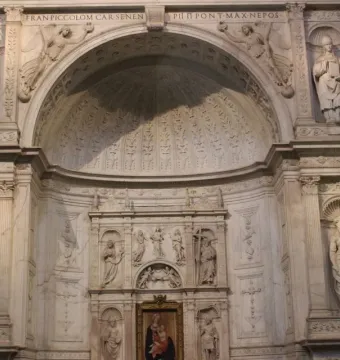
Saint Paul is one of four marble statues created by Italian sculptor and painter Michelangelo Buonarroti around 1501–1504 for the Piccolomini Altarpiece in Siena Cathedral. The commission, arranged with Cardinal Francesco Piccolomini, called for fifteen statues to decorate the chapel, with Michelangelo expected to finish them in three years for 500 ducats. By 1504, four altarpiece statues had been completed. The work has received limited attention from art historians, and neither Vasari nor Condivi mentioned it. According to Ainema, the statue may even be a youthful self-portrait of Michelangelo.
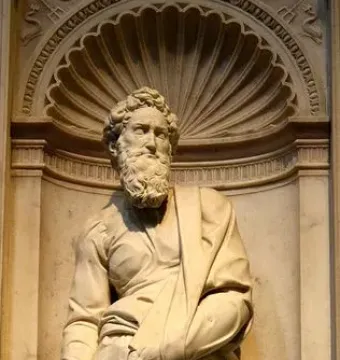
September 2009 © Michelangelo · Public domain
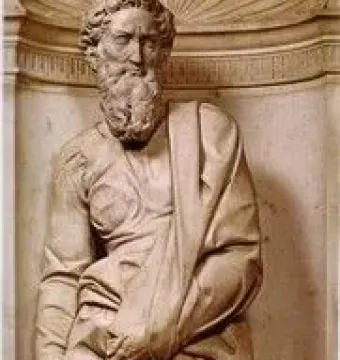
© Michelangelo · Public domain
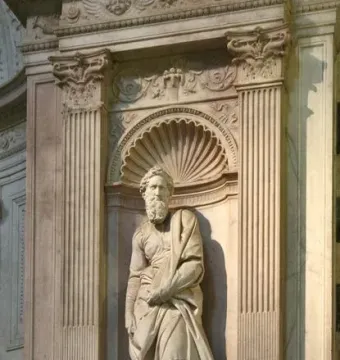
1503 © user:J Hakkonnen · CC BY-SA 4.0
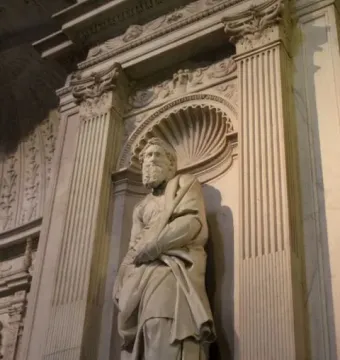
July 2015 © Miguel Hermoso Cuesta · CC BY-SA 4.0
July 2015 © Miguel Hermoso Cuesta · CC BY-SA 4.0
Identification | |
| Title | Saint Paul |
| Type | statue |
| Figure | Saint Paul, the Apostle Paul |
| Original title | San Paolo |
Creator | |
| Artist | Michelangelo Buonarroti |
| Artist nationality | Italian |
| Artist period | Renaissance |
Historical context | |
| Working location | Florence |
| Burial association | Pope Pius III had originally planned to be buried in front of this altar but later chose Saint Peter's in Rome |
| Related work | Michelangelo was working on the David during the same period |
| Progress by 1504 | Four altar statues had been completed |
| Completion | 1504 |
| Commission | Part of a contract for fifteen statues to decorate the Piccolomini Chapel in Siena Cathedral; Michelangelo was to carve them within three years for 500 ducats |
| Previous project state | Pietro Torrigiani had abandoned the project after carving one statue |
| Commission scale | A fairly large commission for its time |
| Commissioner | Cardinal Francesco Piccolomini |
| Commissioned for | Piccolomini Chapel in Siena Cathedral |
| Commission date | 1501 |
| Date | c. 1501–1504 |
Materials | |
| Material | Marble |
Physical characteristics | |
| Hair and beard | Thick curly hair and a long curly beard |
| Head and face | Head shifted to the right; brows furrowed; concentrated, firm expression |
| Appearance | Fully clothed figure wrapped in a large mantle with broad, heavy folds |
| Pose | Contrapposto; right arm hangs along the body, left arm bent holding drapery, left leg extended forward, right shoulder slightly lowered |
| Height | 127 cm |
| Number in group | One of four marble altar statues |
| Placement in altar | Lower tier, right side, in one of the four niches of the Piccolomini altar |
Technique | |
| Drapery style | Wet style (bagnato) |
| Technique influence | Derived from Andrea del Verrocchio and modeled on Donatello |
Appearance | |
| Stylistic references | The mantle recalls Verrocchio, and the contrapposto recalls Donatello |
| Art-historical comparison | Several features anticipate Michelangelo's David |
Interpretation | |
| Possible self-portrait | According to Herbert von Einem, the statue may be a possible self-portrait of Michelangelo in his youth |
| Comparative interpretation | In the fresco The Conversion of Paul, Paul is interpreted as Michelangelo's portrait in old age |
| Scholarly assessment | William Wallace described it as having an expressionistic pose and drapery |
| Evaluation | Probably the most successful of the Piccolomini statues |
Location and ownership | |
| Current location | Cathedral of Our Lady of the Assumption, Siena, Tuscany |
| Part of | the Piccolomini Altarpiece complex |
| Original intended location | Piccolomini altar in Siena Cathedral |
History and restoration | |
| Completion status in source | The statue is incomplete in the supplied fragment |
Significance | |
| Art-historical reception | The commission has received insufficient attention from art historians |
| Literary reception | Mentioned in Vasari and Condivi as absent; also referred to in Karel Schulz's Stone and Pain (1943) and Irving Stone's The Agony and the Ecstasy (1961) |
Other | |
| Assistance | Michelangelo made substantial use of assistants |
| Production pace | About one statue per year |
| Artist attitude | Michelangelo may have regarded these works as products of his youth and haste |
| Source note | The attribution and extent of Michelangelo's own contribution to the broader Piccolomini series are difficult to determine |