
Smiling Angel
The Smiling Angel, also known as the Smile of Reims or Angel of the Annunciation, is a stone sculpture at the Cathedral of Reims in France. Carved between 1236 and 1245, it appears on the right side of the north portal of the west facade. Part of the cathedral’s Annunciation sculpture, it is one of thousands of sculptures at Reims Cathedral and a notable example of Gothic art. The figure has become a popular tourist attraction and is recognized for its cultural, political, social, and religious significance.
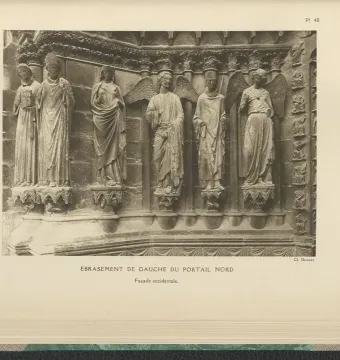
© Étienne Moreau-Nélaton · Public domain
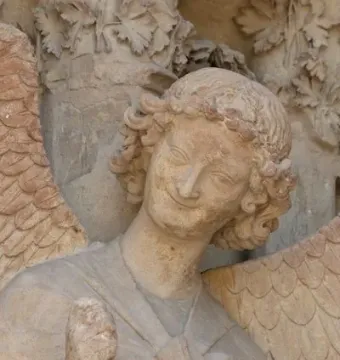
April 2022 © PMRMaeyaert · CC BY-SA 4.0
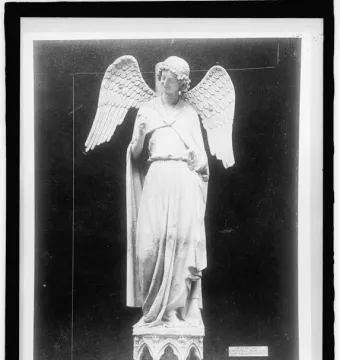
© National Photo Company Collection · Public domain
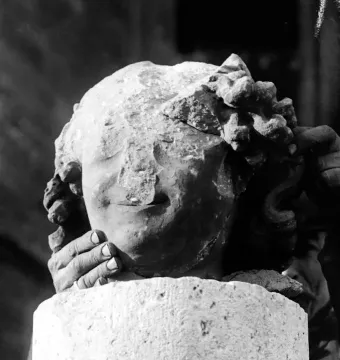
1915 © Unknown authorUnknown author · Public domain
May 2024 © Gérald Garitan · CC BY-SA 4.0
Identification | |
| Title | Smiling Angel |
| Original French title | L'Ange au Sourire |
| Alternative names | Smile of Reims; Angel of the Annunciation; The Smiling Angel of Reims; L'Ange au sourire; Sourire de Reims |
| Type | Stone sculpture; statue |
| Subject | An angel |
Historical context | |
| Date of creation | c. 1236–1245 |
| Style | Gothic |
| Historical period | 13th century; the Middle Ages |
Creator | |
| Author | Unknown |
Discovery and provenance | |
| Part of | The sculptural decoration of Reims Cathedral; the cathedral's Annunciation sculpture; an ensemble of three larger-than-life figures |
| Current location | North portal of the west facade of Reims Cathedral, Reims, France |
| Placement | Right side of the north portal; opposite the Angel of the Annunciation |
| Original location | Reims Cathedral, Reims, France |
Physical characteristics | |
| Depiction | An angel with spread wings |
| Pose | Contrapposto, with an S-shaped curve |
| Orientation | Looks to the right |
| Expression | Smiling; graceful, light, pointed, almost mischievous smile |
| Clothing | A waist-gathered garment with softly flowing folds and a mantle held across the chest by a brooch |
| Hands | Right hand raised, probably once holding an object; left hand lost |
| Proportions | Longer body with a relatively small round head |
| Composition | A smiling angel on the left of a male figure, turning toward him; another angel stands on the right of the male figure |
Materials | |
| Material | Stone; limestone |
Iconography and meaning | |
| Iconographic role | Likely a psychopomp guiding a decapitated martyr to the Kingdom of Heaven |
| Possible associated martyr | Saint Nicasius or Saint Denis |
| Interpretation | Represents local and French history, religious authority, political authority, medieval history, Catholicism, and broader medieval themes |
| Name origin | Named for the angel's cheerful, restrained smile |
Location and ownership | |
| Associated building | Reims Cathedral |
| Specific setting | North portal of the western facade; left jamb in the central doorway of the west portal; Saints Portal |
| Placement context | Next to St. Nicasius and within the cathedral's angelic sculptural program |
History and restoration | |
| Damage to features | The nose and right eye were permanently lost |
| Restoration | Restored after World War I and put back in place on 13 February 1926, using original fragments and prewar plaster molds/casts preserved at the Musée national des Monuments Français / Musée des Monuments français |
| Rediscovery | Discovered by architect Max Sainsaulieu on 30 November 1915 |
| Head storage | Kept in the cellars of the Archbishop of Reims / archbishopric of Reims; fragments of the facade sculptures were taken to the cellar of the Palais du Tau |
| Head recovery | Collected by Abbot Thinot the day after the fire and later found again among rubble in 1915 |
| Damage event | Damaged during World War I when German shelling caused a fire at Reims Cathedral; the head was knocked off and shattered after falling about 4.5 m |
| Damage date | 19 September 1914 |
Significance | |
| Art-historical significance | One of the earliest examples of a smiling face in sculpture after smiles had largely disappeared from Western art since the 5th century; influential for the Reims style |
| Historical reception | Initially received little attention, but became famous and widely reproduced after the World War I damage |
| Public fame | Became a symbol of Reims Cathedral and later of the city of Reims, and an icon of French wartime propaganda against German destruction |
| Scholarly interest | Well known to scholars for the gentle, graceful smile of the Reims angels |
| Related scholarship | Discussed by Eugène Viollet-le-Duc, Émile Mâle, and André Michel |
| Broader context | Part of the richly decorated facade program of Reims Cathedral, which has over 2,300 sculptures |