
Talking Statues of Rome
Talking Statues of Rome were a series of statues, traditionally six, that served as a channel for anonymous political expression in Rome from the 16th century onward. Poems and witty remarks criticizing popes, cardinals, and nobles were posted on the city’s best-known statues, making them an early form of public noticeboard. Positioned at strategic points in the center of Rome, the statues helped spread satirical sayings and political commentary during a period when powerful cardinals dominated the city. The group included Pasquino, Madame Lucrezia, Facchino, Marforio, Abbot Luigi, and Babuino. None was especially finely sculpted, and all but Marforio were not in particularly good condition, but they played an important role in Roman political culture.
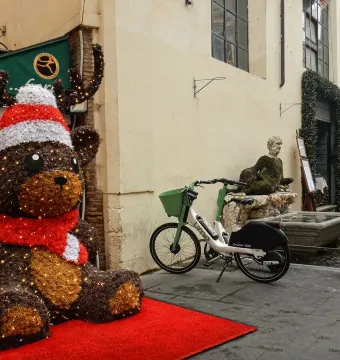
December 2023 © Albarubescens · CC BY-SA 4.0
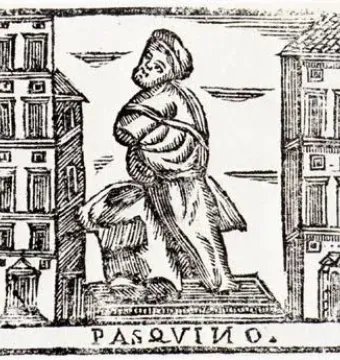
© Unknown authorUnknown author · Public domain
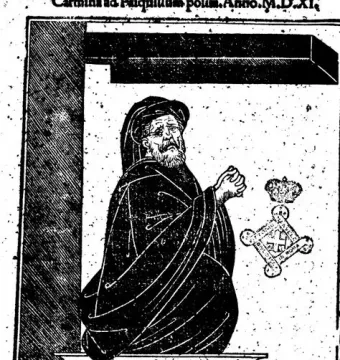
1511 © Unknown authorUnknown author · Public domain
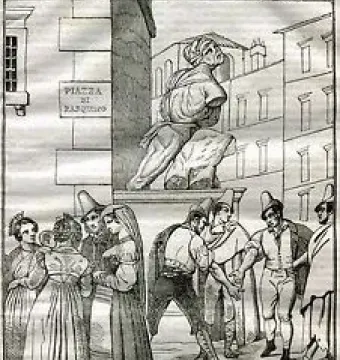
© Unknown authorUnknown author · Public domain
Identification | |
| Title | Talking statues of Rome |
| Original names | Le statue parlanti di Roma; Roman "talking" statues; Congrega degli Arguti / dei Guitti; the Congregation of Wits; congregación de ingeniosos; pasquinate; pasquinades |
| Type | A form of anonymous public political expression using statues |
| Number of statues | Traditionally six |
Historical context | |
| Origin date | 16th century |
| Duration | From the 16th century to the present day |
| Current status | Still continues today; only Pasquino is still in use |
| Period of wider use | Widely used until the 19th century |
Creator | |
| Named after | Pasquino, probably a local resident; in versions of the story, a tailor, barber, or schoolmaster |
Discovery and provenance | |
| Early suppression | In 1523 Pope Adrian VI issued a measure to prevent sheets from being posted on Pasquino |
| Discovery and installation of Pasquino | Found during road construction in 1501 and installed in a small piazza in Rome |
| Origin of the tradition | Anonymous messages were posted on public statues in Rome, especially in busy public places |
Physical characteristics | |
| Condition of the statues | None were finely sculpted; most were not in good condition, except Marforio |
| Included statues | Pasquino, Marforio, Madama Lucrezia, Abate Luigi, Il Babuino, and Il Facchino |
| Most famous statue | Pasquino |
| Original subject of Pasquino | Probably a fragment of a sculptural group depicting Menelaus holding the body of Patroclus |
| Identification of Madama Lucrezia | Probably the goddess Isis or one of her priestesses; the name may honor Lucrezia d'Alagno |
| Identification of Babuino | Actually a satyr or silenus; nicknamed for its ugliness |
| Identification of Abate Luigi | Historically the portrait of a high magistrate; later associated by name with a sacristan of the Basilica of Sant'Andrea della Valle |
| Identification of Marforio | Etymology uncertain; many hypotheses have been proposed |
| Identification of Facchino | Depicts a water carrier or Roman porter; formerly popularly identified with Martin Luther |
Materials | |
| Material | Sculpture fragment or statue; material not specified |
Technique | |
| Display method | Anonymous messages were attached or pasted to the bases of the statues or hung on them at night |
Appearance | |
| Special custom | Pasquino was sometimes dressed as a pagan god on Saint Mark's Day |
Iconography and meaning | |
| Message content | Anonymous poems, epigrams, jokes, libels, and satirical compositions; often in Roman dialect, but also in Italian and Latin |
| Nature of the texts | Often real poetic compositions using wordplay, daring metaphors or similes, and Roman sarcasm |
| Targets of criticism | Mainly the pope and the political establishment; less often notable people or, in rare cases, common people |
| Role in political expression | A quick and safe way to express anonymous dissent in papal Rome |
| Derived term | Pasquinade, meaning a satirical protest written in verse |
| Origin of derived term | Named after Pasquino |
| Function | Used as a surface for anonymous satirical criticism of religious and civil authorities, especially the pope and the papacy |
Location and ownership | |
| Location | Rome, Italy, especially the historic center and other very busy public places |
| Notable locations | Marforio and Madama Lucrezia were in the Capitoline area, opposite the residence of the Conservator of Rome |
| Current posting location | A notice board beside Pasquino is now used instead of attaching sheets directly to the statue |
History and restoration | |
| Decline | Use declined after the Breach of Porta Pia and the annexation of the Papal State to the Kingdom of Italy, though it never disappeared completely |
| Historical consequence | Composing pasquinate was among the accusations leading to the death sentence of Niccolò Franco |
| Historical role | A local institution and one of the earliest examples of a bulletin board or notice board |
| Early use | Small poems or epigrams criticizing religious and civil authorities were posted on Pasquino from the 16th century |
| Later development | The public moved to other statues, creating dialogue-like exchanges, especially between Pasquino and Marforio |
| Alternative suppression story | A reward may have been offered to anonymous writers if they revealed themselves; according to the tale, one man came forward and his hands were cut off |
| Adrian VI anecdote | He reportedly planned to throw Pasquino into the Tiber River, but was dissuaded when told it would croak louder in water like a frog |
| Suppression attempts | Several popes tried to limit the posting of comments on Pasquino; authorities later stationed guards around it |
Significance | |
| Cultural impact | Important for spreading witty sayings and political criticism in Rome under powerful cardinals and the papacy |
| Influence | Inspired talking statues in other Italian cities, though none became as famous as the Roman ones |
| Notable exception | The Milanese Uomo di Pietra briefly inspired a namesake periodical that published satires and caricatures |