
Major General George B. McClellan
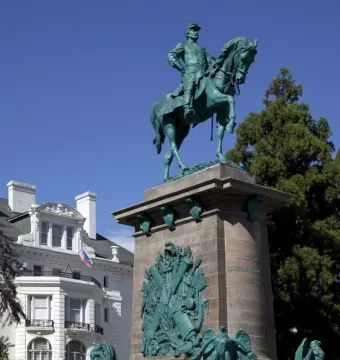
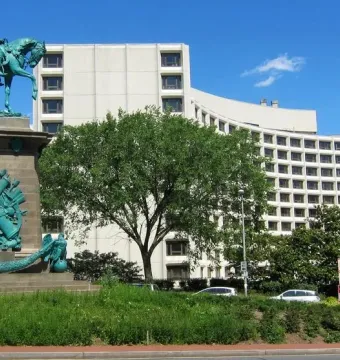
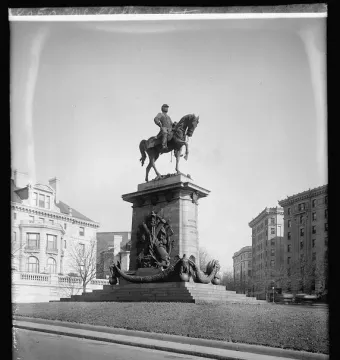
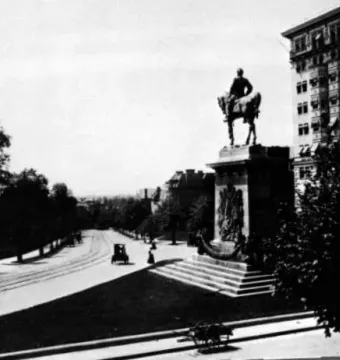
Major General George B. McClellan is an equestrian statue in Washington, D.C., honoring the Civil War general and politician George B. McClellan. Sculpted by Frederick William MacMonnies, the bronze figure rests on a tall granite base decorated with bronze emblems and reliefs. The monument stands in a small public park in Kalorama Triangle, bounded by California Street, Columbia Road, and Connecticut Avenue NW. It was dedicated in 1907 at a ceremony attended by President Theodore Roosevelt, New York City Mayor George B. McClellan, Jr., and other prominent guests. The monument is one of the Civil War memorials in Washington, D.C., listed on the National Register of Historic Places in 1978 and is maintained by the National Park Service.
© Carol M. Highsmith · Public domain
June 2010 © AgnosticPreachersKid · CC BY-SA 3.0
© National Photo Company Collection · Public domain
1910 © Unknown authorUnknown author · Public domain
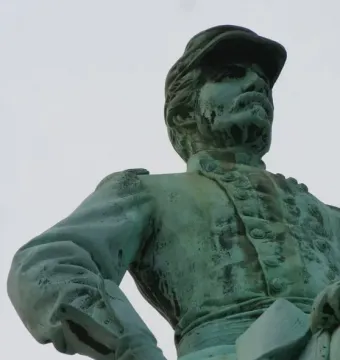
May 2007 © dbking · CC BY 2.0
Identification | |
| Title | Major General George B. McClellan |
| Type | Equestrian statue |
Iconography and meaning | |
| Battle references | The pedestal emblems honor McClellan's leadership in the named Civil War battles |
| Subject | George B. McClellan (1826–1885), Union major general in the American Civil War and later 24th Governor of New Jersey |
| Commemorates | George B. McClellan |
Location and ownership | |
| Ownership | National Park Service |
| Maintenance | National Park Service |
| Managing agency | National Park Service, a federal agency of the U.S. Department of the Interior |
| Dedication date | May 2, 1907 at 2:30 p.m. |
| Neighborhood | Kalorama Triangle |
| Location | Prominent site at the intersection of Connecticut Avenue and Columbia Road NW, Kalorama Triangle, Washington, D.C., United States |
| Orientation | Faces south along Connecticut Avenue toward Dupont Circle and downtown Washington, D.C. |
Historical context | |
| Commission purpose | To honor General George B. McClellan |
| Statue commission formed | April 1901 |
| Commission leadership | Secretary of War Elihu Root, Senator George P. Wetmore, and General George D. Ruggles |
| Advisory committee members | Daniel Chester French, Augustus Saint-Gaudens, and Charles Follen McKim |
| Design competition | 1902 competition at the Corcoran Gallery of Art; 23 designs submitted, 4 finalists, with a $500 prize for each of the four best models |
| Finalists | Austin Hays, Charles Henry Niehaus, Attilio Piccirilli, and Thomas Waldo Story |
| Competition outcome | Thomas Waldo Story's model was favored by Nelly McClellan; three designs were rejected for lack of individuality and symbolism; Niehaus's design was reluctantly approved, but the commission judged all the submitted designs unsatisfactory |
| Commissioned by | The Society of the Army of the Potomac |
| Part of | One of the eighteen Civil War monuments in Washington, D.C. |
| Congressional appropriation | $50,000 on March 3, 1901 |
Creator | |
| Founder | Edmond Gruet Jeune |
| Initial design rejected because | Cost overruns |
| Monument designer | James Crocroft |
| Accepted design influenced by | Alexandre Falguière rather than Saint-Gaudens |
| Previous works mentioned | Statue of Nathan Hale in New York City; Columbian Fountain at the World's Columbian Exposition in Chicago; Bacchante and Infant Faun at the Boston Public Library; sculptural groupings on the Soldiers' and Sailors' Arch in Brooklyn, New York |
| Artist residence at the time | Paris |
| Artist training | Graduate of the École des Beaux-Arts; apprenticed with Saint-Gaudens for four years beginning at age seventeen |
| Artist nationality | American |
| Artist | Frederick William MacMonnies |
Discovery and provenance | |
| Site selection | Chosen after consideration of Florida Avenue and Massachusetts Avenue NW, Sheridan Circle, and N Street and Connecticut Avenue NW; local residents of Kalorama Triangle (then called Washington Heights), represented by Clifford K. Berryman and Rear Admiral Thomas Oliver Selfridge Jr., requested the Connecticut Avenue and Columbia Road NW site |
| Site approval reason | Considered more satisfactory and imposing; the area had been a Union camp in summer 1861 when McClellan arrived in Washington, D.C. |
| Site improvements paid by | The Society of the Army of the Potomac |
| Exhibited before shipment | 1906 Salon d'Automne in Paris |
Physical characteristics | |
| Setting | Surrounded by a small public park |
| Nearby landmarks | Churchill Hotel to the west, Lothrop Mansion to the north, and Washington Hilton to the east |
| Material | Bronze |
| Base material | Granite |
| Park boundaries | California Street, Columbia Road, and Connecticut Avenue NW |
Appearance | |
| Depicted attire | Union Army military uniform with gauntlets, a hat, a sash, and a sword |
| Inscription | Front: MAYOR GENERAL / GEORGE BRINTON MCCLELLAN / 1826–1885; rear: erected by the / GRAND ARMY OF THE POTOMAC / AND THE / CONGRESS OF THE UNITED STATES / 1907; signature: MAC MONNIES / E. GRUET JNE FONDEUR |
| Depicted pose | McClellan is mounted on a horse, holding the reins with his left hand and resting his right hand on his hip |
| Pedestal decoration | Bronze emblems and bronze reliefs; eight shield-shaped emblems naming the battles of Antietam, Fair Oaks, Gaines's Mill, Malvern Hill, Mechanicsville, South Mountain, Williamsburg, and Yorktown; bronze reliefs of cannons, eagles, flags, and swords; a bronze oak and laurel garland between bronze eagles at each corner |
History and restoration | |
| Previous conservation | No major conservation since the dedication in 1907 |
| Restoration equipment | Scaffolding and nylon mesh were installed around the monument for several months |
| Restoration work | Cleaning, painting, waxing, removal of spray paint from the base, repair of water leakage inside the horse's legs and stomach, and replication of a missing bronze shield on the pedestal |
| Restoration overseen by | Catherine Dewey, NPS architectural conservator |
| Restoration contractor | Kreilick Conservation |
| Restoration cost | $114,000 |
| Restoration year | 2009 |
| Closing music | "My Country, 'Tis of Thee" |
| Dedication delay | Originally planned for October 18, 1906, but postponed because a fire at MacMonnies's polishing works prevented completion of the pedestal on time |
| Other music | The Fourth Field Artillery Band played "The Star-Spangled Banner"; the Marine Band and an overture from Semiramide were also performed |
| Letter read | A letter from General Daniel Sickles was read by General Grenville M. Dodge |
| Other speaker | General Oliver O. Howard |
| Military review leader | General J. Franklin Bell |
| Unveiling | George B. McClellan Jr. |
| Historical presentation | General Horatio Collins King |
| Invocation | Henry Y. Satterlee, Episcopal bishop |
| Dedication presiding officer | Brigadier General Henry C. Dwight, president of the Society of the Army of the Potomac |
| Dedication attendees | President Theodore Roosevelt; George B. McClellan Jr.; William Howard Taft; Edward C. Stokes; George Lewis Gillespie Jr.; Frederick Dent Grant; Wallace F. Randolph; Nelly McClellan; members of Congress; foreign diplomats; cabinet members; thousands of citizens; and around 700 veterans in a pre-ceremony march |
| Dedication event | 37th annual reunion of the Society of the Army of the Potomac |
Significance | |
| National Register status | Individually listed as one of the eighteen Civil War monuments in Washington, D.C. on September 20, 1978; contributing property to the Kalorama Triangle Historic District, listed on May 4, 1987 |
| District of Columbia Historic Sites Inventory date | March 3, 1979 |