
Monument of Jews and Poles Common Martyrdom in Warsaw
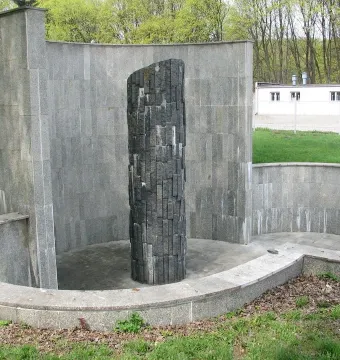
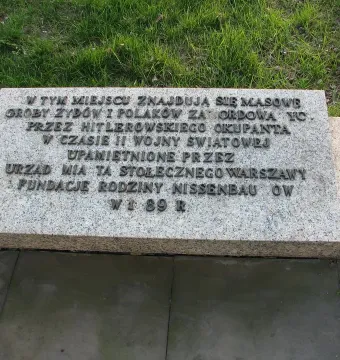
Monument of Jews and Poles Common Martyrdom in Warsaw is a memorial and cemetery-mausoleum in Warsaw, standing at 21 Gibalskiego Street on a mass grave of about 7,000 Jews and Poles murdered during World War II. It commemorates their martyrdom and deaths during the Nazi occupation, especially the mass executions carried out there between 1940 and 1943. Designed by Tadeusz Szumielewicz and Marek Martens, the monument has a very restrained, almost ascetic form. A tall granite-clad obelisk stands in a sunken oval space lined with light sandstone, and a gas flame burns on top during solemn and festive days. The site also includes plaques, display cases, and commemorative inscriptions in several languages.
© Grzegorz Petka · Public domain
April 2009 © Grzegorz Petka · Public domain
© Grzegorz Petka · CC BY 3.0
© Grzegorz Petka · Public domain
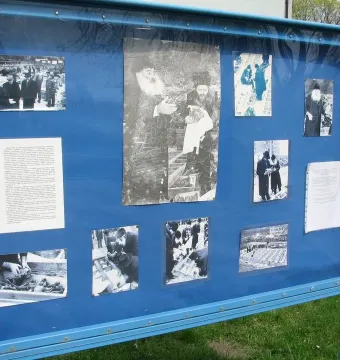
April 2009 © Grzegorz Petka · Public domain
Identification | |
| Title | Monument of Jews and Poles Common Martyrdom in Warsaw |
| Type | Monument |
| Polish title | Pomnik Wspólnego Męczeństwa Żydów i Polaków w Warszawie |
Historical context | |
| Historical period | German occupation of Poland during World War II |
| Commemorated event | Mass executions and mass burial at the site between 1940 and 1943 |
| Commemorated victims | About 7,000 Jews and Poles |
| Purpose | Commemorates the martyrdom and death of Jews and Poles murdered during the Nazi occupation |
| Uniqueness | Described as the only monument of its kind in the world |
Creator | |
| Designed by | Tadeusz Szumielewicz and Marek Martens |
| Concept by | Tadeusz Szumielewicz and Marek Martens |
| Medal designer | Andrzej Nowakowski |
Discovery and provenance | |
| Burial rite | Jewish (Mosaic) and Roman Catholic ritual and ceremony |
| Catholic official mentioned | Bishop Henryk Muszyński, then delegate of the Episcopal Conference for relations with Judaism |
| Religious participation | 21 rabbis from around the world and Catholic clergy took part in the ceremony and joint prayer |
| Discovery of burial site | Human remains were discovered in September 1988 during excavation for the foundations of a high-rise building |
| Reburial date | 13 December 1988 |
| Reburial location | Powstańców Cemetery on Wolska Street in Warsaw |
| Earlier exhumations | After the war, the bodies of murdered left-wing activists were exhumed from the site, followed by 6,588 Jewish bodies |
Location and ownership | |
| Installation date | September 1989 |
| Exhibition cases | Display photographs from ceremonies of burying the remains of murdered people |
| Base setting | Placed in the center of a deep oval depression |
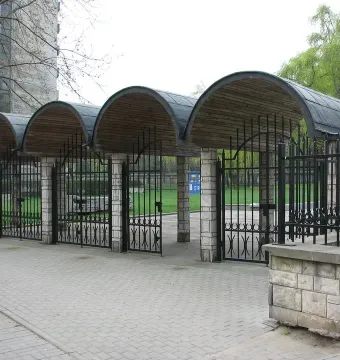
| Approach | A stone alley of elongated steps leads downward from the gate |
| Entrance | Through a stylized shelter on Gibalskiego Street |
| Current setting | Located in a fenced grassy square |
| Prior land use | Before 1939, a sports field belonging to the Workers-Academic Sports Club SKRA |
| Site management | The area is managed by the Nissenbaum Family Foundation |
| Adjacent landmark | Borders the Jewish Cemetery on Okopowa Street to the south |
| Site | Built on a mass grave at the former SKRA sports field / stadium area |
| Location | Former Skra stadium area, Gibalskiego Street 21, Wola, Młynów, Warsaw, Poland |
Physical characteristics | |
| Overall character | Very modest, almost ascetic |
| Form | A tall pillar |
| Circumference | Almost 3 meters |
| Left-side element | An irregular elongated sandstone obelisk |
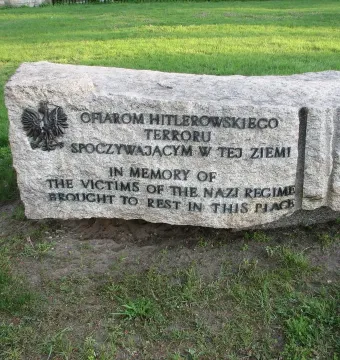
| Additional blocks | Three stone blocks lie on the edge of the mass grave |
Materials | |
| Additional blocks material | Stone |
| Left-side element material | Sandstone |
| Depression wall material | Light sandstone |
| Main material | Gray granite slabs |
Technique | |
| Cladding | Narrow slabs of gray granite |
Appearance | |
| Decorations | Polish coat of arms and the Star of David |
| Inscriptions | Texts in Polish, English, Hebrew, and Yiddish on the sandstone obelisk; trilingual inscriptions in Polish, Hebrew, and Yiddish on the three stone blocks |
| Flame | A gas flame burns on top of the obelisk on solemn and festive days |
Iconography and meaning | |
| Subject | The common martyrdom of Jews and Poles; victims of German terror during the Nazi occupation |
| Symbolism | The obelisk symbolizes an offering pyre |
History and restoration | |
| State of monument | Stood in its present form as of September 1989 |
| Funding | Funded by the City Office and the Nissenbaum Foundation |
Significance | |
| Associated commemorative medal | A special medal was struck by the State Mint to honor the mourning ceremony of 13 December 1988 and the unveiling of the monument |