
Equestrian Statue of the Duke of Cambridge
The Equestrian Statue of the Duke of Cambridge is a 1907 work by sculptor Adrian Jones, erected on Whitehall in London. It commemorates Field Marshal George, Duke of Cambridge, a member of the British royal family and commander-in-chief of the British Army from 1856 to 1895. The statue was unveiled by King Edward VII on 18 May 1907. It was made using 45 tons of granite, and the pedestal and statue together are about 7.6 m high. The life-size figure shows the duke on horseback in full field marshal uniform, with his decorations, baton, and reins, and the pedestal includes two bronze relief panels and inscriptions on the west and east sides.
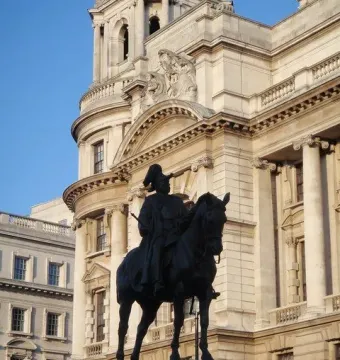
February 2010 © Derek Harper · CC BY-SA 2.0
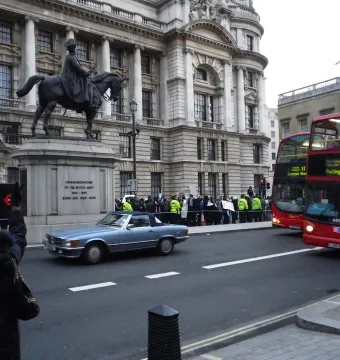
December 2011 © Fernando Losada Rodríguez · CC BY-SA 4.0
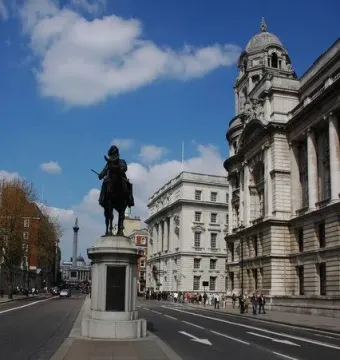
April 2007 © Philip Halling · CC BY-SA 2.0
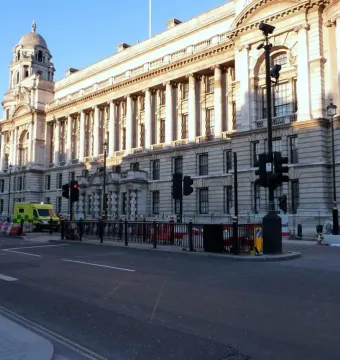
March 2010 © Lewis Clarke · CC BY-SA 2.0
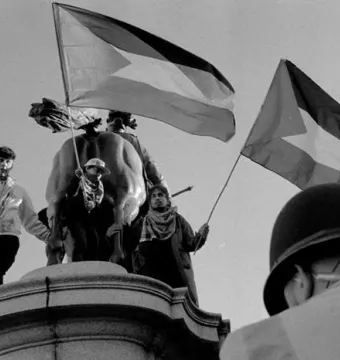
October 2023 © Sleyatx · CC BY-SA 4.0
Identification | |
| Title | Equestrian statue of the Duke of Cambridge |
| Title in Russian | Памятник Георгу герцогу Кембриджскому |
| Type | Equestrian statue |
| Title in Ukrainian | Пам'ятник Джорджу герцогу Кембриджському |
Historical context | |
| Subject's role | Commander-in-chief of the British Army, 1856–1895 |
| Subject's status | Member of the British royal family |
| Subject's lineage | Grandson of King George III in the male line |
| Subject's birth and death | 1819–1904 |
| Subject's rank | Field Marshal |
| Date | 1907 |
Creator | |
| Sculptor | Adrian Jones |
| Architect | John Belcher |
Discovery and provenance | |
| Original proposed location | Outside Horse Guards, Whitehall, Westminster |
| Later location proposal | Outside the new War Office building, Whitehall, London |
| Commissioned as memorial to | Prince George, Duke of Cambridge |
| Studio location | Church Street, Chelsea, London |
| Notable studio visitor | Queen Alexandra, accompanied by Princess Victoria, Princess Sophia of Greece, Duchess of Sparta, and Prince George of Greece and Denmark |
| Original proposal year | 1905 |
| Committee chair | Prince Arthur, Duke of Connaught and Strathearn |
| Reason for location change | The new War Office building had opened in August 1906, and the committee requested a change of site from the original Westminster permission |
Physical characteristics | |
| Total height | About 7.6 m |
| Scale | Life-size |
Materials | |
| Main material | Granite |
| Plinth material quantity | 45 tons |
| Relief panels material | Bronze |
| Plinth material | Granite |
Technique | |
| Relief type | Bas-relief panels |
Appearance | |
| Decorations shown | His orders and campaign medals |
| Horse detailing | The horse's muscles and veins are carved in fine detail |
| Depicted subject | George, Duke of Cambridge |
| Pose | On horseback |
| Attire | Full field marshal's uniform |
| Object held in right hand | Field marshal's baton |
| Object held in left hand | Horse's reins |
Iconography and meaning | |
| Baton meaning | It represents the baton associated with King William IV, who presented one to the duke's father |
| Relief panels subject | The Duke's connections with the Grenadier Guards and the 17th Lancers (the Duke of Cambridge's Own) |
| Grenadier Guards connection | He was colonel of the Grenadier Guards from 1861 until his death in 1904 |
| 17th Lancers connection | The 17th Lancers were named the Duke of Cambridge's Own |
Location and ownership | |
| Ownership at unveiling | It was actually owned by the Office of Works, not the City of Westminster |
| Attendees at unveiling | Queen Alexandra, Princess Victoria, Edward, Prince of Wales, the Duke of Connaught and Strathearn, Prince Christian of Schleswig-Holstein, Field Marshal Wilhelm von Hahnke and other German Army officers, and Major General Wykeham Leigh Pemberton |
| King's statement at unveiling | The statue was entrusted to the care of the City of Westminster |
| Escort to unveiling | A detachment of the 2nd Regiment of Life Guards escorted the King from Buckingham Palace |
| Unveiled by | King Edward VII |
| Unveiling date | 15 June 1907 |
| Location | Outside the new War Office building, Whitehall, London, United Kingdom |
History and restoration | |
| Plinth contractor | Pethick Brothers |
| Plinth completion date | 18 May 1907 |
| Installation method | The statue was added during the night shortly before the unveiling and concealed until the ceremony |
| Ownership resolution | About two weeks after the unveiling, the City of Westminster agreed to return the statue to the Office of Works |
| Later incident | In November 2012, a nude man climbed onto the statue for more than an hour before coming down and being taken into police custody |
Significance | |
| Purpose | Memorial to Prince George, Duke of Cambridge |