
Jules Rimet Trophy
The Jules Rimet Trophy was the prize awarded to the national team that won the FIFA World Cup between 1930 and 1970. Also known as the Jules Rimet Cup or Rimet Cup, it was named in 1946 after Jules Rimet, the French sports official who led FIFA and helped create the tournament. The rules stated that the trophy would be kept permanently by the federation whose team first won the World Cup three times, even if not consecutively. That happened in 1970, when Brazil won its third title. From 1974 onward, the world champions received the FIFA World Cup Trophy instead. The original 1970 trophy is now lost, though replicas are displayed in Brazil and at the National Football Museum in Manchester.
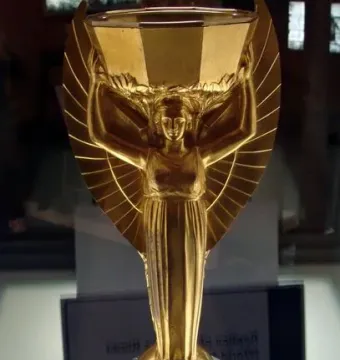
© Abel Lafleur · Public domain
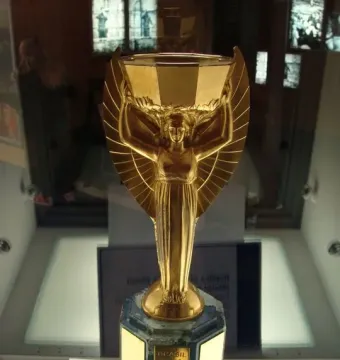
February 2009 © Abel Lafleur · Public domain
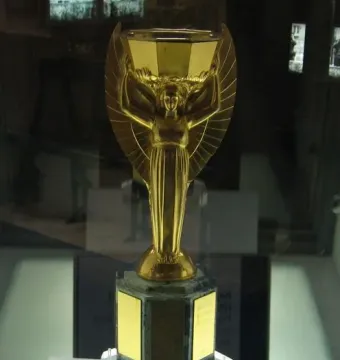
May 2008 © Abel Lafleur · CC BY-SA 3.0
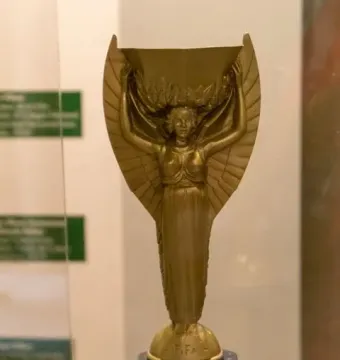
May 2026 © ProtoplasmaKid · CC BY 4.0
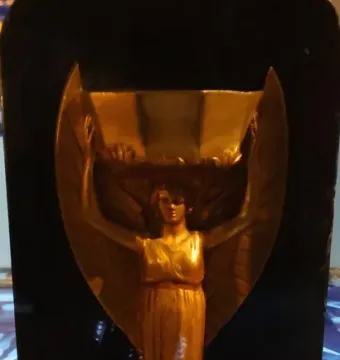
November 2014 © Abel Lafleur · CC BY-SA 4.0
Identification | |
| Title | Jules Rimet Trophy |
| Associated event | FIFA World Cup |
| Original names | Coupe du Monde; Coupe Jules Rimet; Copa Jules Rimet; Taça Jules Rimet; Weltpokal (Coupe du Monde) |
| Type | Football World Cup trophy / cup |
| Also known as | Jules Rimet trophy; Rimet Cup; Victory with Wings; Diosa de la Victoria (Goddess of Victory) |
Historical context | |
| Proposed by | FIFA Executive Committee at the FIFA Congress |
| Geographic distribution of winners | The cup went to South America five times and to Europe four times |
| Single-time holders | Germany and England each held it once |
| Other multiple winners | Uruguay and Italy, with two wins each |
| Most frequent winner | Brazil, with three wins |
| Winning condition for permanent retention | The association whose team wins the cup three times may keep it |
| Replacement trophy | From the 1974 edition onward, the FIFA World Cup trophy designed by Silvio Gazzaniga |
| Condition fulfilled | Brazil won its third title in the 1970 World Cup |
| Initial winning nation | Uruguay |
| Name change date | 1 July 1946 |
| Renaming reason | After World War II, renamed on the suggestion of Rodolphe William Seeldrayers, and on 1 July 1946 in Luxembourg to honor Jules Rimet on the 25th anniversary of his election as FIFA president |
| Condition for permanent award | The trophy would be permanently awarded to the federation whose team first won the World Cup three times, even non-consecutively, and then replaced by a new trophy |
| Proposal date | 28 May 1928 |
| Historical context | Created for the first FIFA World Cup |
| Period of use | 1930 to 1970 |
| First announced | At the beginning of the first FIFA World Cup in 1930 |
| Purpose | Award for the national team winning the FIFA World Cup |
| First awarded | Montevideo, 1930 |
Creator | |
| Design approved | 29 May 1928, at the FIFA Congress in Amsterdam |
| Designer nationality | French |
| Completion date | April 1929 |
| Designer life dates | 1875–1953 |
| Commission date | 1928 |
| Commissioned by | Jules Rimet, then president of FIFA |
| Made by | Abel Lafleur, French goldsmith and sculptor |
Physical characteristics | |
| Surviving part | Only the original lapis lazuli base/pedestal remains today |
| Height | 30 cm |
| Total cost | 50,000 Swiss francs |
| Base | Octagonal lapis lazuli pedestal/base |
| Base later modified | After 1954, the base was replaced with a slightly longer but very similar version to allow room for more winners |
| Inscription | Coupe du Monde de Football; later added 'Coupe Jules Rimet' in 1946 |
| Base description | Octagonal lapis lazuli block with plaques inscribed with the names of the first four winners: Uruguay (1930 and 1950) and Italy (1934 and 1938) |
| Weight | 3.8 kg |
Materials | |
| Main material | Gold-plated sterling silver |
| Gold content | About 1.8 kg of gold |
| Base material | Lapis lazuli |
Appearance | |
| Clothing | A long, tightly fitting gown with fine folds |
| Surface finish | The gilded silver surface made the statue gleam gold and emphasized the worked details of the gown, wings, and facial features |
| Style | Art Nouveau and Art Deco influences; female form recalling ancient Greek statues |
| Depicted figure | Nike, the ancient Greek goddess of victory, shown as a woman with outspread wings and arms raised, holding an octagonal cup |
Technique | |
| Plates | Four gold plaques were inserted into the sides of the base |
| Object held | An octagonal cup |
| Form | Gold statuette |
| Base inscriptions | Gold plaques on the base recorded the names of the winning national teams |
Location and ownership | |
| Current location of 1997 replica | National Football Museum in Preston |
| Current display location of 1930 pedestal | Museum of the federation in Zurich |
| Current display location of base | FIFA Museum in Zurich |
| Final ownership transfer | In 1970, after Brazil's third victory, ownership passed to the Brazilian Football Federation |
| Function | A passing prize retained by each tournament winner until the next World Cup |
| Recipient | The winning national team |
History and restoration | |
| Outcome of 1983 theft | It was never recovered |
| 1930 pedestal discovery | Found in 2015 in FIFA storage |
| Original base rediscovered | In 2015, the original stone base was found in a FIFA storage depot |
| 1997 replica | After George Bird's death, his heirs sold the 1966 replica at Sotheby's; FIFA bought it for £254,500 after some mistook it for the original |
| Replica in England | A replica is displayed at the National Football Museum in Manchester, England |
| Replica in Brazil | A replica is displayed at the Brazilian Football Confederation headquarters |
| Destruction status | The text suggests the original Lafleur trophy may not have been destroyed in 1983 |
| Current status | No longer exists; no trace remains |
| Probable fate after 1983 theft | Probably melted down for gold scrap; believed to have been stolen in Brazil to recover gold bars by melting down its gold parts |
| Theft in 1983 | Stolen again in December 1983 from the headquarters of the Brazilian football federation |
| Gold processing detail | Barbudo's equipment could melt at most 250 grams at a time; the 1,800 grams of gold were cut up and melted piece by piece over 7 hours |
| Intended fate after second theft | Planned to melt it into gold ingots |
| Investigation trigger | Antonio Setta, contacted as a first accomplice, refused to cooperate and exposed the plan |
| Second theft perpetrators | Sergio Pereira Ayres (Peralta), José Luis Rivera (Luiz Bigode), Francisco José Rocha (Chico Barbudo), with help from José Carlos Hernández |
| Secret replica use | Used for subsequent occasions until 1970 and later returned to its maker |
| Secret replica material | Gilded bronze |
| Secret replica maker | George Bird, a London jeweller |
| Replica authorized | No; FIFA denied permission |
| Recovery after 1966 theft | Recovered by Pickles, a mixed-breed dog owned by David Corbett, on 27 March 1966, under a hedge in a south London garden, wrapped in newspaper |
| Theft in London | 20 March 1966, from a sport stamp exhibition at Westminster Central Hall, London |
| Later movement | Returned to Uruguay in 1950, then moved to Germany and Brazil after their respective wins in 1954, 1958, and 1962 |
| Rescued after the war | In 1946, Barassi took it to Luxembourg |
| Custody during World War II | Secretly removed from a bank and hidden by Ottorino Barassi, including in his home in Piazza Adriana, later in a shoebox under a bed, and then in an olive-oil barrel at the home of Leonardo and Lisetta Barassi in Torremaggiore |
| Passengers on the Conte Verde | Jules Rimet and the French, Romanian, Belgian, and Brazilian national teams; the Yugoslav delegation traveled on another ship |
| Transport to first World Cup | Carried to South America aboard the Italian ship Conte Verde, which left Villefranche-sur-Mer near Nice on 21 June 1930 |
Iconography and meaning | |
| Legend | Said to carry a curse, linked to the unusual deaths of people involved in its thefts, including Pickles |