
Birth of a New Man
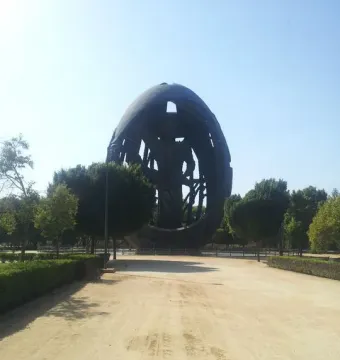
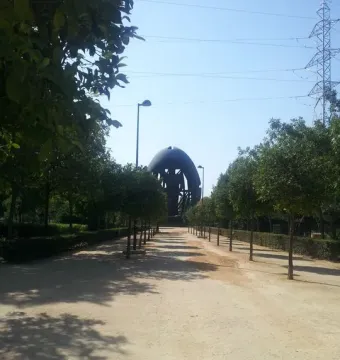
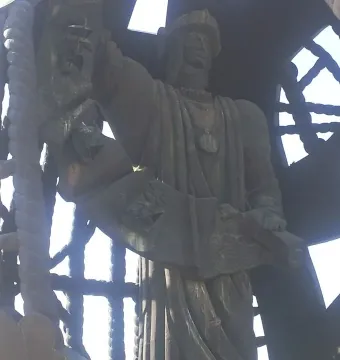
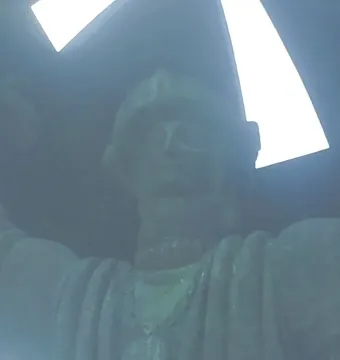
Birth of a New Man, also known in Spanish as Nacimiento de un Hombre Nuevo and popularly as el huevo de Colón, is a monumental sculpture in Seville, Spain. Created by Zurab Tsereteli, it depicts Christopher Columbus partially enclosed by an egg-like shell. The work was given to Seville by the city of Moscow to mark the 500th anniversary of Columbus’s arrival in the Caribbean in 1492. It was inaugurated in 1995 by Elena de Borbón and Jaime de Marichalar. The sculpture is described as the largest statue in Spain, ahead of the Cristo del Otero.
July 2013 · CC BY-SA 3.0
July 2013 · CC BY-SA 3.0
July 2013 · CC BY-SA 3.0
July 2013 · CC BY-SA 3.0
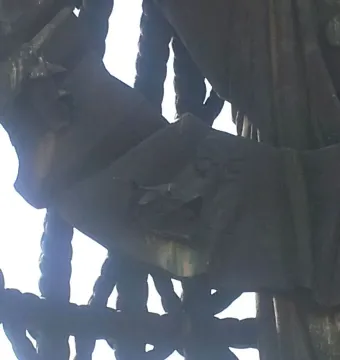
July 2013 · CC BY-SA 3.0
Identification | |
| Title | Birth of a New Man |
| Original title | Nacimiento de un Hombre Nuevo |
| French title | La Naissance de l'homme nouveau |
| German title | Geburt eines neuen Menschen |
| Italian title | Nascita di un Uomo Nuovo |
| Nickname | El Huevo de Colón |
| Type | Monumental bronze sculpture |
| Subject | Christopher Columbus |
Historical context | |
| Commissioning context | Created in connection with 1992 talks between Seville and Moscow for the 500th anniversary of Columbus's arrival in the Caribbean |
| Project | First part of the project How Europe Discovered America |
Creator | |
| Artist origin | Russian sculptor of Georgian origin |
| Artist | Zurab Tsereteli |
Discovery and provenance | |
| Donor | City of Moscow |
| Recipient | City of Seville |
| Gift occasion | The 500th anniversary of Columbus's arrival in the Caribbean in 1492 |
| Transport to Seville | Disassembled and shipped by sea from Saint Petersburg to Santurtzi, then transported by road to Seville using seven trailer trucks and two special vehicles for the largest pieces |
| Assembly | The assembly was accident-prone and delayed |
Physical characteristics | |
| Height | 32 m inner statue; 45 m outer egg-shaped shell |
| Shape | Egg-shaped |
| Structure | Outer shell made of three large surfaces joined by twisted rope-like structures |
| Scale | Colossal |
Materials | |
| Material | Bronze, with some parts covered in copper plates |
Appearance | |
| Surface motif | Each of the three outer surfaces has a Templar-cross opening |
| Ship models | Santa María, Pinta, and Niña |
| Depiction | Christopher Columbus stands inside an egg-like shell holding an unrolled navigation chart; three ship models rise from the chart |
Iconography and meaning | |
| Meaning of Templar-cross openings | They refer to the crosses that also adorned the sails of the ships |
| Symbolic meaning | A symbol of the change in worldview triggered by the discovery of America |
| Meaning of outer surfaces | They represent the sails of Columbus's ships |
Location and ownership | |
| Current location | San Jerónimo Park, Seville, Andalusia, Spain |
| Installation site | At the end of a central avenue in a basin on a large circular square at the northwestern edge of San Jerónimo Park |
| Site history | The park originated from Expo 92 nurseries and was later turned into a park |
| Park area | About 148,000 m² |
History and restoration | |
| Later damage | Bronze plates were again stolen from the inside of the egg, up to about 15 m high |
| Recovered material | 42 bronze plates weighing 503 kg were recovered from scrap yards in Seville and São Brás de Alportel |
| Arrests | Four people were detained at the end of April 2021 |
| Police investigation | In March 2021 the National Police opened an investigation after a complaint by the Seville City Council |
| Initial damage | The sculpture initially suffered looting and vandalism, including theft of the bronze plates forming the egg |
| Restoration | Damages were repaired starting in February 2000 |
| Related ceremony | The monument was inaugurated after Infanta Elena was granted the title Adoptive Daughter of the City by Mayor Soledad Becerril in Plaza de San Francisco |
| Inaugurated by | Infanta Elena de Borbón and Jaime de Marichalar |
| Inauguration date | 9 October 1995 |
Significance | |
| Size ranking in Spain | Claimed largest statue in Spain, ahead of Cristo del Otero |
| Size ranking in Europe | One of the largest statues in Europe |
| Condition | The damage is visible, with missing panels exposing the underlying scaffolding and creating cavities used by birds, especially pigeons |
Other | |
| Replica | The artist donated a smaller replica to UNESCO in 1996; it measures 160 × 112 × 90 cm and is located in front of UNESCO headquarters in Paris |
| Replica occasion | Donated on the occasion of his appointment as UNESCO Special Ambassador |
| Commemorative stamp | Russia issued a stamp featuring the sculpture in 2005 for UNESCO's 60th anniversary |