
Plutei of Trajan
Plutei of Trajan, also called Anaglypha Hadriani or Anaglypha Traiani, are two long marble relief slabs from the early 2nd century. They were discovered in 1872 on the Forum Romanum and are now kept in the Curia. The slabs were probably part of the balustrade of the Rostra, the speaker’s platform in the Roman Forum. Their inner sides are decorated with reliefs of sacrificial animals: a pig, a sheep, and an ox. The outer sides show historical scenes, including an act of food distribution and the cancellation of debts announced by Hadrian in 118 CE, with architectural backgrounds from the Forum Romanum.
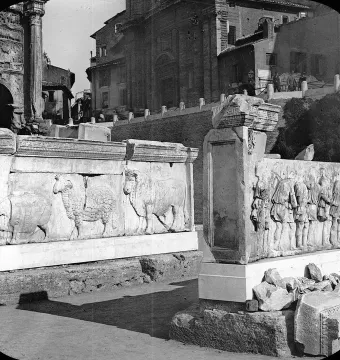
© Brooklyn Museum · No restrictions
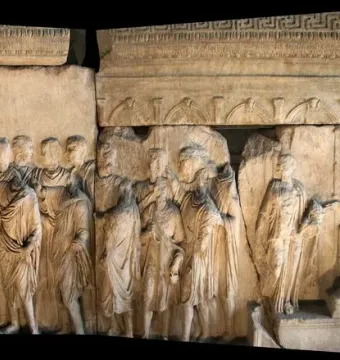
June 2013 © Cassius Ahenobarbus · CC BY-SA 3.0
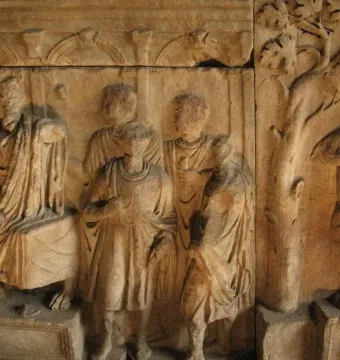
April 2011 © Institute for the Study of the Ancient World · CC BY 2.0
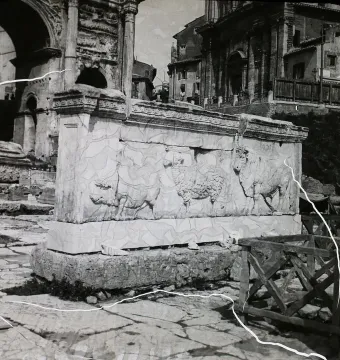
1906 · Public domain
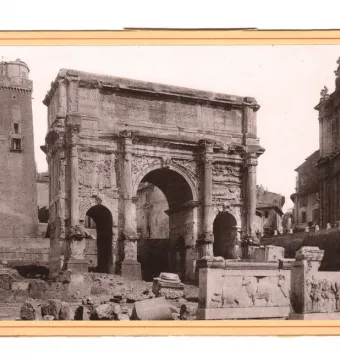
January 2013 © Unknown authorUnknown author · Public domain
Identification | |
| Title | Plutei of Trajan |
| Alternative names | Anaglypha Hadriani; Anaglypha Traiani; Anaglyphs of Trajan; Anaglypha of Trajan; I Plutei di Traiano; Plutei Traiani |
| Type | Two marble relief panels (plutei) |
Historical context | |
| Date | Early 2nd century CE |
| Associated ruler | Trajan, with uncertain attribution to Hadrian for at least part of the execution |
| Dating of depicted events | Mainly the principate of Trajan; the second scene may instead reflect the beginning of Hadrian's reign, especially January 118 |
| Related earlier event | A similar debt remission is said to have been carried out under Trajan after his victory in the First Dacian War in 102 |
Creator | |
| Attribution | Attributed to Trajan; also speculated to be by Hadrian |
Discovery and provenance | |
| Discovery date | 1872, probably in September |
| Discovery location | The Roman Forum, beneath a medieval structure called the Torre del Campanaro, in front of the Arch of Septimius Severus; also described more generally as between the Column of Phocas and the Comitium |
| Original location | Uncertain and disputed; probably in the Roman Forum, possibly on the edge of the Rostra, around the Lapis Niger, on a base in that area, or beside the sacred area associated with the statue of Marsyas |
| Original function | Uncertain; probably balustrades for the Rostra or a tribune, but other hypotheses include marking off the Ficus Ruminalis area or supporting the praetorian court stands |
Location and ownership | |
| Current location | Curia Julia, Roman Forum, Rome |
| Current display status | Displayed in the Curia Julia today, but not part of its original structure |
Physical characteristics | |
| Dimensions | About 5 meters long each |
| Orientation at discovery | Found facing each other, aligned on a southwest-northeast axis |
| Number of panels | Two |
Materials | |
| Material | Marble |
Technique | |
| Carving technique | Low relief |
Appearance | |
| Background monuments | The Roman Forum is shown in the background, including the Rostra, Temple of Divus Julius, Arch of Augustus, Temple of Castor and Pollux, Basilica Julia, Temple of Saturn, Temple of Vespasian and Titus, Vicus Tuscus, Vicus Iugarius, and an arch marking the start of the Clivus Capitolinus; one section is missing where the Temple of Concord should be |
| Missing element | Part of the second scene is lost where the Temple of Concord should appear |
| Decoration scheme | Each panel has a historical scene on the outer face and sacrificial animals on the inner face |
| Figures depicted | Trajan; Italia personified; lictors; officials carrying tablets; the statue of Marsyas; the Ficus Ruminalis |
| Scene 2 | An emperor orders documents to be burned in the Forum, with officials bringing tablets of debt records before the Rostra |
| Scene 1 | Trajan on the Rostra addressing the crowd and distributing aid, then seated on a podium in the Forum receiving or distributing gifts with the personification of Italia carrying a child |
| Outer-face subjects | Historical scenes from Trajan's reign, with the second scene possibly depicting an event from the beginning of Hadrian's reign |
| Inner-face decoration | Suovetaurilia: a pig, a sheep or ram, and a bull, shown as sacrificial animals and decorated with fibulae and laurel garlands |
Iconography and meaning | |
| Left scene interpretation | Usually interpreted as the destruction of tax records or fiscal remission in the presence of Trajan or Hadrian in 118, with unpaid debts said to have reached 900 million sesterces |
| Right scene interpretation | Usually interpreted as the institution of the alimenta by Trajan, a charitable system for orphans financed through loans to Italian landowners |
| Alimenta | Charitable institution for orphans financed by interest from loans to Italian landowners |
| Historical setting | The Forum Romanum, depicted as a rare and detailed ancient view of its monuments and topography |
Significance | |
| Historical importance | Highly valuable for reconstructing the topography and buildings of the Roman Forum; they helped identify the location of some Forum monuments with certainty |
Other | |
| Attribution note | The name Anaglypha Hadriani / Traiani reflects uncertainty between Hadrian and Trajan |
| Compositional note | The two panels are meant to be read consecutively; Marsyas and the Ficus Ruminalis function as linking landmarks between the scenes |