
Borghese Vase
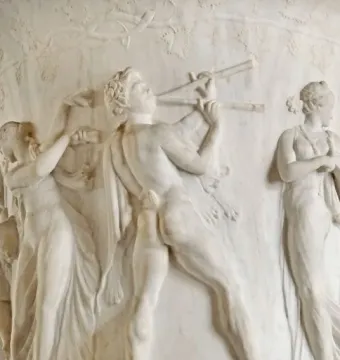
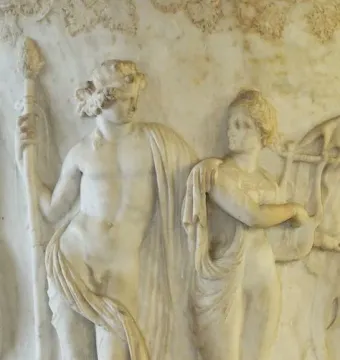
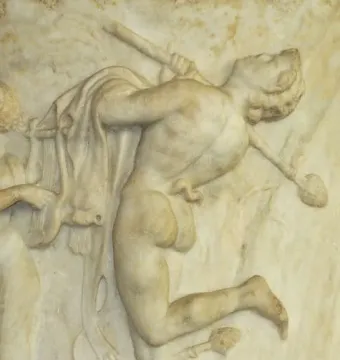
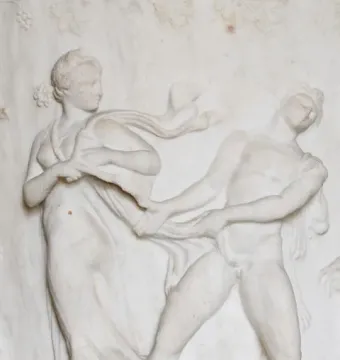
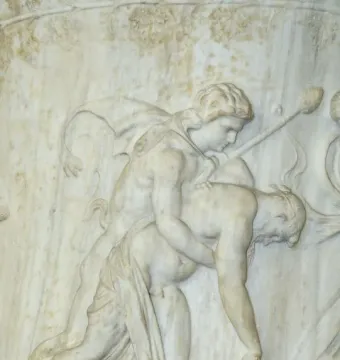
The Borghese Vase is an ancient Greek marble vase, now in the Louvre. Shaped like a large krater, it was probably made by a Neo-Attic artist in the 1st century BC. The vase stands 1.72 meters high and 1.35 meters in diameter. Its surface is decorated with a relief showing a Bacchic scene: Dionysus crowned with ivy and holding a thyrsus, Ariadne playing the lyre, and a procession of maenads, drunken satyrs, and sileni. Discovered in 1566 in the Gardens of Sallust in Rome, it later belonged to the Borghese family and was admired in the Villa Borghese. In 1807 it was purchased by Napoleon and taken to Paris, where it entered the Louvre collection.
May 2013 © Jean-Pierre Dalbéra · CC BY 2.0
© Unknown artistUnknown artist · Public domain
2007 © Marie-Lan Nguyen · Public domain
© Unknown artistUnknown artist · Public domain
© Unknown artistUnknown artist · Public domain
Identification | |
| Title | Borghese Vase |
| Original names | Waza Borghese; El Vaso Borghese; Vase Borghese; "Ваза Боргезе" |
| Type | Monumental Neo-Attic krater |
Historical context | |
| Mahdia shipwreck date | Beginning of the 1st century BC |
| Date | Probably second half of the 1st century BC, with some sources narrowing it to circa 40–30 BC |
Creator | |
| Attribution | Probably made by an artist or workshop working in the Neo-Attic style |
| Place of production | Athens |
Discovery and provenance | |
| Discovery date | 1566; some sources only say 16th century |
| Discovery location | Rome, in the Gardens of Sallust (Horti Sallustiani), probably in the garden of Carlo Muti on the site |
| Discovery context | Rediscovered in a Roman garden occupying part of the site of the Gardens of Sallust; Flaminio Vacca noted it was found at the same time as a Silenus carrying the child Dionysus |
| Former ownership | Borghese family / Borghese collection |
| Former display location | Villa Borghese, Rome |
| Acquisition by Napoleon | Bought by Napoleon Bonaparte from Prince Camillo Borghese in 1807 or 1808 |
| Moved to | Paris |
Location and ownership | |
| Current location | Louvre Museum, Paris, in the Hall of the Caryatids |
| Current display date | Displayed in the Louvre since 1811; previously exhibited in the Galerie Daru |
Physical characteristics | |
| Base | Low octagonal pedestal or plinth; the foot is a modern restoration |
| Handles | Originally had loop handles supported by satyr or silenus heads; the handles are now lost |
| Structure | Expanded bowl with a deep frieze, everted gadrooned lip, gadrooned lower section, and a low octagonal plinth |
| Form | Large bell-shaped krater |
| Diameter | 1.35 m |
| Height | 1.72 m including the base |
Materials | |
| Material | Pentelic marble |
Technique | |
| Decoration technique | Figured relief, with a high-relief or bas-relief frieze |
Appearance | |
| Rim decoration | Ionic kymatia and an astragal beneath the outward-turned rim |
| Lower decoration | Fluting or gadroons |
| Upper ornament | Two intertwined vine shoots and paired satyr heads marking the transition between sections |
Iconography and meaning | |
| Main subject | A Dionysian thiasos, or Bacchic procession |
| Depicted figures | Dionysus, Ariadne, satyrs, maenads, and sileni |
| Other scenes | One figure is shown being anointed; some interpretations identify Apollo and Dionysus rescuing Silenus, who is shown falling and reaching for spilled wine |
| Interpretive notes | Some figures are often identified as satyrs, though some references call them sileni; the draped figures have also been interpreted as maenads, but this identification is disputed |
| Associated saying | The scene has been linked to the saying 'The Gods look after children and drunken men' |
| Function | A garden ornament for the Roman market; a krater used for mixing wine with water, though this example is far larger than a utilitarian vessel |
| Dionysus depiction | Dionysus is shown wearing a panther skin or ivy wreath and holding or playing aulos or thyrsus, depending on the description |
Significance | |
| Reception | Highly admired by contemporary artists and considered one of the finest ancient sculpted vases since the mid-17th century |
| Reproductions and influence | Frequently copied and imitated in marble, bronze, alabaster, stone, biscuit porcelain, black biscuit, artificial stone, silver, and engraving across Europe |
| Copies and adaptations | Copied for Versailles, Houghton Hall, Osterley Park, and Saint Petersburg; adapted by Josiah Wedgwood; used by John Flaxman and represented by Hubert Robert |
| Hubert Robert depictions | Hubert Robert repeatedly depicted the vase in imaginary settings, including a monumental capriccio on the Aventine overlooking the Colosseum and scenes in the gardens of Versailles |
| Related examples | Two additional similar versions were found in the Mahdia shipwreck |