
Stele of Avile Tite
The Stele of Avile Tite is a monumental sculpted limestone stele, now preserved in the Guarnacci Museum in Volterra. Dating to the years around the 6th century BC, it survives in two fragments. The relief shows an armed warrior in profile facing left, with legs apart and equipped with a short tunic, cuirass, shoulder guards, greaves, a spear, and a dagger. His face has a pointed beard, stepped hair, an elongated eye, and a faint smile. The stele bears an inscribed funerary message naming Avile Tites and reflects a style associated with central-northern and Tyrrhenian Etruria, with Greco-Oriental influences.
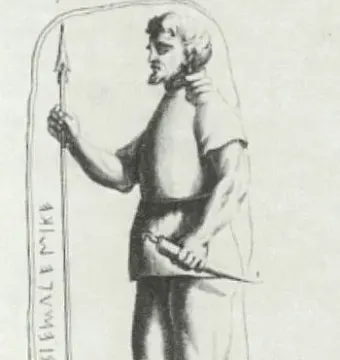
1722 © Bernard de Montfaucon · Public domain
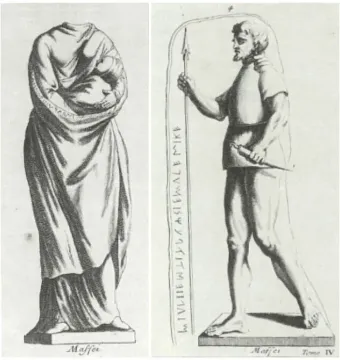
1722 © Bernard de Montfaucon · Public domain
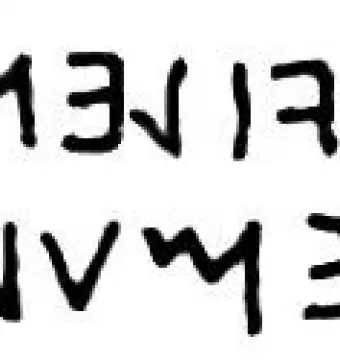
© Unknown authorUnknown author · Public domain
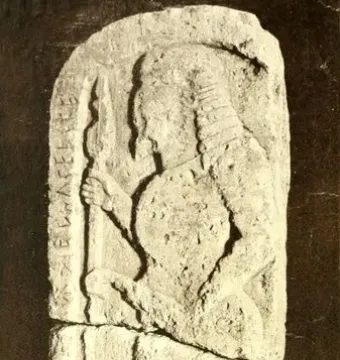
1910 © Internet Archive Book Images · No restrictions
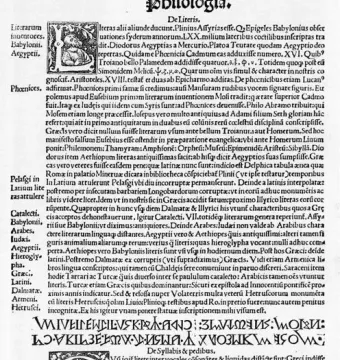
1506 © Raffaele Maffei · Public domain
Identification | |
| Type | Etruscan monumental funerary stele |
| Title | Stele of Avile Tite |
Historical context | |
| Culture | Etruscan |
| Period | Archaic phase |
| Date | c. 550 BC |
| Inscription date | 6th century BC |
Creator | |
| Inscription language | Etruscan |
| Inscription script | Etruscan letters in an archaic style |
Discovery and provenance | |
| Former location in modern times | Kept by Raffaello Maffei in his palace in Volterra |
| Associated object | An Etruscan marble statue of a woman with a child (Kourotrophos Maffei) was kept with it |
| Inscription copy | Raffaello Maffei made an early transcription of the inscription |
| Probable findspot | Near Volterra (Etruscan Velathri), possibly outside the city near the necropoleis beyond Porta a Selci, Porta all’Arco, or the necropolis of Portone north of Volterra |
| Probable discoverer | Italian humanist Raffaello Maffei (1451–1522) |
| Probable discovery date | Probably around 1494 |
| Discovery | Found in two fragments |
Location and ownership | |
| Etruscan city name | Volterra was Etruscan Velathri |
| Current location | Guarnacci Museum, Volterra |
Physical characteristics | |
| Inscription layout | Engraved on the left side of the frame, written without word separation and divided into two sections |
| Frame modification | The right side of the frame was probably originally present but removed after discovery; the lower edge was probably also cut down |
| Frame | The figure panel is set within a carved frame along the sides; the upper frame is asymmetrically domed and the lower frame is rounded only at the left corner |
| Overall shape | Cuboid with a domed top and a rounded lower left corner |
| Construction | Composed of two approximately equal fragments |
| Preservation state | Survived in two fragments |
| Object size | 170 cm high, 70 cm wide, 30 cm thick |
Materials | |
| Material | Limestone |
Technique | |
| Relief type | Bas-relief |
| Depiction technique | Figure carved in relief from the limestone background |
Appearance | |
| Stylistic influences | Ionic references and Greco-Oriental influences; linked to monumental, full forms typical of mature Ionic style |
| Hair style | Daedalic-type hair |
| Depicted figure | An armed man, shown as a warrior |
| Facial features | Pointed beard, shoulder-length hair apparently braided into a pigtail at the back, almond-shaped eyes, and an archaic smile |
| Clothing and armor | Short tunic, cuirass, shoulder guards, and greaves |
| Pose | Shown in profile facing left, with legs apart as if walking forward |
| Weapons | A spear and a dagger with a curved hilt |
Iconography and meaning | |
| Possible identity of Avile Tite | Possibly an ancestor of an aristocratic gens or a high official in the popular assembly, perhaps the representative of a curia |
| Possible social status of the deceased | Unclear |
| Possible original context | The monument may originally have stood before a burial chamber or the tumulus of an important family with a multi-chamber tomb |
| Possible social context | If UCHSIE was the ending of a first name, the dedicator could have been a son and the stele may have belonged to an aristocratic ancestor cult |
| Dagger interpretation | Probably had a ritual character as a sacrificial instrument and may have assigned a religious function to the deceased |
| Spear interpretation | Possibly an attribute of an official dignitary |
| Interpretation of figure | The figure is now considered not simply a warrior but a civilian dressed with weapons as symbols of social status |
| Dedication | Dedicated to the warrior depicted |
| Function | Funerary memorial or grave marker |
Other | |
| Inscription | "mi avileś tite[ś] [...] uchsie mulenike"; translated as "I am the property of Avile Tite. (...)uchsie has dedicated (me)." (TLE2 386) |
| Name analysis | AVILEŚ TITEŚ is the genitive form of the deceased person's name, with Avile as the first name and Tite as the family name (gentilname) |
| Letter values | The reversed-F-shaped letter transcribed as V was pronounced like W; Ś probably stood for a sibilant sound and was used mainly in northern Etruria; CH probably stood for an aspirated K |
| Naming convention | The form combining a first name with a name of origin had arisen about one century earlier |
| Possible explanation for dedication | The dedication may have resulted from a special obligation toward the deceased or from a gift contract between two leaders that sealed a kind of succession |
| Maffei's transcription | Maffei copied the inscription upside down and mostly with incorrect characters, and his copied text may combine text from the stele and the associated marble statue |
Significance | |
| Importance of the copy | Among the earliest transcriptions of Etruscan texts |
| Art-historical interpretation | According to Ranuccio Bianchi Bandinelli and Mario Torelli, the Daedalic-type hairstyle indicates a provincial milieu using a style already outdated by then |
| Typology | Typical of north-central and Tyrrhenian Etruria, with East Greek derivations |