
Townley Venus
Townley Venus is a 2.14-metre Roman sculpture of Venus in Proconnesian marble, from the collection of Charles Townley. It was bought from the dealer Gavin Hamilton, who excavated it at Ostia in 1775. The statue had already been broken when found, so Townley sent it to England in two parts to pass papal customs controls. Adapted from a lost Greek original, it shows the goddess partially clothed with her torso exposed. The arms were restored in the 18th century, and the statue was placed on a different pedestal, altering its original pose and viewpoint. Sold to the British Museum in 1805, it is usually displayed in Room 84.
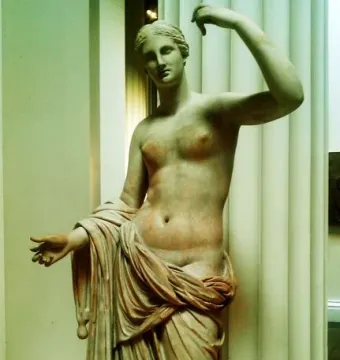
March 2012 © Andres Rueda · CC BY 2.0
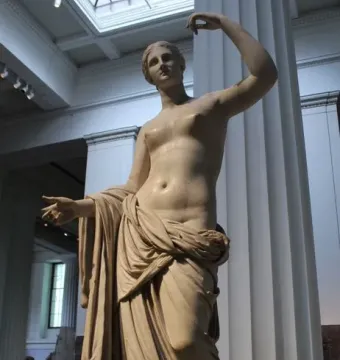
November 2025 © 14GTR · CC0
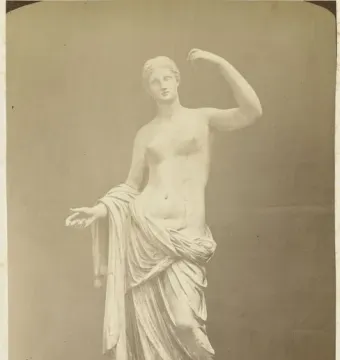
© Rijksmuseum · CC0
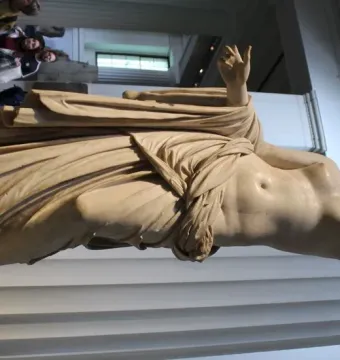
November 2025 © 14GTR · CC0
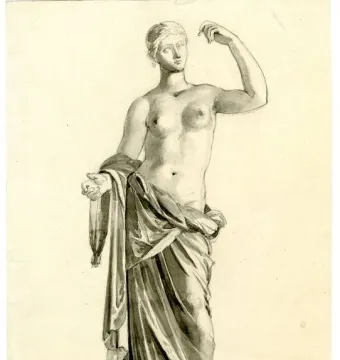
© Charles Townley · Public domain
Identification | |
| Title | Townley Venus |
| Type | Roman sculpture / Roman copy |
| Current name | Venus of Townley |
| Named after | Charles Townley, a British collector |
| Original language title | Vénus de Townley / La Venere Townley |
Historical context | |
| Date | 1st or 2nd century AD |
| Depicted figure | Venus (Aphrodite in Roman mythology) |
| Modelled after | a lost Greek original of the 4th century BC |
| Interpretation | Considered one of the copies of the Aphrodite of Thespiae attributed to Praxiteles |
| Comparison | Like the Venus d'Arles |
Creator | |
| Attributed artist of original | Praxiteles |
Discovery and provenance | |
| Sale price | uncertain; either £600 or £700 |
| Documentation for sale | A drawing annotated in red chalk showing the main restorations |
| Sale arrangement | Later offered in a lot with a sculpture of Thalia |
| Notification to Townley | Hamilton informed Townley of the statue in a letter in January 1776 |
| Preparation for export | Hamilton understated the value, did not clean the work, and separated the two parts to obtain an export license from the Assessore delle Antichità and pass papal customs |
| Transport to England | Townley shipped it to England in two parts to pass papal antiquities customs checks |
| Sale date | May 1777 |
| Acquired by | Charles Townley from Gavin Hamilton |
| Discovery condition | Found already broken, in two parts: head and torso; lower body and drapery |
| Discovery date | 1775 |
| Discovery location | the Baths of Porta Marina, Ostia |
| Discovered by | Gavin Hamilton |
Physical characteristics | |
| Height | 2.14 meters |
| Pose / drapery | Partially draped, with the torso nude |
Materials | |
| Material | Proconnesian marble |
Technique | |
| Reconstructed original pose hypothesis | If the restoration is correct, the arms were posed like the Venus de Capua or Venus de Milo, and the figure may have held a mirror |
| Base / plinth | The statue was set on a different base, changing the original pose and viewpoint |
| Restored parts | The arms, including the left arm and right hand, were restored in the 18th century |
Location and ownership | |
| Current location | British Museum, London |
| Collection | Charles Townley collection |
| British Museum registration number | 1805.0703.15 |
| British Museum sculpture number | 1574 |
| Usual display location | Room 84 |
| Temporary exhibition loan | Praxiteles exhibition at the Louvre in 2007 |
| Shown at | Royal Academy, London, in the exhibition From Life; also shown in a virtual reality garden inspired by a Scottish neoclassical painting |
History and restoration | |
| Damage incident | In 2012, part of the hand was knocked off and later repaired; in December 2015, a museum employee accidentally hit the right hand, breaking the thumb, which was then restored |
Significance | |
| Referenced work | Yinka Shonibare used a cast of the statue for Venus Presenting Helen to Paris (with Townley Venus) |
| Modification in referenced work | Wrapped in African-patterned textiles and given a globe for a head |