
Arca di San Domenico
Arca di San Domenico is the tomb of Saint Dominic, who died in the convent he founded in Bologna. It is located in the basilica that bears his name in the city, specifically in the chapel dedicated to Saint Dominic, which opens onto the right-hand aisle. Its present appearance is the result of several interventions carried out over time. The monument is considered one of the most important works of art in Bologna and reflects the virtuosity of Nicola Pisano, Arnolfo di Cambio, Niccolò dell’Arca, Michelangelo Buonarroti, and Alfonso Lombardi.
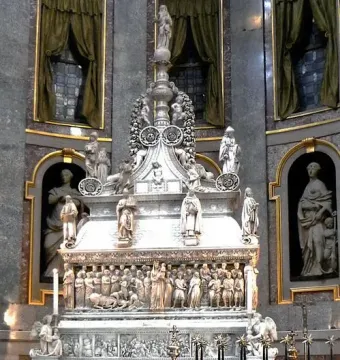
May 2010 © SchiDD · CC BY-SA 4.0
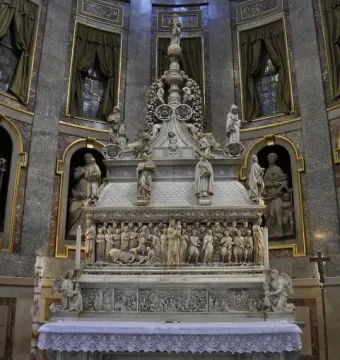
April 2012 © Paul Hermans · CC BY-SA 4.0
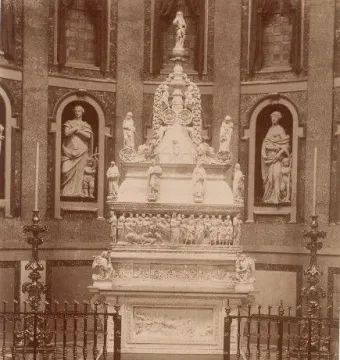
© Fotografia dell'Emilia · Public domain
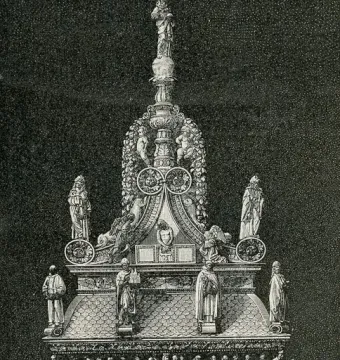
1900 © Incisore anonimo · Public domain
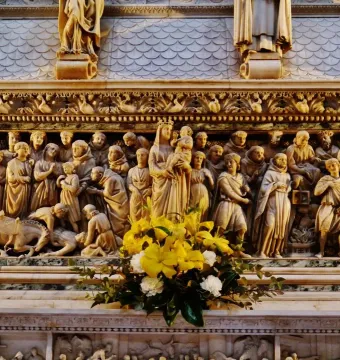
April 2022 © Zairon · CC BY-SA 4.0
Identification | |
| Title | Arca di San Domenico |
| Subject | Saint Dominic of Guzmán, founder of the Dominican Order |
| Alternative title | Le sépulcre de saint Dominique |
| Type | Funerary monument / tomb / sarcophagus / shrine |
Historical context | |
| Purpose | Created as a new shrine for Saint Dominic because the earlier tomb was difficult for pilgrims to see |
| Commissioned by | The Dominicans |
| Commission date | 1264 |
| Creation period | The monument was built in stages and took almost 500 years to complete |
Creator | |
| Original designer and sculptor | Nicola Pisano |
| Workshop completion | Completed by Nicola Pisano's workshop assistants led by Lapo di Ricevuto |
| Later decorative sculptor | Niccolò da Bari, known as Niccolò dell'Arca |
| Later sculptor | Michelangelo Buonarroti |
| Later sculptor | Alfonso Lombardi |
| Other associated artists | Fra' Guglielmo; Arnolfo di Cambio; Girolamo Cortellini; J.-B. Boudard |
Discovery and provenance | |
| Relocation of remains in 1411 | The sarcophagus was moved from the middle of the church to the chapel dedicated to Saint Dominic |
| Relocation in 1411 | Moved to a chapel dedicated to Saint Dominic in the church |
| Main construction completion | 5 June 1267 |
| Main construction start | Probably 1264 |
| Reason for replacement | The original small marble sarcophagus became inadequate for the growing number of pilgrims |
| Commission context | After his canonization by Pope Gregory IX in 1234 and the growth of the Dominican order, pilgrims increasingly visited the tomb |
| Initial translation of remains | In 1233 his body was placed in a cypress coffin, enclosed in a simple marble sarcophagus, and moved to a side chapel in the church |
| Saint Dominic's death date | 6 August 1221 |
| Saint Dominic's death place | Bologna, in the convent he founded, now the Convent of San Domenico |
| Original burial place | Behind the altar of the small convent church of San Nicolò delle Vigne |
Physical characteristics | |
| Base form | Rectangular sarcophagus |
| Caryatid supports | Originally supported by caryatid figures |
| Caryatid survival | The original caryatids were later dispersed into museum collections |
| Current appearance | The present appearance results from interventions carried out between the 13th and 18th centuries |
Materials | |
| Main material | Marble |
| Secondary material | Cypress wood for the coffin |
Technique | |
| Decorative technique | High-relief marble sculpture |
Appearance | |
| Alfonso Lombardi addition | A predella with reliefs showing scenes from the life of Saint Dominic and the Adoration of the Magi |
| Later altar addition | A relief of the death of Saint Dominic was added below the altar in 1768 |
| Niccolò dell'Arca additions | An architectural canopy and additional statues were added above the sarcophagus |
| Michelangelo additions | Statuettes of Saint Petronius, Saint Proculus, and an angel with a candelabrum |
| Medieval core | Six high-relief marble panels showing scenes from the life of Saint Dominic |
Iconography and meaning | |
| Narrative scenes from Nicola Pisano's work | Miracle of the resurrection of Napoleon Orsini; trial by fire burning the books of the Albigensians; Saints Peter and Paul giving the Gospel to Saint Dominic; approval of the rule by Pope Innocent III; Reginald of Orléans joining the Order; the friars' meal served by angels |
| Michelangelo figure resemblance | Saint Proculus closely recalls the statue of David |
| Subject of later fresco in the chapel | The glory of Saint Dominic, showing his ascent to heaven |
Location and ownership | |
| 1411 placement | Placed in the middle of the church |
| Museum locations of surviving caryatids | Victoria and Albert Museum, London; Musée du Louvre, Paris; Museo del Bargello, Florence; Museum of Fine Arts, Boston |
| Current chapel builder | Floriano Ambrosini |
| Early placement | After the 1233 translation, the remains were kept in a simple marble sarcophagus in a side chapel of the church |
| Original location | Originally on the site of the former church of San Nicolò delle Vigne |
| Current location | Chapel of Saint Dominic, Basilica of San Domenico, Bologna, Italy |
History and restoration | |
| Michelangelo intervention date | 1494-1495 |
| Head reliquary location | The reliquary with the saint's head is in a small chapel at the back of the tomb |
| 18th-century placement | In the 18th century the whole tomb was placed on a marble altar |
| Chapel fresco | Glory of Saint Dominic on the apse dome, painted by Guido Reni between 1613 and 1615 |
| Chapel rebuilding | The present Chapel of Saint Dominic was rebuilt in 1597, replacing a small Gothic chapel built in 1413 |
| Step addition | In 1532 Alfonso Lombardi added a step between the sarcophagus and the altar slab |
| Predella | Executed by Alfonso Lombardi in 1532, with date and signature engraved in the middle part |
| Canopy installation | Niccolò solemnly installed the canopy on the sarcophagus about four years after the contract |
| Missing statue of Saint Petronius | Saint Petronius was among the missing statues; it is uncertain whether it was damaged, remade, or finished before Niccolò's death |
| Subsequent design changes | The resurrected Christ was omitted from the rear face, and Saints Thomas and Vincent Ferrer were replaced by Saints Proculus and John the Baptist |
| Canopy unfinished at installation | Five of the 21 planned statues and the predella were still missing |
| Canopy contract | Niccolò dell'Arca was contracted to make the canopy and decorative top |
| Head reliquary | The head is kept in a reliquary made by Jacopo Roseto da Bologna in 1383 |
| Sarcophagus opening | The sarcophagus was opened to verify the relics and separate the saint's head |
| Exposure after church enlargement | After the church was enlarged, the tomb was exposed to sun and rain and protected only by demolition debris |
| Original enclosure | Surrounded by strong brick walls with a large stone fixed with cement on top |
Significance | |
| Artistic importance | One of the most important works of art in Bologna |
| Artistic significance | The monument preserves testimonies of several major artists and demonstrates their virtuosity |
Other | |
| Categories from source | Arches/tombs; funerary monuments; marble sculptures by Michelangelo; 13th-century sculptures in Italy; 15th-century sculptures in Italy; 16th-century sculptures in Italy; Bologna; sculptures dated 1494 |