
Angel of Peace (Mannheim)
Angel of Peace (Mannheim) is a memorial for the victims of National Socialism and the Second World War, created in 1951/52 by sculptor Gerhard Marcks. It is also known as the Mannheim Angel and Death Angel; in popular speech it is called Die schepp’ Liesel (“the crooked Liesel”). The sculpture became an important place of remembrance in Mannheim, especially around Volkstrauertag, and was associated with debates over how victims should be commemorated together. In May 1983, it was moved from its prominent location at Schillerplatz to a less visible site in square E 6 beside the Spitalkirche. In later years, it also served as a starting or finishing point for peace movement and anti-fascist actions.
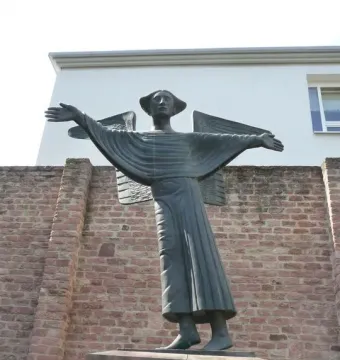
April 2014 © Immanuel Giel · CC BY-SA 3.0
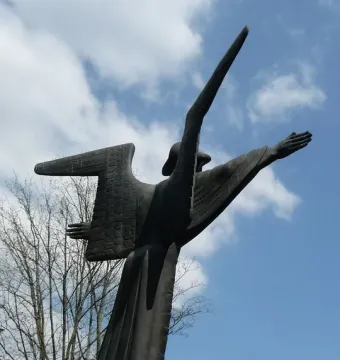
April 2014 © Immanuel Giel · CC BY-SA 3.0
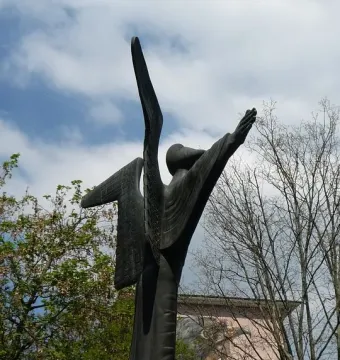
April 2014 © Immanuel Giel · CC BY-SA 3.0
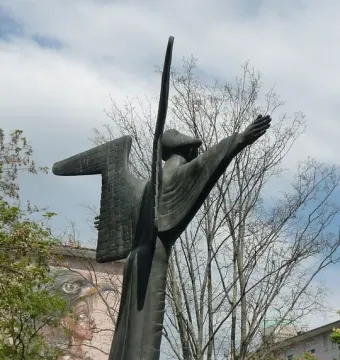
April 2014 © Immanuel Giel · CC BY-SA 3.0
November 2012 © Graf Foto · CC BY-SA 3.0
Identification | |
| Title | Angel of Peace (Mannheim) |
| Alternative names | Mannheimer Engel; Angel of Death; Todesengel |
| Local nickname | Die schepp’ Liesel (The crooked Liesel) |
| Type | Memorial sculpture and warning monument |
| Original German name | Friedensengel |
Historical context | |
| Created | 1951–1952 |
| Commissioned | by the city of Mannheim in early 1951 |
| Historical context | Created amid postwar disputes in Mannheim over how to commemorate victims of National Socialism and the war |
Creator | |
| Sculptor | Gerhard Marcks |
| Foundry | Schmäke, Düsseldorf |
Discovery and provenance | |
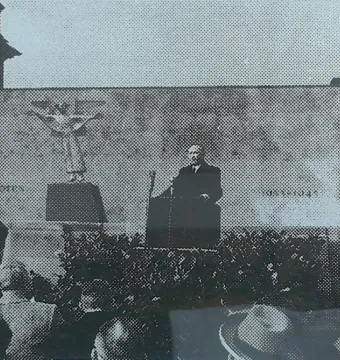
| Unveiling date | 16 November 1952 |
| Purchase approval date | April 1952 |
| People present at unveiling | Mayor Hermann Heimerich, Chancellor Konrad Adenauer, Bishop Julius Binder, protonotary apostolic Wilhelm Reinhard, and Rabbi Robert Raphael Geis |
| Unveiling occasion | German National Day of Mourning |
| Installation location | Square B4 next to the Jesuit Church, Mannheim |
| Installation date | Early November 1952 |
| Current location | Square E6 near the Hospital Church, Mannheim |
| Later proposed location | Schillerplatz in the city centre |
| Original proposed memorial site | Georg-Lechleiter-Platz (Lechleiter-Platz) in Schwetzingerstadt |
Physical characteristics | |
| Figure height | 3 metres |
| Base height | 2 metres |
Materials | |
| Figure material | Bronze |
| Base material | Sandstone |
| Overall material | Bronze figure on a sandstone base |
Technique | |
| Casting | Cast in summer 1952 |
Appearance | |
| Iconography | An angel figure |
| Pose | Arms spread in front of the wings; feet raised to suggest floating |
| Surface treatment | Wings and robe rendered with parallel lines |
| Hand positions | Left hand slightly bent back; right hand slightly raised |
| Expression | Painfully restrained, austere expression with huge, captivating eyes; described by Walter Passarge as showing an excess of suffering |
| Form | Largely relief-like, except for the fully sculpted head and skin/body surface |
Iconography and meaning | |
| Commemorates | Victims of National Socialism and the Second World War, including resistance fighters, political, religious and racial persecuted people, concentration camp prisoners, deportees from Mannheim, those who died elsewhere, civilians and military dead |
| Inscription | “Es mahnen die Toten” and “1933–1945” |
| Meaning of inscription | A passionate reminder to survivors that 1945 could not be understood without 1933; it was described as inclusive rather than exclusive |
| Artistic inspiration | Based on ancient Persian mythology, according to which the angel of man is the son who hovers over the earth on the last day |
| Related earlier works | Two angel sculptures made in 1937 and 1940; the 1940 angel was destroyed during the war |
| Related works | Die Trauernde (Cologne) and Fahrt über den Styx in the Ohlsdorf Cemetery, Hamburg |
History and restoration | |
| 1955 ceremony | On 7 May 1955 a ‘hour of reflection’ was held there for the tenth anniversary of the end of the war, with Helmut Gollwitzer speaking |
| Relocation | Moved in May 1983 to a less prominent place at square E6 near the hospital church |
| Initial reception | The mayor and city councillors were initially sceptical, but later approved and admired the work |
| Early commemorations | In 1953 a reduced National Day of Mourning ceremony was held there; from 1954 a wreath was informally laid at the monument |
| Use | Used as a focal point for memorial ceremonies, especially on the German National Day of Mourning |
Significance | |
| Historical significance | Seen as a serious warning and politically meaningful memorial intended as a symbol for Mannheim and a lasting admonition for the population |
| Contested remembrance | Became part of contested postwar remembrance involving Jews, Holocaust survivors, victims of persecution, resistance, military associations, returnees, and former Waffen-SS members |
| Critical interpretation | According to Christian Peters, the angel fascinates the viewer but resists quick identification; the work’s special quality lies in the combination of artistic ambition, serious admonition, and political message |
| Later interpretation | Hans-Joachim Hirsch wrote that the monument had an important commemorative function because of its prominent location, but that the attempt to integrate broad sections of the population was at least partly a failure |
| Press comment | In November 1954 the Rhein-Neckar-Zeitung said the Angel of Peace was falling into intellectual isolation and lacked a unifying annual gathering community |
| Later view by Heimerich | Shortly before the end of his term in summer 1955, Heimerich considered the monument not yet fully absorbed into the consciousness of the population |
| Political / memorial context | The monument was associated in the 1950s with attempts to create a new tradition of remembrance after World War II |