
Compianto sul Cristo morto by Niccolò dell'Arca
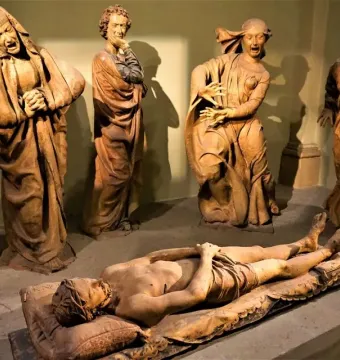
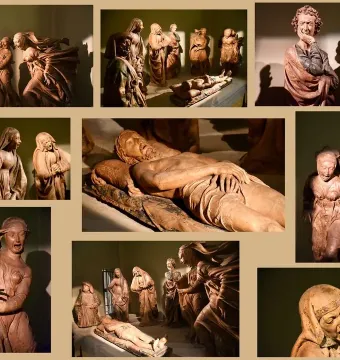
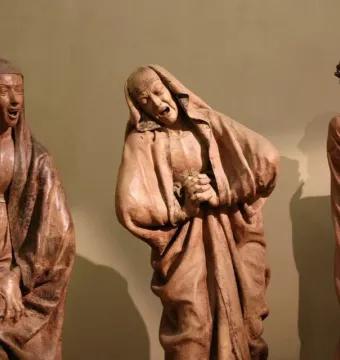
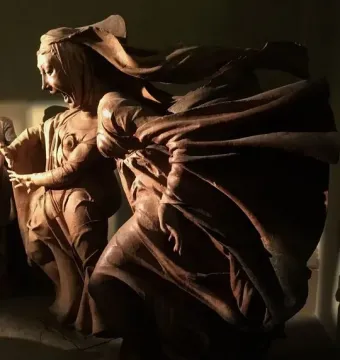
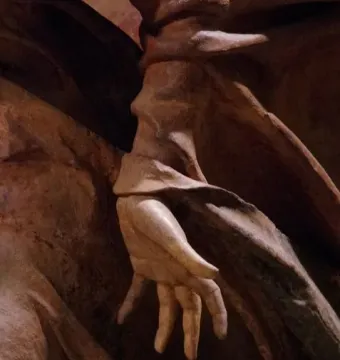
Compianto sul Cristo morto is a group of seven life-sized terracotta sculptures by Niccolò dell'Arca, dating to the 15th century and kept in the Sanctuary of Santa Maria della Vita in Bologna. It depicts the Lamentation of Christ. Christ lies at the center with his head on a pillow, while the surrounding figures form a semicircle. The two Marys stand out for their grief and windblown garments, while the other figures are calmer, including the Virgin Mary in prayer and Saint John the Evangelist weeping silently. A kneeling figure in Renaissance dress, set apart on the left, may represent the patron who financed the work. The sculpture group includes some polychromy.
August 2018 © Joyofmuseums · CC BY-SA 4.0
November 2018 © Wikipub · CC BY-SA 4.0
March 2022 © Patafisik · CC BY-SA 4.0
February 2017 © Miguel Hermoso Cuesta · CC BY-SA 4.0
May 2016 © Paolo Villa · CC BY-SA 4.0
Identification | |
| Title | Compianto sul Cristo morto |
| Type | Sculptural group |
| Number of figures | Seven life-size figures |
| English title | Lamentation over the Dead Christ |
Historical context | |
| Style | Early Renaissance; Late Gothic |
| Subject | The Lamentation of Christ; a Pietà/Lamentation scene |
Creator | |
| Artist | Niccolò dell'Arca (1435–1494), Italian |
| Date of creation | Probably between 1463 and 1490 |
| Commissioner | Unknown |
Physical characteristics | |
| Scale | Life-size |
Materials | |
| Material | Terracotta with traces of polychromy |
Appearance | |
| Mary Salome depiction | Identified as the mother of James the Greater and John the Evangelist; shown as a disciple of Jesus, with a gesture of regret |
| Emotional style | Highly dramatic and pathos-filled |
| Other figures depiction | The other figures are calmer, though their faces remain highly expressive and full of painful participation |
| Nicodemus depiction | A separate kneeling figure on the left, wearing Renaissance clothing and looking toward the viewer |
| Mary of Cleophas depiction | Shown with hands extended forward and marked by intense grief |
| Saint John the Evangelist depiction | Shown weeping silently, with one hand supporting his chin |
| Virgin Mary depiction | Shown praying with joined hands |
| Mary Magdalene depiction | Placed at Christ's feet and shown in intense grief, with garments blown by the wind |
| Depicted figures | The Virgin Mary, Mary Magdalene, Mary of Cleophas, Mary Salome, Saint John the Evangelist, Nicodemus, and one additional kneeling figure |
| Figure arrangement | The other figures surround Christ in a semicircle |
| Central figure | The dead Christ lies in the center, with his head resting on a pillow |
Location and ownership | |
| Current location | Sanctuary of Santa Maria della Vita, Bologna, Italy |
| Original location | Church of Santa Maria della Vita, Bologna |
| Previous location | Pinacoteca Nazionale di Bologna |
History and restoration | |
| Original arrangement | Unknown exactly |
| Intermediate placement at sanctuary | First in the room of the former monastery/convent, then in the first chapel to the right of the altar |
| Conservation history | The group was preserved at Santa Maria della Vita during the 15th and 16th centuries, then kept for a long time at the Pinacoteca Nazionale di Bologna; since the 1990s it has returned to its original setting at Santa Maria della Vita |
Significance | |
| Artistic significance | Considered a masterpiece of Niccolò dell'Arca |
| Art-historical significance | Its dramatic pathos was said to have no equal in surviving Italian sculpture of the period |
| Influences | Burgundian sculpture, Gothic humanism beyond the Alps, and the dramatic innovations of late Donatello |
| Related artists and works | A direct connection has been proposed with Ercole de' Roberti's lost frescoes for the Garganelli Chapel in Bologna; surviving evidence includes one fragment in the Pinacoteca Nazionale and a copy in the sacristy of San Pietro |
| Influence on local art | The work apparently did not have significant influence on the Emilian school of its time |
| Later competing works | Its expressive force was later softened in public taste by the widely diffused Compianti of Guido Mazzoni and by groups by Alfonso Lombardi |
| Literary reception | A passionate description was made by the young Gabriele D'Annunzio in one of his early poems |
Other | |
| References | Pierluigi De Vecchi and Elda Cerchiari, I tempi dell'arte, vol. 2, Bompiani, Milan, 1999; Paolo Cova, "Il Compianto di Niccolò dell'Arca in Santa Maria della Vita: riflessione sulla sua funzione devozionale e sui suoi possibili riflessi formali," in Tra la Vita e la Morte: due confraternite bolognesi tra Medioevo e Età Moderna, SilvanaEditoriale, Milan, 2015, pp. 79-83 |