
Reliquary Bust of Saint Rossore
The Reliquary Bust of Saint Rossore is a gilded bronze sculpture made by Donatello between 1424 and 1427. It was commissioned by the monks of Ognissanti, Florence, after they acquired the skull of Saint Luxorius, known in Pisa as Saint Rossore, in 1422. The casting was carried out by Jacopo degli Stroza, who assembled it from five separate cold-assembled parts. Far from the traditional medieval reliquary type, the saint is represented as a realistic Roman-style bust with expressive features and a short beard rendered with engraved details. The work is documented in Pisa in 1591 and is now in the Museo Nazionale di San Matteo.
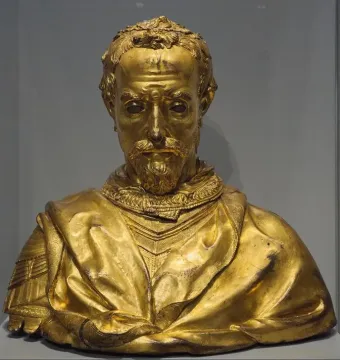
July 2014 © MenkinAlRire · CC BY-SA 4.0
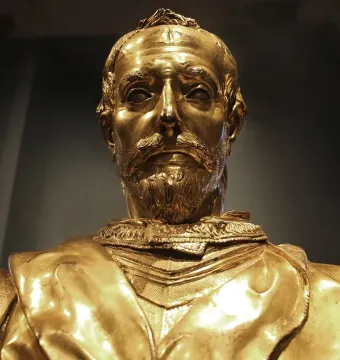
April 2022 © Francesco Bini · CC BY-SA 4.0
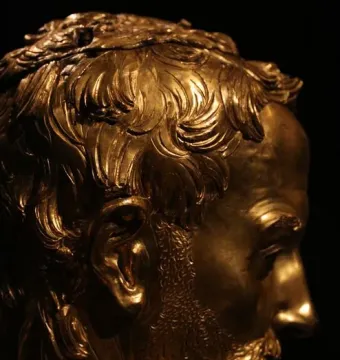
June 2019 © Francesco Bini · CC BY-SA 4.0
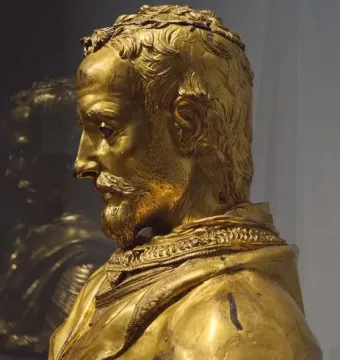
October 2022 © MenkinAlRire · CC BY-SA 4.0
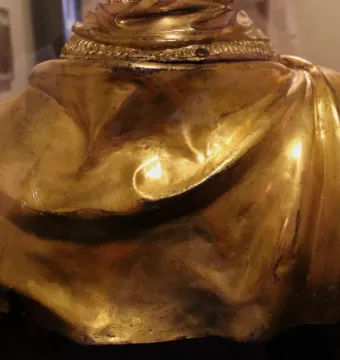
July 2014 © Miguel Hermoso Cuesta · CC BY-SA 4.0
Identification | |
| Title | Reliquary Bust of Saint Rossore |
| Alternative title | The San Rossore Reliquary |
| Original title | Il Reliquiario di San Rossore |
| Original French title | Buste-reliquaire de saint Rossore |
| Type | Reliquary bust |
Historical context | |
| Date | c. 1424–1427 |
| Commission date | 1422 |
| Commissioned by | the monks of Ognissanti, Florence |
| Purpose | to house and honor the skull relic of Saint Lussorio, popularly known in Pisa as Saint Rossore |
| Relic origin | the skull of Saint Lussorio, who was decapitated in Sardinia during the persecutions of Diocletian |
| Relic recovered | 1422 |
Creator | |
| Artist | Donatello |
| Casting handled by | Jacopo degli Stroza |
Physical characteristics | |
| Dimensions | 56 × 60.5 cm |
| Form | Bust representation in the round |
| Construction | made of five individually cast parts assembled cold |
| Base | Octagonal molded base with crystal windows on the front |
Materials | |
| Material | Bronze, gilded and silvered |
Technique | |
| Casting technique | Cast in five parts and assembled cold |
Appearance | |
| Aureole | A halo appears in a 1924 photograph, but it is not mentioned in the Zeri Foundation description |
| Pose | Bust with the head slightly bent forward and the gaze directed downward |
| Skull visibility | The skull is visible only through a small opening in the base |
| Facial features | Strong, expressive features with a short beard rendered in incised strokes |
| Depiction of the saint | Saint Rossore shown as an idealized Roman soldier with military attributes, wearing a Roman tunic fastened with a round fibula, with armor visible at the neck and epaulettes |
| Style | Realistic Roman-style bust modeled on ancient statues |
| Facial hair | Mustache and goatee |
Iconography and meaning | |
| Interpretive reading | The face has been interpreted by some as a portrait or even a self-portrait, though this is considered unlikely because of the sacred nature of the object |
| Art-historical significance | A clear break with the earlier medieval tradition of reliquary production |
| Stylistic inspiration | Ancient Roman statuary and busts rather than a hieratic devotional form |
| Placement implication | The downward gaze suggests the reliquary was intended to stand high up, both for viewing and to reduce the risk of theft |
Location and ownership | |
| Current location | Museo Nazionale di San Matteo, Pisa |
| Associated location | Dal Pozzo chapel, Camposanto Monumentale, Pisa |
| In museum since | 1949 |
| Original location | Church of Ognissanti, Florence |
| Transferred in | 1591 |
| Transferred to | Church of Santo Stefano dei Cavalieri, Pisa |
| Documented location in 1591 | Pisa |
Other | |
| Photograph date | 1924 |
| Photograph note | Photograph of the work taken at the 1924 Milan VI Triennale of Art |
| Associated saint | Saint Camerino |