
Bacchus
Bacchus is a marble sculpture by Michelangelo, made in Rome in 1496–1497 and measuring 203 cm high. It is now in the Museo Nazionale del Bargello in Florence. The work reflects Michelangelo’s response to ancient sculpture and to discoveries from excavations in Rome. Contemporary descriptions emphasized its sensual, androgynous character and its link to classical hedonism. The figure includes a satyr-like reference to Silenus, the teacher of Bacchus, while the flayed skin and grapes symbolize life over death. Commissioned by Cardinal Riario and later rejected, it was kept in the garden of the banker Jacopo Galli, drawn by Maarten van Heemskerck around 1532, and later acquired by Francesco I de’ Medici in 1572.
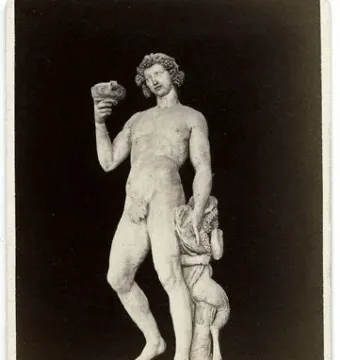
© Giacomo Brogi · Public domain
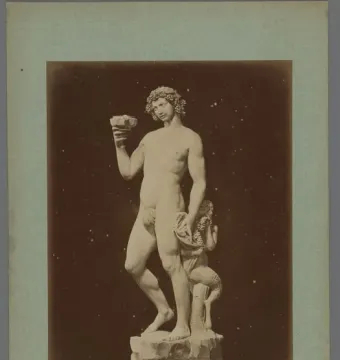
© Rijksmuseum · CC0
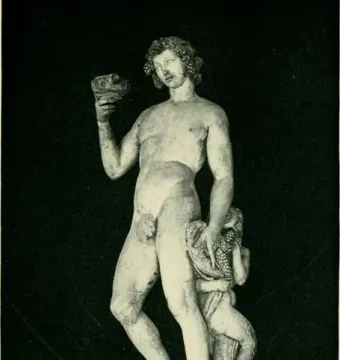
1905 © Internet Archive Book Images · No restrictions
© Zygmunt Szczotkowski · CC BY-SA 3.0
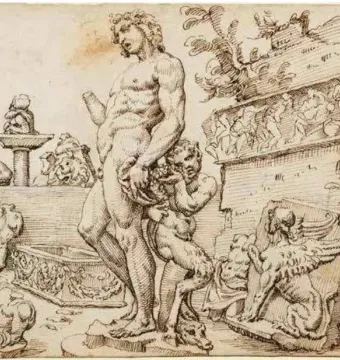
1532 © Maarten van Heemskerck · Public domain
Identification | |
| Title | Bacchus |
| Type | Free-standing marble sculpture |
| Alternative titles | Baco; Bacco; Drunken Bacchus |
Historical context | |
| Date made | 1496–1497 |
| Place of creation | Rome |
| Commission date | c. 1496 |
| Commissioned for | Cardinal Raffaele Riario's collection |
| Cultural context | Seen as something Savonarola and his followers tried to suppress in Florence |
| Stylistic inspiration | Classical antiquity; possibly Pliny the Elder's account in Natural History of a lost bronze by Praxiteles depicting Bacchus, drunkenness, and a satyr |
Creator | |
| Artist | Michelangelo Buonarroti |
| Artist description | Italian High Renaissance sculptor, painter, architect, and poet |
| Intended style | all'antica, in the antique/classical style |
Discovery and provenance | |
| Moved to Florence | During the 17th century, to the grand ducal collections (Uffizi) |
| Subsequent owner | Jacopo Galli |
| Acquired by Francesco I de' Medici | 1571 or 1572, for 240 ducats |
| Early display context | Placed among antique and fragmentary Roman works, including an ancient torso and Roman relief fragments |
| Early display location | The garden of Jacopo Galli in Rome |
| Commission outcome | Rejected by Cardinal Raffaele Riario after completion |
Location and ownership | |
| Current location | Museo Nazionale del Bargello, Florence, Italy |
| Current display location | Sala di Michelangelo |
| Moved to current location | 1873 |
Physical characteristics | |
| Anatomical features | Androgynous, with swollen breast and abdomen and swollen testicles |
| Center of gravity | High |
| Pose | Standing but swaying and leaning backward in a precarious, staggering pose |
| Size | Slightly larger than life-size |
| Height | 203 cm |
| Sculptural form | Sculpture in the round |
Materials | |
| Material | Marble |
Appearance | |
| Facial expression | Eyes rolled back and mouth open |
| Crown | Wreath of grapevine leaves and ivy leaves |
| Right hand attribute | Cup of wine |
| Left hand attribute | Tiger skin |
| Associated figure | A satyr seated behind Bacchus, eating grapes slipping from Bacchus's left hand |
| Condition shown in early depictions | The right hand was missing in the 1530s; the penis was already broken/chiseled away |
History and restoration | |
| Damage and restoration | The right hand holding the cup was broken off before the 1530s and restored in the early 1550s; the penis was also broken or chiseled away before the 1530s |
Iconography and meaning | |
| Symbolism | The grapes, tiger skin, vine crown, and unstable pose evoke intoxication, sensuality, and classical hedonism; the figure is also read as embodying life over death |
| Interpretation | The sculpture evokes sexuality in an androgynous form |
| Associated meaning | The satyr refers to Silenus, Bacchus's teacher |
| Subject | Bacchus, the Roman god of wine, shown drunk |
Significance | |
| Art-historical significance | Considered Michelangelo's first great masterpiece by Ascanio Condivi and one of his few surviving secular works |
| Historical significance | One of only two surviving sculptures from Michelangelo's first Roman period, together with the Pietà |
| Reception | Contemporary and later criticism noted its unsettling, non-idealized drunkenness; Percy Bysshe Shelley found it crude and revolting, while Johannes Wilde summarized the response as 'it is not the image of a god' |
Other | |
| Drawing evidence | Maarten van Heemskerck drew the sculpture around 1532, showing it missing the right hand |
| Print evidence | It also appears in a print by Cornelis Bos with the right hand missing |
| Literary reception | Francisco de Holanda reported seeing it presented as an ancient work but judged it not ancient because of the hands and unstable contrapposto |
| Influence on later works | Its precarious high-centre-of-gravity effect reappears in later works by Michelangelo, especially the David and the Sistine Chapel ceiling figures |