
Crucifix by Benvenuto Cellini
Crucifix by Benvenuto Cellini is a sculptural representation of the crucified Christ, made in white Carrara marble between 1559 and 1562. It is currently displayed in the Basilica of El Escorial, set on a black marble cross superimposed on a wooden one. In a bold choice for its time, Cellini depicted the figure in full nudity without the usual loincloth, though the genital area is often covered for reasons of religious decorum. The sculpture measures 184 centimeters in height and 186 centimeters across. Christ’s head is slightly inclined to the right, and no crown of thorns is shown. The anatomy is rendered with strong realism.
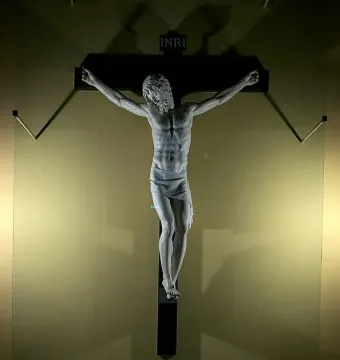
November 2015 © José Luis Filpo Cabana · CC BY 3.0
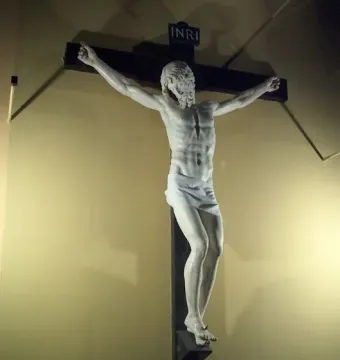
© I took this picture myself · CC BY-SA 3.0
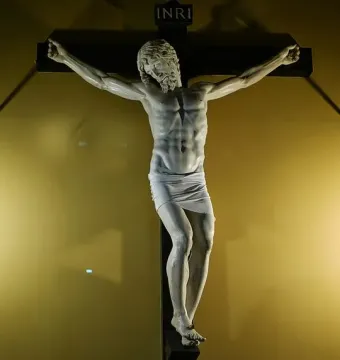
January 2025 © Jl FilpoC · CC BY-SA 4.0
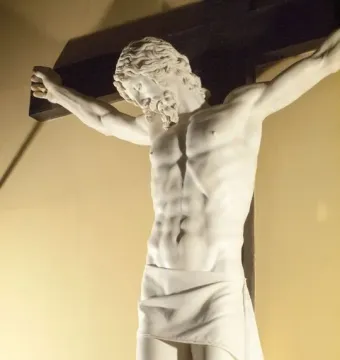
July 2016 © Bolumena · CC BY-SA 4.0
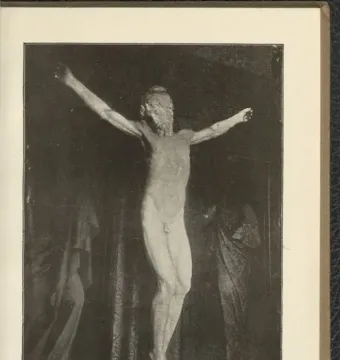
© Alfred W Fred · Public domain
Identification | |
| Title | Crucifix of Benvenuto Cellini |
| Type | Crucifix |
Creator | |
| Artist | Benvenuto Cellini |
Historical context | |
| Original intended use | Made for Cellini's own tomb |
| Bequest of works | All his finished and unfinished sculptures were left in his will to Francesco I de' Medici |
| Date of will | 1555 |
| Intended burial place | Basilica of Santa Maria Novella, Florence |
| Cellini's account source | Described in Cellini's Vita |
| Reason for imprisonment | Accused of stealing gems from the papal tiara after the Sack of Rome |
| Imprisonment location | Rome, first at Tor di Nona and then at Castel Sant'Angelo |
| Context of creation | Created after a period of spiritual desolation during Cellini's imprisonment in Rome |
| Origin of concept | Based on a wax model Cellini made after a vision while imprisoned in Rome in 1539 |
| Date made | Between 1559 and 1562 |
Discovery and provenance | |
| Destination in Spain | San Lorenzo de El Escorial |
| Arrival date | 11 November 1576, the eve of Saint Martin's Day |
| Transportation to Spain | On 9 November 1576 Philip II ordered it brought to El Pardo, and Batista Cabrera then carried it with fifty men to San Lorenzo de El Escorial |
| Purpose of gift | To complete Philip II's church of San Lorenzo de El Escorial |
| Acquired by | Cosimo I de' Medici, who saw it in Cellini's workshop and offered to buy it |
| Year gifted | 1576 |
| Donor | Francesco I de' Medici, Grand Duke of Tuscany |
| Donated to | King Philip II of Spain |
| Former collection | Palazzo Pitti collection |
Physical characteristics | |
| Body appearance | Rendered with great realism and described as luminous |
| Inscription | An inscription is on the foot of the sculpture |
| Headgear | No crown of thorns |
| Covering | The genitals are usually covered with a cloth for religious modesty, which can be removed |
| Nudity | Completely nude, without the usual loincloth |
| Facial expression | Mouth and eyes slightly open, as if after exhaling the last breath |
| Pose | Arms spread; head slightly inclined to the right |
| Figure depicted | Christ crucified |
| Dimensions | 184 cm high and 186 cm in span |
Materials | |
| Main material | White Carrara marble |
| Cross material | Black marble |
| Support structure | The Christ figure is displayed on a black marble cross superimposed on a wooden cross |
| Model material | Wax |
Technique | |
| Source of form | Based on the wax model Cellini kept after his release |
Location and ownership | |
| Current condition of display | Usually exhibited with the genitals covered for religious modesty |
| Current display setting | Displayed on a black marble cross superimposed on a wooden cross |
| Display tradition | Since the work has been in Spain, its intimate parts have continued to be covered with a cloth |
| Current setting | Displayed in the Chapel of the Doctors of the Church in the basilica, on the counterfacade left side |
| Current location | Basilica of El Escorial, Spain |
History and restoration | |
| Restoration date | 1994 |
| Post-restoration location | Chapel of the Doctors of the Church, left side of the basilica's counterfacade |
Significance | |
| Rarity of depiction | A nude representation of Christ is very uncommon |
| Historical note | An audacious choice for the time to depict Christ in full nudity |
| Comparative references | Notable comparable works by Michelangelo include the Crucifix of Santo Spirito, the Last Judgment in the Sistine Chapel, and Christ of the Minerva, which also faced prudish censorship |
| Associated vision | A radiant sun that expanded into a luminous sphere containing images of a crucified Christ, the Madonna and Child enthroned, and Saint Peter |
| Associated figures in vision | Christ crucified, the Madonna and Child, and Saint Peter |
| Associated written work | Cellini's book Benevenuto Celino, del modo que se ha de tener para labrar en mármor, in which he described carving the work and claimed it was the first crucifix piece carved up to that day |
| Associated poems | Two Tuscan sonnets were included at the end of Cellini's book |
| Source description | Fray Antonio de Villacastín described the crucifix in the monastery chronicle |
| Historical context | Connected to Cellini's spiritual crisis and visionary experience in prison |