
Warka Mask
The Warka Mask, also known as the Lady of Warka or Lady of Uruk, is a sculpture dated to around 3300 BC from the Uruk period in Mesopotamia. Created in the time of Sumerian civilization in southern Mesopotamia, it is carved from sandstone and shows a rough, experimental workmanship. It was originally painted in different colors, including white for the skin and other tones for the ornaments, hair, and details. The face is highly stylized, with almond-shaped eyes, a continuous brow line, and a strong geometric sense centered on the nose. It is considered one of the earliest works to depict a female face.
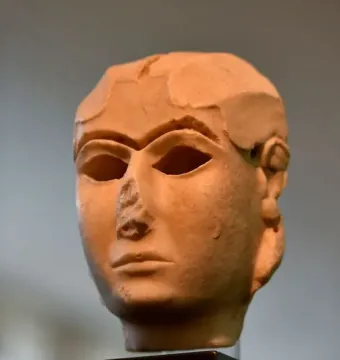
May 2019 © Osama Shukir Muhammed Amin FRCP(Glasg) · CC BY-SA 4.0
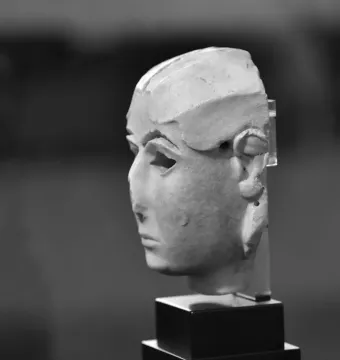
March 2019 © Osama Shukir Muhammed Amin FRCP(Glasg) · CC BY-SA 4.0
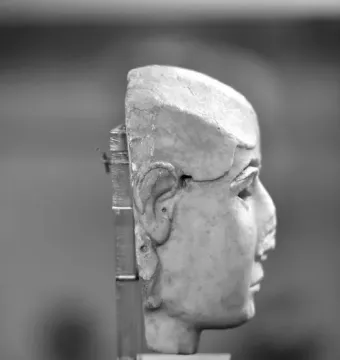
March 2019 © Osama Shukir Muhammed Amin FRCP(Glasg) · CC BY-SA 4.0
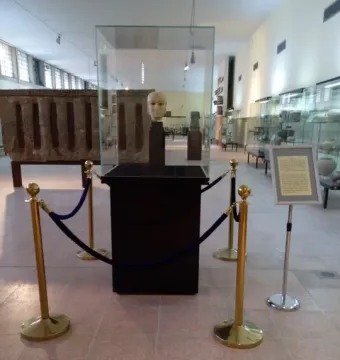
December 2016 © Solider 16IQ · CC BY-SA 4.0
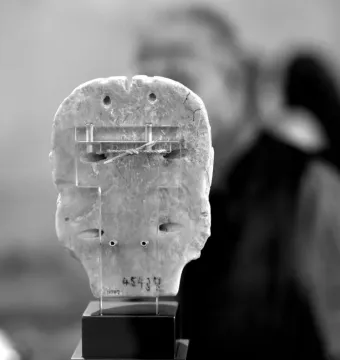
March 2019 © Osama Shukir Muhammed Amin FRCP(Glasg) · CC BY-SA 4.0
Identification | |
| Title | Mask of Warka |
| Alternative names | Lady of Warka; Lady of Uruk; Warka Mask; Woman's mask of Uruk; Dama di Warka; Dama de Uruk; colloquially called the Sumerian Mona Lisa or the Mona Lisa of Uruk |
| Type | Female head mask |
Historical context | |
| Date | Late 4th millennium BC, c. 3300–3100 BC |
| Cultural period | Uruk period |
| Civilization | Sumerian civilization |
| Historical context | Part of the last millennium of the Chalcolithic in Mesopotamia |
| Geographic context | Southern Mesopotamia, in the area of the Tigris and Euphrates rivers (present-day Iraq) |
Creator | |
| Discovered by | German Archaeological Institute expedition led by Dr. Arnold Nöldeke (also given as Dr. A. Nöldeke) |
Discovery and provenance | |
| Original function | Probably part of a larger wooden cult image or idol |
| Associated deity | Inanna |
| Named after | The modern village of Warka, near ancient Uruk |
| Nearby place | About 280 km south-southeast of Baghdad, near Samawa |
| Discovery region | Al-Muthanna Province, Iraq |
| Discovery site | Uruk, in the Eanna (Ianna) district |
| Discovery date | 22 February 1939 |
Physical characteristics | |
| Height | 20.1 cm |
| Original form | Probably part of a life-size statue |
| Description | Carved female head or mask |
| Back | Smoothed on the back and flat at the back of the head, possibly for wall attachment |
| Crown feature | A groove at the crown held the figure's hair |
| Attachment features | Holes for fastening a wig with metal studs, possibly engraved |
| Ears | Ear holes indicate the head once wore jewelry |
Materials | |
| Back of head covering | Possibly bitumen beneath a layer of colored metal, perhaps gold foil or copper foil |
| Eye inlay | Shell and lapis lazuli may have been used for the eyes |
| Hair material | Probably gold sheet |
| Body material | Marble, probably white marble |
Appearance | |
| Original appearance | Originally polychromed |
| Original colors | White for the skin, with other colors for ornaments, hair, and details |
| Stylistic features | Roughly worked, experimental, with a lack of stylization and a geometric tendency |
| Eyes | Large almond-shaped eyes with very dilated pupils and no eyelids |
| Eyebrows | Continuous eyebrows forming a unibrow |
| Symmetry axis | The nose serves as the axis of symmetry |
| Preservation state | The eyes and eyebrows are not preserved; traces of ancient inlay remain |
Iconography and meaning | |
| Artistic influence | Its intense gaze was later inherited in Assyrian and Babylonian guardian sculpture |
| Possible significance | The decorations suggest it may have been a highly valuable divine representation |
| Uniqueness | Unique for its period, with no known parallels |
| Interpretation | One of the earliest known representations of the human face and one of the first depictions of a female face |
| Depicted figure | A female face, probably the goddess Inanna; this identification is only a presumption |
Location and ownership | |
| Current location | National Museum of Iraq, Baghdad |
History and restoration | |
| Looting date | 9–12 April 2003 |
| Looting event | Looted from the National Museum of Iraq during the United States invasion of Iraq |
| Number of stolen objects | Forty-one pieces in total, including the sculpture |
| Other stolen objects mentioned | Warka Vase; Bassetki Statue |
| Recovery date | September 2003 |
| Recovery circumstances | Recovered intact after being buried, hidden by an Iraqi man/farmer, and found through an informant tip, investigation, and raid |
| Recovery location | A farm in northern Baghdad |
| Condition when recovered | Intact and undamaged |
Significance | |
| Historical significance | One of the oldest works in the world depicting a female face |