
Venus Italica
Venus Italica is a marble sculpture commissioned by Napoléon Bonaparte and fashioned by the Italian sculptor Antonio Canova. Canova completed the original work in 1802 and later modelled two further variants, finished in 1819. The sculpture was intended as a replacement for the Venus de Medici, an antique copy by Cleomenes of Athens that had been seized, taken to France, and placed in the Louvre in 1802 by order of Bonaparte. After Napoleon’s abdication, the Venus de Medici was returned to Italy in 1815 and is now displayed in the Room of Venus at the Galleria Palatina in the Palazzo Pitti in Florence.
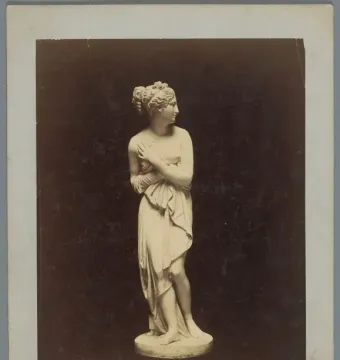
© Rijksmuseum · CC0
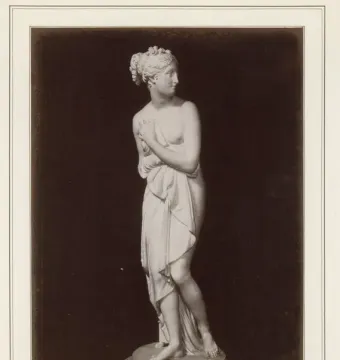
© Rijksmuseum · CC0
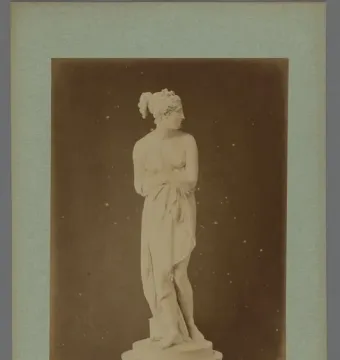
© Rijksmuseum · CC0
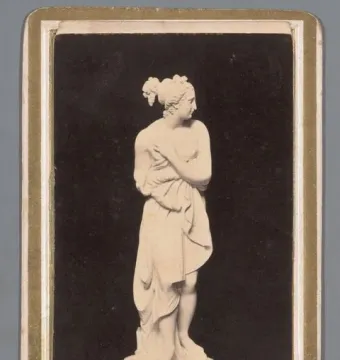
© Rijksmuseum · CC0
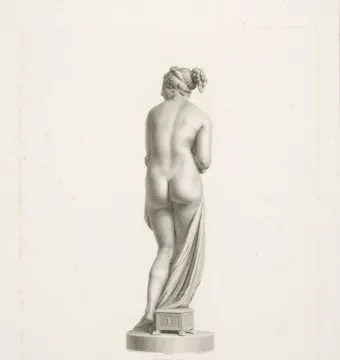
© Rijksmuseum · CC0
Identification | |
| Title | Venus Italica |
| Type | Marble sculpture |
Historical context | |
| Date | 1805 |
| Model used | Worked from the original mold of the Venus de' Medici preserved at the Louvre |
| Later location | Galleria Palatina, Palazzo Pitti, Florence |
| First public display | 1812 in the Uffizi, labeled "Stolen by the Emperor" |
| Related work current location | Room of Venus, Galleria Palatina, Palazzo Pitti, Florence |
| Related work | Venus de' Medici: a Roman copy of an ancient work by Cleomenes of Athens, seized by order of Napoleon and placed in the Louvre in 1802, then returned to the Uffizi on 27 December 1815 |
| Additional versions | Two further variants were completed in 1819 |
| Inspiration | Inspired by the Venus de' Medici |
| Purpose | Created as compensation for the transfer of the Venus de' Medici to France and intended to replace it in the Uffizi |
| Commission date | 1804 |
| Commissioned by | Giovanni degli Alessandri, president of the Florence Academy of Fine Arts |
| Style | Neoclassical |
| Historical context | Created in the context of the Napoleonic plunder and the removal of the Venus de' Medici from Florence in 1802 |
Creator | |
| Artist | Antonio Canova |
| Artist nationality | Italian |
Physical characteristics | |
| Surface color | Soft rosy-pink tint |
| Subject | The goddess Venus in the Venus pudica pose |
| Depicted action | She is hiding behind a drape or towel, apparently surprised by someone’s arrival |
| Formal qualities | Finer proportions; modest movements; softness and emotion |
Iconography and meaning | |
| Iconographic theme | Venus Pudica |
Materials | |
| Material | Marble |
| Materials | White and pink marble |
Technique | |
| Finishing process | He softened the transitions between body parts and rubbed the surface with special tools and pumice stone for weeks or months |
| Patina treatment | An unknown patina compound was applied to the flesh to lighten the skin tone |
| Lighting practice | Canova displayed the work in his studio by candlelight |
| Lighting effect studied | He was interested in the effect of candlelight on the translucent marble surface |
| Surface treatment | A soft pinkish mixture was spread over the surface to enhance the goddess's beauty |
| Finishing process name | "Last touch" |
| Technique | Canova's "direct touch" technique for creating the illusion of human flesh |
Significance | |
| Literary praise | Foscolo also praised it in The Graces |
| Status | Considered one of Canova's masterpieces |
| Popularity | It achieved great popularity and was widely reproduced in many sizes and materials |
| Theoretical influence | Deliberately follows Johann Joachim Winckelmann's theories, especially the search for ideal beauty, the distancing from passions and emotions, and "noble simplicity and quiet grandeur" |
| Literary comparison | Ugo Foscolo praised it as superior to the Venus de' Medici, saying it brought "paradise" into "this valley of tears" |
| Critical interpretation | According to Edward Lucie-Smith, it conveys modesty and sexual vulnerability better than the Venus de' Medici |
| Reception | Praised for artistic conception and craftsmanship; most viewers noticed Canova's superior skill in marble surfaces and textures |
| Aesthetic aim | To evoke the tenderness of flesh, its soft vibration, and movement in space through the free articulation of the body and delicate nuances |
Location and ownership | |
| Original intended location | The Uffizi in Florence |
| Current location | Room of Venus, Galleria Palatina, Palazzo Pitti, Florence |
| Reproductions | Later replicas and reduced-scale versions were made by Canova's assistants and other artists; examples are in Venice, Berlin, Munich, and Hearst Castle, Los Angeles |