
Gorilla Carries a Woman
Gorilla Carries a Woman is a group sculpture by Emmanuel Frémiet from 1887. It was a revised version of an earlier Gorilla carrying a woman composition that had caused a scandal at the Salon of 1859. Frémiet created the first artistic depiction of a gorilla in 1859, making a life-size ape the central subject of a work of art for the first time. The 1887 version earned the artist a salon medal, but the French government ultimately declined to have it cast in bronze. The sculpture is now in the Musée des Beaux-Arts de Nantes, and a plaster version was shown in Dresden in 2016.
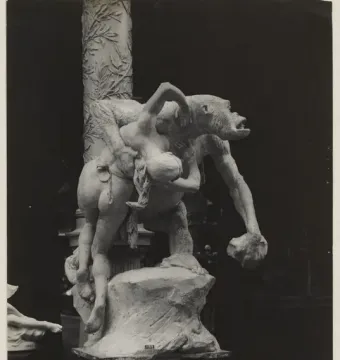
© Blancard, Hippolyte (1843 - 1924), photographe · CC0
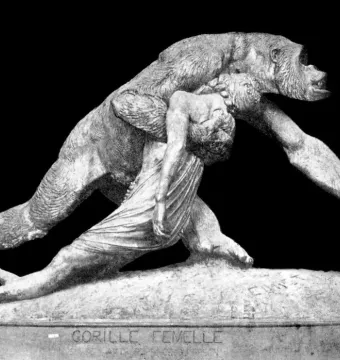
© Sculpture by Emmanuel Frémiet. Photographer unknown. · Public domain
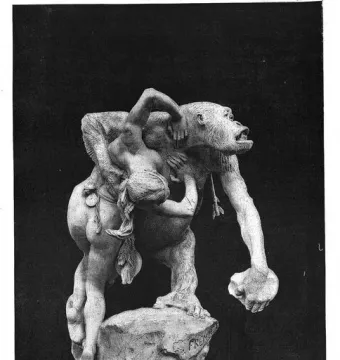
November 1887 © Emmanuel Frémiet · Public domain
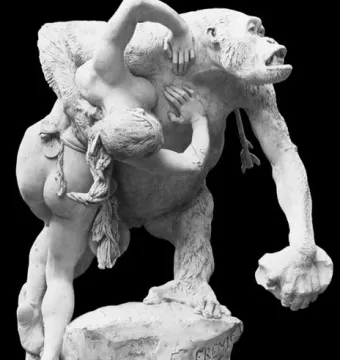
January 2014 © ketrin1407 · CC BY 2.0
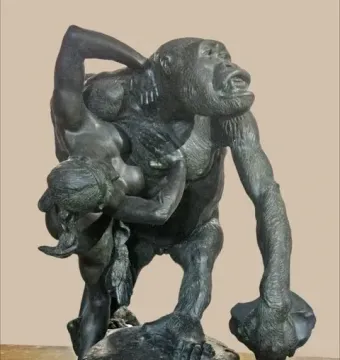
July 2012 © Jean-Pierre Dalbéra · CC BY 2.0
Identification | |
| Title | Gorille enlevant une femme |
| Original French title | Gorille enlevant une femme |
| Type | Plaster sculptural group |
| Alternative titles | Gorilla Carrying a Woman; Gorilla Carrying Off a Woman; Gorilla Abducting a Woman; Gorilla Stealing a Woman; Gorilla Carrying Off a Black Woman; Gorilla Carrying a Black Woman; Gorilla Abducting a Black Woman; Gorilla Trägt eine Frau |
Historical context | |
| Probable setting | Prehistory |
| Second version scientific context | By the 1870s scientists knew that real gorillas are peaceful, usually avoid humans, and have little interest in human women because of low libido and anatomical incompatibility; the 1887 version lagged behind this research |
| Relation to Darwin | Created in the same year that Darwin's On the Origin of Species caused a sensation |
| Second version subject | A gorilla abducting a woman; the woman is nude and resisting |
| First version scientific status | At the time, Frémiet's depiction was considered in line with the latest science, but it conflicted with contemporary moral norms |
| First version scandal context | Linked to polemics surrounding Charles Darwin's theory of evolution, contemporary interest in bestiality, and the first direct Western observations of gorillas |
| First version material | Plaster |
| First version exhibition | Shown at the Salon of 1859 |
| First version subject | A female gorilla carrying off a Black African woman |
| First version title | Gorille enlevant une négresse |
| First version | Created in 1859; destroyed in 1861 |
| Date | 1887 |
| Second version title | Gorille enlevant une femme |
Creator | |
| Artist background | Trained in both art and natural history; sought success in both fields and did not want to be regarded only as an animal sculptor |
| Artist | Emmanuel Frémiet |
History and restoration | |
| Bronze casting | Cast in bronze in 1889 |
| Second version international reception | Had similar success in Munich in 1888 |
| Reason bronze casting was not made in Paris | The Paris National Museum of Natural History withdrew it for fear of public disorder |
| Second version award | Awarded an honorary medal at the Salon of the Société des Artistes Français in 1887 |
| Second version reception | Scandalous because of its erotic charge, lubricity, and displayed bestiality; also described as a scandal at the Salon of 1887 |
| Planned bronze casting | Planned for public display in Paris at the Jardin des Plantes |
| First version display conditions | Displayed in a niche hidden by a curtain that only men and married women were allowed to lift |
| First version reception | Caused a scandal at the Salon of 1859; the jury rejected it as offensive and indecent, but it was exhibited with support from the Fine Arts administration |
Significance | |
| 1915 cartoon reuse | An Australian Melbourne Punch cartoon renamed the work The German and Civilization during World War I |
| Ravished Armenia poster adaptation | In the 1919 U.S. film poster, the gorilla was replaced by a Turk and the woman by an Armenian |
| Interpretive debate | Opinions vary because of differences between the first and second versions and because the work can be viewed either as art or as a natural-history museum object |
| Influence on other works | Inspired serial novels, caricatures, the 1919 U.S. film poster for Ravished Armenia, and later filmmakers Merian C. Cooper and Ernest B. Schoedsack |
| Influence on anti-German poster | Inspired Harry Ryle Hopps's 1917 anti-German poster Destroy This Mad Brute, created in his Los Angeles office |
| Influence on King Kong | One of the sources of inspiration for the creators of King Kong |
| Commercial reproduction | Reproductions sold relatively successfully as statuettes and became popular on mantels and desks among American admirers |
| 1920 cartoon reuse | The German satirical magazine Kladderadatsch reused the work to depict African soldiers from the French colonies in the Rhineland in a highly racist way |
| Frémiet's aim | He aimed to excel in both art and natural history and wanted recognition beyond being only an animal sculptor |
| First artistic gorilla depiction claim | Described as the first artistic, not merely scientific, depiction of a gorilla |
| First life-sized ape as main subject claim | Described as the first depiction in which a life-sized ape became the main figure |
Physical characteristics | |
| Woman depiction | The woman is now naked and no longer inert; she tries to repel the animal |
| Gorilla wound | An arrow embedded in one arm |
| Second version composition | More compact and impressive than the first version |
| Gorilla depiction | The animal's arm is almost masculine |
| Gorilla object held | A large stone in one forepaw |
Iconography and meaning | |
| Iconographic reference | Renews the theme of the satyr and bacchante, including James Pradier's famous 1834 version |
Appearance | |
| Stone symbolism | The stone resembles a Paleolithic biface |
| Woman clothing | Nude; at most a hairband with half of a gorilla jaw and a rudimentary belt |
Discovery and provenance | |
| Artist's research | Frémiet researched the stone tools used by prehistoric humans |
Location and ownership | |
| 2016 exhibition | Shown in the exhibition Die Vermessung des Unmenschen at the Kunsthalle im Lipsius-Bau in Dresden |
| Current status of plaster original | The original patinated plaster sculpture is preserved there |
| Current location of plaster original | Musée d'Arts de Nantes |
| Current location of bronze version | Allerton Park in Illinois |
| Bronze display location | Lawn of the American Museum of Natural History in New York |
Materials | |
| Bronze version material | Bronze |
| Original material | Patinated plaster |