
Demeter of Knidos
Demeter of Knidos is a white marble statue depicting a Kore, probably the goddess Demeter. It was made by the sculptor Leochares and placed in the city of Knidos, which gave the sculpture its name. The statue was later rediscovered among the ruins of the ancient Greek city of Caria and taken to England, where it is now preserved in the British Museum. In 2008, the city of Datça asked the British Ministry of Culture and Tourism for the return of the Demeter of Knidos and the Knidos Lion.
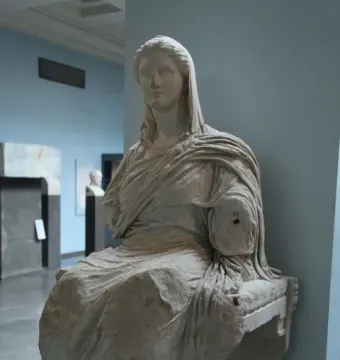
July 2011 © Raymond.ellis · CC0
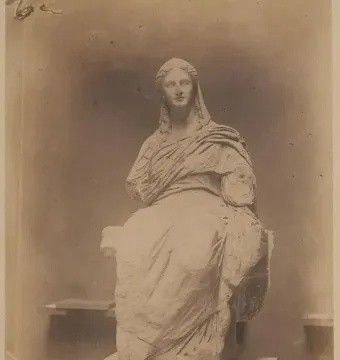
© Catsimpoolas, Nicholas; Scull, S. A. (Sarah Amelia) · Public domain
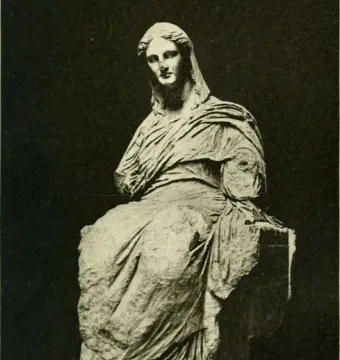
1906 © Internet Archive Book Images · No restrictions
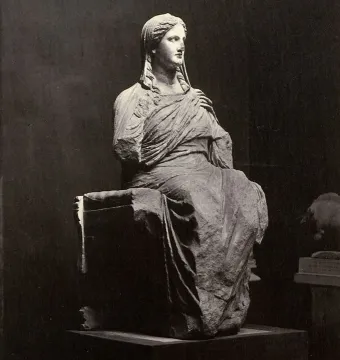
© W. A. Mansell & Co. · Public domain
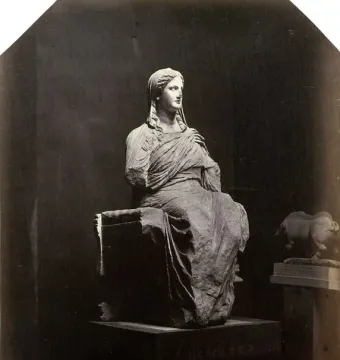
© W. A. Mansell & Co. · Public domain
Identification | |
| Title | Demeter of Knidos |
| Type | Ancient Greek statue |
| Original title | La Déméter de Cnide |
Historical context | |
| Date | c. 350 BC |
| Style | Hellenistic sculpture |
| Culture | Greek |
Creator | |
| Artist | Learches (Leocares) |
| Artist gender | male |
Discovery and provenance | |
| Transferred to | London almost immediately after rediscovery |
| Sanctuary setting | A long terrace beside the acropolis overlooking the city and the sea |
| Rediscovered | 1857–1858, by Charles Thomas Newton |
| Condition at discovery | Nearly completely intact |
| Discovery context | Found among votive statuettes in the sanctuary temple; most of the other votive sculptures were later found in fragments |
| Associated sanctuary | Sanctuary of Demeter at Knidos |
| Original location | Sanctuary of Demeter at Knidos, near the ancient port of Knidos in southwestern Asia Minor (present-day near Datça, Turkey) |
| Sanctuary date | 350 BC, when the city was reestablished |
Location and ownership | |
| Current location | British Museum, London, England |
| Collection | British Museum Greek and Roman art collection |
Physical characteristics | |
| Size | Life-size; about 1.50 m tall |
| Condition | Relatively intact, but the back and armrests of the throne and the goddess's forearms and hands are missing |
| Pose | Seated on a throne |
Technique | |
| Construction | The forearms and hands were carved separately, and the head was carved separately from the body and attached at the neck |
Materials | |
| Material | White marble |
Iconography and meaning | |
| Depicted figure | Demeter |
| Identification | A kore, probably the goddess Demeter |
| Description | Serene, timeless appearance |
| Interpretation | Seen as expressing Demeter's maternal role in the Greek pantheon |
| Associated deities | Hades and other underworld deities, including Persephone |
| Mythological relation | Persephone is Demeter's daughter |
Other | |
| Repatriation request | In 2008, the city of Datça requested its return from the British Ministry of Culture and Tourism, along with the Lion of Knidos |