
Hope Dionysus
Hope Dionysus is a marble statue of Dionysus, the Greek god of wine. He wears a panther skin over a short chiton and under an himation, and extends his restored left arm above a small female figure for support. That figure has been interpreted as a possible representation of Spes, the goddess of hope, or as a statue of a hermaic pillar type. The sculpture dates from the Roman period, between 27 and 68, and was restored by Vincenzo Pacetti. It is inspired by a Greek model.
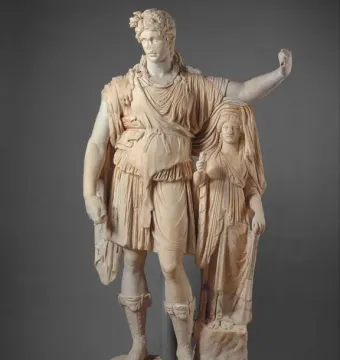
© Creator:Pacetti, Vincenzo · CC0
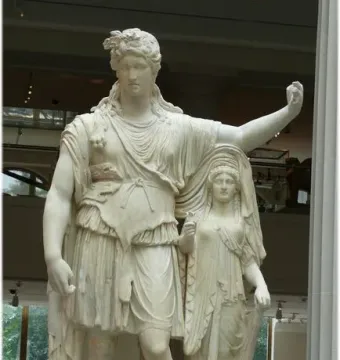
© Ad Meskens · CC BY-SA 3.0
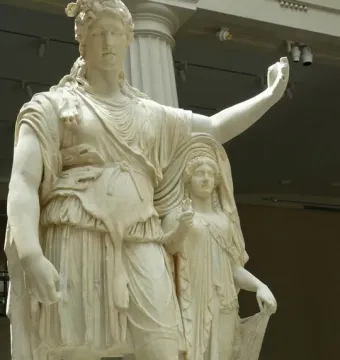
June 2007 © Mary Harrsch · CC BY 2.0
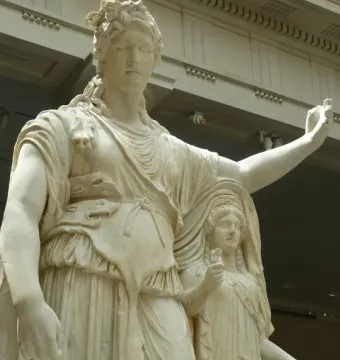
June 2007 © Mary Harrsch · CC BY 2.0
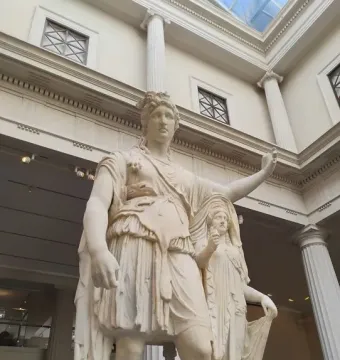
October 2025 © Ferfive · CC BY 4.0
Identification | |
| Title | Hope Dionysus |
| Alternative name | Dionysus Hope; Dionysus leaning on a female figure |
| Type | Roman marble statue |
Historical context | |
| Date | Between 27 BC and AD 68 |
| Style | Neo-Attic or archaizing pose |
| Original model | Believed to copy a 4th-century BC Greek bronze original |
Creator | |
| Restorer | Vincenzo Pacetti |
Discovery and provenance | |
| Former owner | Thomas Hope or Henry Philip Hope |
| Previous owner | Francis Howard, a descendant of Benjamin Franklin |
| Purchased from | Vincenzo Pacetti |
| Named after | Thomas Hope |
Location and ownership | |
| Current location | Metropolitan Museum of Art, New York |
| Acquisition date | 1990 |
Physical characteristics | |
| Height | 82 in. (2.1 m) |
| Depicted figure | Dionysus |
| Secondary figure | A small female figure used as support; possibly Elpis/Spes or a herm-like statue |
| Pose | Dionysus leans on the small female figure and extends his restored left arm over it |
| Left arm condition | Restored |
| Clothing | Panther skin (pardalide) over a short chiton and under an himation |
| Footwear | High sandals with animal heads on the projecting leather flaps |
Iconography and meaning | |
| Subject | Dionysus, Greek god of wine and liberation of the senses |
Other | |
| Original presence of secondary figure | Unclear whether the female figure was present in the original Greek version |
| Function of secondary figure | Possibly added in Roman times to support the outstretched arm |