
Poseidon of Melos
Poseidon of Melos is a large statue of the sea god in the National Archaeological Museum, Athens (inv. no. 235). It is dated to the last quarter of the 2nd century BCE and was found on the island of Melos in 1877. Carved from Parian marble, the over-life-size figure stands 2.35 m tall and was reassembled from several pieces. Modern restorations include parts of the left foot and the himation, while parts of the nose, beard, and hair are missing. Poseidon is shown largely nude, with a himation wrapped around the hips and legs, holding it at his left side, and raising his right arm as if once holding a trident. A dolphin on the rear right side serves as a support.
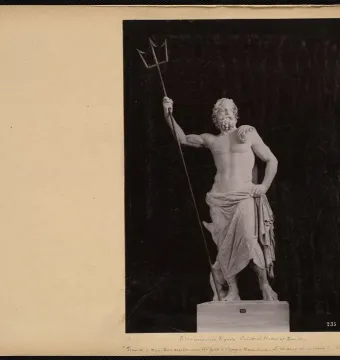
© Boston Public Library · Public domain
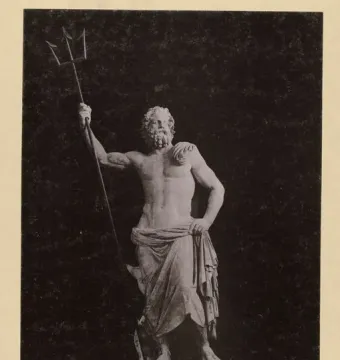
© Rijksmuseum · CC0
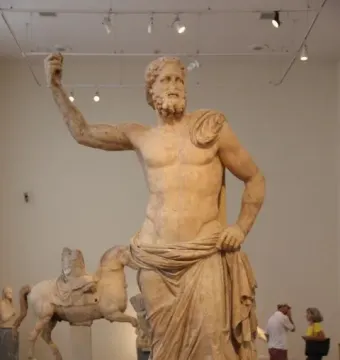
July 2016 © Gary Todd · CC0
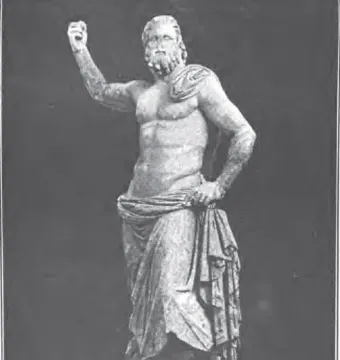
1893 © Diomedes, Paulos · Public domain
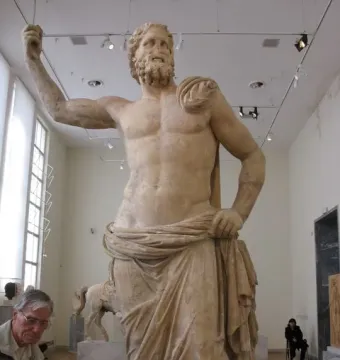
March 2009 © Tilemahos Efthimiadis · CC BY 2.0
Identification | |
| Title | Poseidon of Melos |
| Object type | Statue |
| Subject | Poseidon, god of the sea |
Historical context | |
| Date | Last quarter of the 2nd century BC |
| Period | Hellenistic period |
| Stylistic and historical context | Shows the influence of Classical sculpture on the eve of the Hellenistic period |
Creator | |
| Attribution | The creator is not known with certainty |
Discovery and provenance | |
| Discovery date | 1877 |
| Discovery location | Milos |
| Associated find | Anfitrite, described as Poseidon's lover, was discovered with the sculpture |
Location and ownership | |
| Current location | National Archaeological Museum, Athens |
| Inventory number | 235 |
Physical characteristics | |
| Restored parts | Parts of the left foot and the himation are modern additions |
| Missing parts | Parts of the nose, beard, and hair are missing |
| Condition at discovery | Found broken into several pieces and later reassembled |
| Scale | Over life-size |
| Height | 2.35 m |
Materials | |
| Material | Parian marble |
Appearance | |
| Depiction | Semi-nude, with the lower body covered by a himation |
| Pose | Standing in a majestic pose with the right arm raised, probably to hold a trident |
| Left hand | Holds the himation at the left side of the pelvis |
| Drapery | The himation is wrapped around the hips, covering much of the legs and the genitals, and partly covering the back; a fold of cloth lies over the left shoulder |
| Body position | The right leg bears the weight and the left leg is free |
| Support | A dolphin on the rear right side serves as a statue support |
| Head position | Slightly turned to the left and looking into the distance |
| Anatomical treatment | The musculature of the arms and body is finely rendered |
Iconography and meaning | |
| Attribute | Trident, probably originally held in the raised right hand and now lost |
| Pose type | A standard pose for Zeus, Poseidon, and Hades |
History and restoration | |
| Commissioning and use | Probably commissioned by high-ranking members of Athenian society for display in public temples, palaces, or academies |