
Battersea Shield
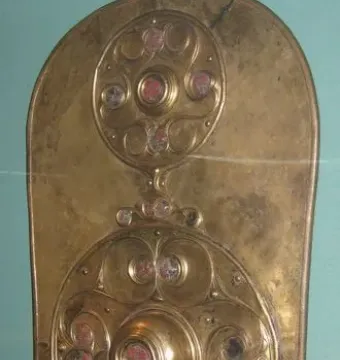
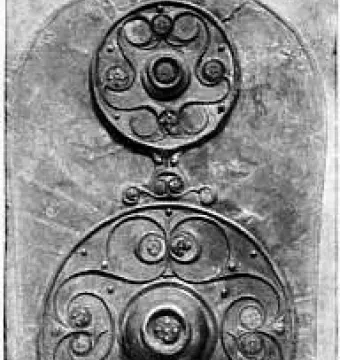
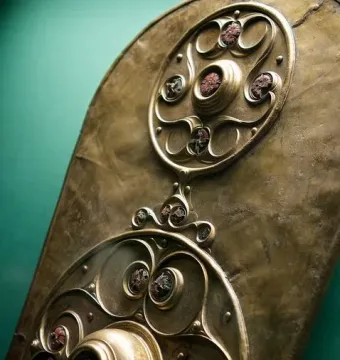
The Battersea Shield is a Celtic ceremonial shield made of bronze and found in the Thames in 1857. It is now on display at the British Museum, in room 50. Probably the best-known Iron Age object from Britain, it takes its name from the place where it was discovered, near the suspended bridge now known as Chelsea Bridge. The shield was not intended for combat, but for display, ceremony, or votive offering, possibly to a water or underworld deity. Its date is debated, with suggestions ranging from 350 to 50 BC, and some scholars extending it into the first half of the 1st century AD.
· CC0
November 2012 © Encyclopædia Britannica, 1911 · Public domain
June 2013 © Paul Hudson · CC BY 2.0
October 2010 © Jorge Royan · CC BY-SA 3.0
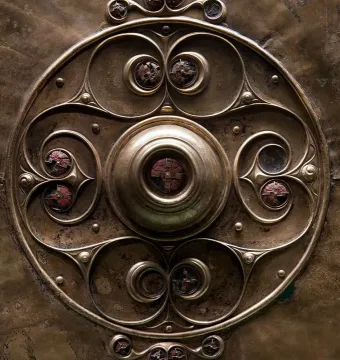
January 2005 © Jorge Royan · CC BY-SA 4.0
Identification | |
| Title | Battersea Shield |
| Type | Celtic shield plate |
Historical context | |
| Site interpretation | The area has been linked by some historians to Julius Caesar’s crossing of the Thames in 54 BC |
| Associated finds at discovery site | Other Roman and Celtic weapons, skeletons, the Waterloo Helmet, and the Battersea Cauldron were found in the same river area |
| Date of manufacture | Probably 1st century BC to early 1st century AD; some museum displays date it to 350–50 BC, and some authors have proposed as early as the 3rd century BC |
| Culture | Iron Age Britain |
Discovery and provenance | |
| Discovery date | 1857 |
| Discovery location | River Thames at Battersea, London, probably near Chelsea Bridge |
| Discovery context | Found during dredging/construction work for the predecessor of Chelsea Bridge |
| Named after | Battersea, the place where it was found |
Creator | |
| Attribution | Insular Celtic art; no specific maker known |
Materials | |
| Main material | Bronze |
| Composition | Copper-tin-lead alloy, about 85% copper, 10% tin, and 5% lead |
| Other materials | Original wooden or leather backing, now lost |
| Inlays | Opaque red vitreous enamel/paste, likely Mediterranean in origin |
Technique | |
| Manufacture | Repoussé, relief, punchwork, engraving, and enamel work |
| Construction | Made in multiple bronze sheets and decorated panels joined by rivets concealed beneath overlapping edges and washers; enclosed by a peripheral band |
Physical characteristics | |
| Condition | No battle damage; the bronze sheet is too thin to have been effective in combat |
| Surviving part | Only the external bronze sheet survives; the original wooden support has decayed |
| Dimensions | 77.7 cm high; 35.7 cm wide at the wider points; 34.1 cm wide at the waist |
| Form | Waisted, elongated shield shape with rounded edges and curved sides |
| Weight | 3.4 kg (surviving remains only) |
Appearance | |
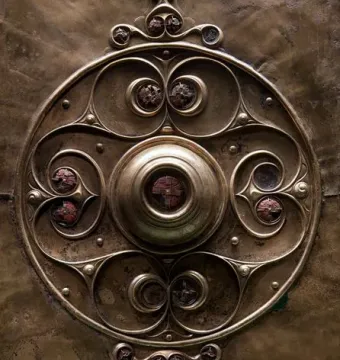
| Decoration | Three symmetrically arranged rosettes/discs, circular and spiral motifs, palmettes, interlaced S-shapes, and red enamel inserts |
| Motif arrangement | Highly symmetrical geometric design with anthropomorphic allusions |
| Central feature | A prominent central boss/umbo at the center of the largest rosette, with the largest enamel insert on it |
| Surface treatment | The surface does not appear to have been gilded |
| Style | La Tène style, though unusually peculiar and not closely comparable to other insular Iron Age objects |
| Enamel details | 26 or 27 red enamel inlays in multiple sizes; the enamel is set in roughened cavities with raised swastika-like griffe or compartments |
| Interpretation of motifs | Some scholars read faces, good-luck symbolism, and solar associations into the design; the swastika-like form was known in antiquity as the whirling sun |
Location and ownership | |
| Museum accession number | 1857,0715.1 |
| Current location | British Museum, Room 50, London |
History and restoration | |
| Debated function | Probably a ceremonial, votive, or prestige object rather than a fighting shield; possible uses include a gala/parade piece or ritual offering to an aquatic or chthonic deity |
| Deposition interpretation | Possibly deliberately cast into the River Thames as a votive offering |
| Dating interpretation | Some interpretations place it slightly before or at the time of the Roman conquest of Britain; the red enamel has been cited as evidence for a late date |
| Scholarly study | A careful 1980 study disassembled and reassembled the shield, but reached no definitive conclusion |
Significance | |
| Artistic significance | One of the most important and famous Celtic artworks from Britain; highly representative of Celtic art |
| Uniqueness | Nearly without parallels in the insular Iron Age |
Other | |
| Related cultural reception | Thought in popular imagination to be the typical shield of the ancient Britons |
| Modern reference | Inspired a 2004 EP by The Orb and Meat Beat Manifesto, released in an embossed tin based on the shield's design |