
Desolation
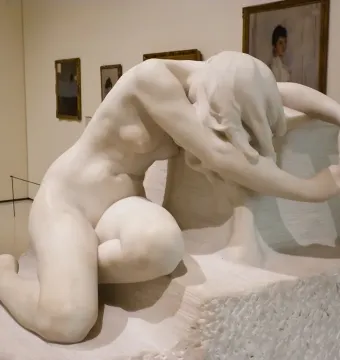
Desolation is a sculpture by Josep Llimona, one of the leading figures of Catalan modernism. The first version, made of plaster in 1903, entered the permanent collection of the National Art Museum of Catalonia thanks to a donation by Domènec Sanllehy, then mayor of Barcelona, in 1909. The work became a paradigmatic example of modernist sculpture, admired for the perfect anatomy of the female body and its melancholic, chaste attitude, which links it to symbolism. A larger marble replica was made in 1917 for the oval pond in Barcelona’s Parc de la Ciutadella. The original replica is now kept in the Catalan Parliament, while copies stand in its place and in other collections.
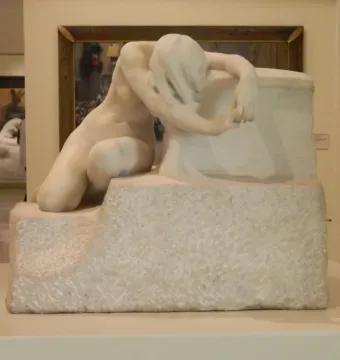
June 2012 © Silverfin75 · CC BY-SA 3.0
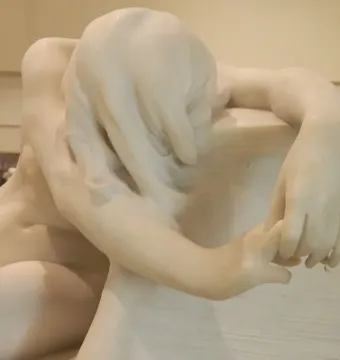
June 2012 © Silverfin75 · CC BY-SA 3.0
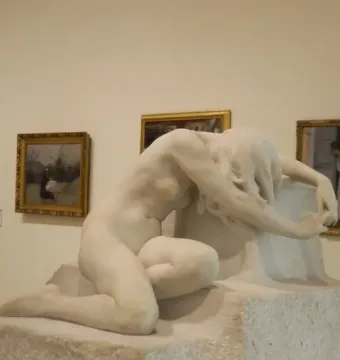
June 2012 © Silverfin75 · CC BY-SA 3.0
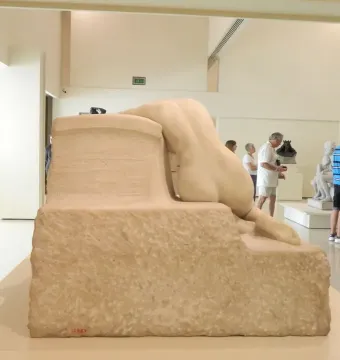
June 2012 © Silverfin75 · CC BY-SA 3.0
July 2011 © Turol Jones, un artista de cojones · CC BY 2.0
Identification | |
| Title | Desolation |
| Spanish title | Desconsuelo |
| French title | Chagrin |
| Type | Sculpture |
| Original title | Desconsol |
Creator | |
| Artist | Josep Llimona |
Historical context | |
| Art movement | Catalan Modernism |
| Stylistic association | Symbolism |
| First version date | 1903; probably made in gypsum/plaster, not preserved |
| First public presentation | 1907, at the V International Exhibition of Fine Arts and Artistic Industries of Barcelona (also described as the International Exhibition of Fine Arts of Barcelona) |
| Award | Honor prize / gold medal at the 1907 Barcelona exhibition |
Discovery and provenance | |
| Acquisition | Bought by Domènec Sanllehy, then mayor of Barcelona, and donated in 1909 to the Municipal Museum of Barcelona, later incorporated into the National Art Museum of Catalonia |
| Donation | Donated in 1909 by Domènec Sanllehy |
Location and ownership | |
| Copy locations | Museo del Prado, Madrid; museum in Sitges (two replicas, one plaster and one marble); Museum of Catalan Modernism, Barcelona; Streep collection, Barcelona; municipal museum of Viña del Mar, Chile; Captaincy General of Catalonia; Kelleher Rose Garden, Back Bay Fens, Boston; courtyard of the painter's house-museum in Palma |
| Heritage status | Listed as a Local Cultural Asset (BCIL) in the Inventory of Catalan Cultural Heritage, code 08019/527 |
| Boston copy | A copy was donated to Boston in 1984 and presented in 1986 |
| Replacement at original site | A copy was installed in its place |
| Original location | Parc de la Ciutadella, Barcelona |
| Current location | National Art Museum of Catalonia (MNAC), Barcelona, Spain |
| Relocated to | Inside the Parliament of Catalonia in 1984, for preservation after damage caused by pollution |
Physical characteristics | |
| Replica size | Replicas described as slightly smaller, slightly larger, or much larger than the original, depending on the version |
| Subject | A nude female figure, or a woman hiding her face in despair |
| Pose | Leaning against a block with her head lowered and face concealed by hair or a veil of hair |
| Expression | Melancholic, chaste, resigned, and despairing; the emotional effect is hermetic and mysterious |
| Anatomy | The female anatomy is rendered with notable perfection |
| Formal features | Hidden gaze, closed body composition, curved contours, undulating lines, softened contours, and hands resting on the stone |
| Measurements | 67 × 76 × 67 cm |
Materials | |
| Primary material | Marble; the earlier first version was in gypsum/plaster |
Technique | |
| Technique | Sculpted from a single block of marble, with the base left roughly carved |
History and restoration | |
| Replica history | Multiple replicas were made during Llimona's lifetime and later; versions include marble, bronze, plaster, and stone, with some made for funerary monuments and others for public display |
| 1917 replica | In 1917, Llimona made a larger marble replica for the oval basin in Forestier's garden design at Ciutadella Park; the original later moved from the Museum of Modern Art in the Parliament of Catalonia to MNAC storage, and pollution damage led to a replacement copy made in 1982 and installed in 1984 |
| Bronze replica | A bronze replica with a marble pedestal was exhibited in 1934 at the Parés Salon as part of an exhibition honoring Josep Llimona |
| Stone replica | A stone variation, with the female figure clothed, forms part of the funerary monument to Mercedes Casas de Vilanova in the Southeast Cemetery in Barcelona |
Significance | |
| Significance | A paradigmatic work of Catalan Modernist sculpture, especially after the lifting of the Circle of Sant Lluc's ban on nude figures |
| Context | Associated with the Artistic Circle of Sant Lluc, a conservative Catholic artists' group founded by Josep Llimona and his brother Joan; the work reflects the shift in modernist sculpture toward expressing feeling over beauty |
| Influence | Shows the influence of Auguste Rodin, especially Danaid, while being noted as more melancholy and chaste |
| Interpretation | Its formal and emotional treatment is seen as a Symbolist expression of inner emotion and desolation |