
Kyffhäuser Monument
The Kyffhäuser Monument is a memorial to German Emperor Wilhelm I, located in the Kyffhäuser mountain range in Thuringia, Germany. It was built between 1890 and 1896 among the ruins of the medieval Kyffhausen Castle near Bad Frankenhausen. Designed by architect Bruno Schmitz, it is the third-largest monument in Germany. Schmitz also designed the Monument to the Battle of the Nations in Leipzig and the Emperor William Monument in Porta Westfalica. The monument reaches a total height of 81 m and stands on a rocky summit in the eastern ridge of the Kyffhäuser, at an elevation of 420 m.
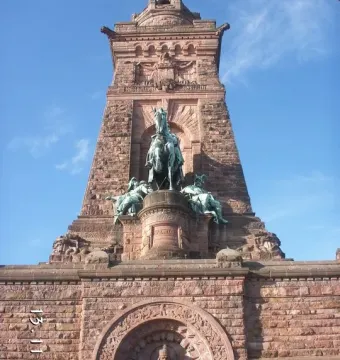
November 2011 © V.pieps · CC BY-SA 3.0
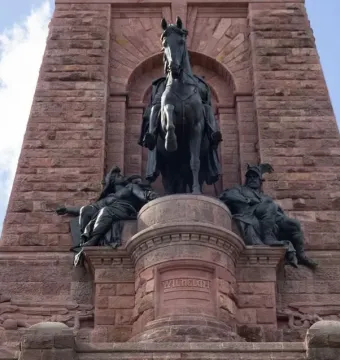
September 2017 © Clemensfranz · CC BY-SA 4.0
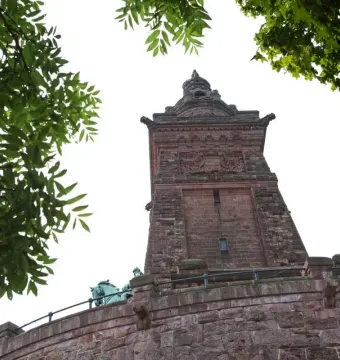
August 2009 © Andreas Vogel · CC BY-SA 3.0
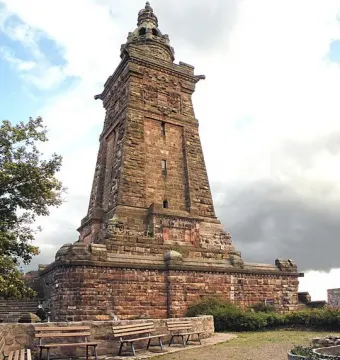
© Vitold Muratov · CC BY-SA 4.0
August 1969 © Jörg Blobelt · CC BY-SA 4.0
Identification | |
| Title | Kyffhäuser Monument |
| Alternative names | Barbarossa Monument; Barbarossadenkmal; Kaiser-Wilhelm-Denkmal auf dem Kyffhäuser; Kyffhäuserdenkmal |
| Type | Monument |
| Subject | Emperor William I |
Historical context | |
| Historical period | Wilhelmine era |
| Construction dates | 1890–1896 |
| Dedication | In honor of Emperor William I and associated with the Wilhelmine era |
| Historical setting | Built among the ruins of the medieval Kyffhausen Castle |
| Monument proposal by | Deutscher Kriegerbund (German Warriors' League), renamed Kyffhäuserbund in 1900 |
Creator | |
| Architect / designer | Bruno Schmitz (1858–1916) |
| Other works by Bruno Schmitz | Battle of the Nations Monument in Leipzig; Kaiser Wilhelm Monument at Porta Westfalica |
| Sculptors | Nikolaus Geiger; Emil Hundrieser |
Location and ownership | |
| Visibility | Visible from nearby valleys and from mountain ranges many kilometers away |
| Visitor status | Popular excursion destination for local residents and tourists |
| Museum exhibition | Museum exhibition located behind the monument in the remains of the imperial castle |
| Site features | Built into the remains of the upper and lower castle; includes a deep castle well, fortress walls, old gate remains, and a castle museum |
| Included in | Road of Monuments (since 2008) |
| Location | Kyffhäuser mountain range, Thuringia, Germany |
| Specific site | On the ruins of the medieval Kyffhausen Castle, near Bad Frankenhausen, in the municipality of Kyffhäuserland/Steinthaleben, Kyffhäuserkreis |
| Nearby places | Bad Frankenhausen; Tilleda; Kelbra |
| Terrain setting | On the summit of a rock ridge on the eastern ridge of the Kyffhäuser, overlooking the Golden Aue plain |
Physical characteristics | |
| Tower height | 57 m |
| Barbarossa figure height | 6.5 m |
| Wilhelm I equestrian statue height | 11 m |
| Group height | Almost 11 m |
| Group weight | About 16 tonnes |
| Elevation of site | 420 m above sea level |
| Castle summit elevation | 439 m above sea level |
| Stairway | 247 steps |
| Total height | 81 m |
Materials | |
| Wilhelm I equestrian statue material | Bronze with 2–3 mm copper sheathing |
| Main building material | Local Upper Carboniferous red Kyffhäuser sandstone |
| Barbarossa figure material | Sandstone; carved on site from several solid sandstone blocks |
| Hindenburg monument material | Bavarian porphyry |
Technique | |
| Style | Monumental style; Neo-Baroque |
| Architectural treatment | Massive stone construction with rough-hewn stones resembling Hohenstaufen ashlar masonry |
Appearance | |
| Main composition | A tower crowned with an imperial crown, with a sandstone statue of Frederick Barbarossa below and a bronze equestrian statue of Wilhelm I above |
| Barbarossa depiction | Frederick Barbarossa is shown awakening, with one hand on his beard; one eye is covered, giving him an Odin-like appearance |
| Crowning feature | Imperial crown |
| Accompanying figures | A Mars figure, a Minerva figure, a German warrior, and a woman with a quill and an oak-leaf wreath |
| Wilhelm I depiction | Wilhelm I is shown as a general on horseback, wearing a Pickelhaube and the Grand Cross of the Iron Cross |
Iconography and meaning | |
| Barbarossa legend | Barbarossa is expected to awaken and rise again when Germany needs his guidance |
| Monument theme | Wilhelm I is presented as completing the German national unification long desired since the time of Barbarossa |
| Political interpretation | Expresses imperial nation-building, integration of non-Prussian populations, and imperial ambitions at internal, European, and global levels |
| Symbolic meaning | Presents the German Empire as the legitimate successor to the medieval Holy Roman Empire; also symbolizes national decline and rebirth |
Significance | |
| Notability | One of the best-known Kaiser Wilhelm monuments and a major sight in Thuringia |
| Rank in Germany | Third-largest monument in Germany |
History and restoration | |
| Inauguration date | 18 June 1896 |
| Caretaking organization since 1900 | Kyffhäuserbund / Kyffhäuser Association |
| Restoration period | 1994–2014 |
| Restoration cost | 14 million euros |
| Postwar demolition demand | Local communists from Bad Frankenhausen demanded that the Kaiser Wilhelm monument be blown up |
| Response to demolition demand | Soviet cultural officers rejected the demand |
| Hindenburg monument | A Paul von Hindenburg figure was installed on 6 May 1939, thrown down and buried in 1945, and partially excavated in 2004; its future remains undecided |