
General Philip Sheridan
General Philip Sheridan is a bronze sculpture honoring Union General Philip Henry Sheridan. Created by artist Gutzon Borglum, who is best known for designing Mount Rushmore, the monument was officially dedicated in 1908. The equestrian statue stands in the center of Sheridan Circle in the Sheridan-Kalorama neighborhood of Washington, D.C., surrounded by a plaza and public park. It is one of eighteen Civil War monuments in the federal capital that were collectively added to the National Register of Historic Places in 1978. The sculpture and the surrounding park are owned and managed by the National Park Service.
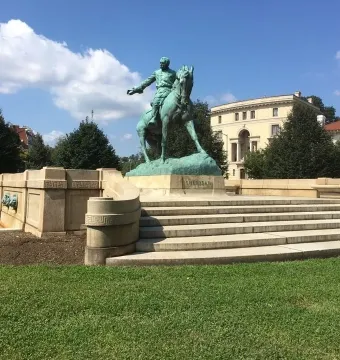
© NPS Photo · Public domain
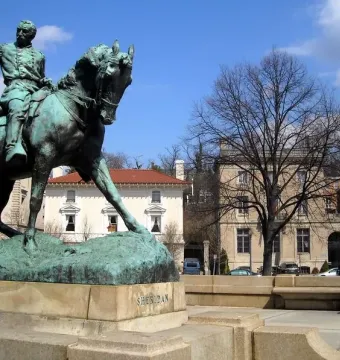
March 2009 © AgnosticPreachersKid · Public domain
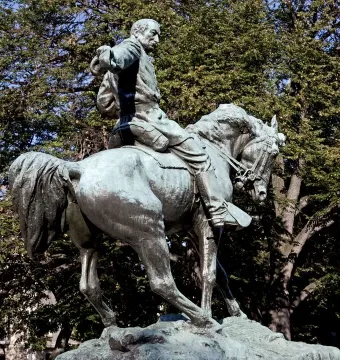
© Carol M. Highsmith · Public domain
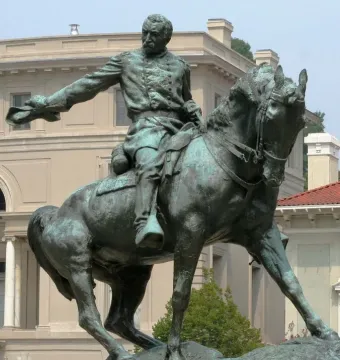
August 2006 © David (dbking) · Public domain
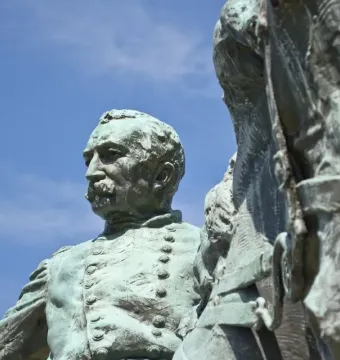
September 2013 © Tim Evanson · CC BY-SA 2.0
Identification | |
| Title | General Philip Sheridan |
| Subject | General Philip Sheridan, a career United States Army officer and Union general |
| Type | Bronze equestrian sculpture |
Creator | |
| Artist | Gutzon Borglum |
| Artist note | Best known for designing Mount Rushmore |
Historical context | |
| Dedication attendees | President Theodore Roosevelt, members of the President's cabinet, high-ranking military officers, and veterans of the Civil War and the Spanish-American War |
| Associated poem recited | Sheridan's Ride by Thomas Buchanan Read |
| Eulogies delivered by | Theodore Roosevelt, Brigadier General Horace Porter, and Luke E. Wright |
| Dedication music | United States Marine Band |
| Dedication procession leader | Brigadier General J. Franklin Bell |
| Dedication presider | Secretary of War Luke E. Wright |
| Invocation delivered by | Denis J. O'Connell, rector of The Catholic University of America |
| Dedication date | November 25, 1908 |
| Borglum contract date | July 2, 1907 |
| Later sculptor | Gutzon Borglum |
| Commission authorization | March 2, 1889, by Congress |
| Original sculptor chosen | John Quincy Adams Ward |
| Original appropriation | $50,000 for construction |
| Design approval date | January 17, 1908 |
Discovery and provenance | |
| Site associated with Irene Sheridan | 2211 Massachusetts Avenue NW, now offices of the Embassy of Greece |
| Model used for Sheridan figure | Philip Sheridan Jr., who closely resembled his father |
| Irene Sheridan's role | Approved the design and chose the memorial site |
| Approval authorities | The Sheridan memorial commission, including Secretary of War William Howard Taft, General Henry C. Corbin, and Brigadier General Michael V. Sheridan |
History and restoration | |
| Ward's rejected model | His final model was rejected by Irene Sheridan and Philip Sheridan Jr.; the commission cancelled Ward's contract in 1905 |
| Ward's early submitted sketch | Submitted in 1892, but not approved |
| Ward's progress by 1903 | Had only completed a life-size study of Sheridan's head |
| Ward's later model | Completed in 1916 and placed in front of the New York State Capitol |
Physical characteristics | |
| Fountain function | Water formerly flowed from the spouts into square basins, but the feature no longer works |
| Plaza features | Five steps at the front and rear, curved benches along the interior, and two pairs of lion-headed fountain spouts on the exterior |
| Appearance | Mustache and wavy hair |
| Plaza and setting | The sculpture is surrounded by a plaza and public park |
| Base | Rectangular granite |
| Horse depicted | Rienzi, later renamed Winchester by Sheridan |
| Clothing | Military uniform with a long coat cinched at the waist |
| Sheridan pose | Mounted on horseback, turned to his right with his right arm extended behind him |
| Horse pose | Slightly rearing while standing on a rocky surface |
| Depicted scene | Sheridan rallying his troops during the Battle of Cedar Creek on October 19, 1864 |
| Form | Equestrian statue |
| Objects held | Sheridan holds his hat in his right hand and the horse's reins in his left |
Materials | |
| Material | Bronze |
| Base material | Granite |
| Stone supplier | Mohegan Granite Company of New York |
| Stone setter | Malnati Stone Company of Washington, D.C. |
Technique | |
| Base and site designer | Architect Henry Winslow |
Location and ownership | |
| Management | National Park Service, a federal agency of the U.S. Department of the Interior |
| Historic register status | One of eighteen Civil War monuments in Washington, D.C. collectively listed on the National Register of Historic Places in 1978; listed individually on September 20, 1978; added to the District of Columbia Inventory of Historic Sites on March 3, 1979; contributing property to the Massachusetts Avenue Historic District (1974) and the Sheridan-Kalorama Historic District (1989) |
| Area | Embassy Row |
| Ownership | National Park Service |
| Location | Center of Sheridan Circle, at the intersection of 23rd Street, R Street, and Massachusetts Avenue NW, Sheridan-Kalorama neighborhood, Washington, D.C., United States |
Significance | |
| Commemoration | Memorial to Sheridan |
| Borglum's notable work | Mount Rushmore and Stone Mountain |
| Borglum's influence | Auguste Rodin |
| Borglum's Washington works | Rabboni in Rock Creek Cemetery and several statues in the National Statuary Hall Collection in the U.S. Capitol |
| Historical context | One of many Union generals commemorated with statues in Washington, D.C. |
| Family reception | Irene Sheridan, Philip Sheridan Jr., and Sheridan's three daughters loved the finished work |
Other | |
| Sheridan's objection to horse portrayal | He reportedly told his wife not to put him on a horse like the one in another cavalry statue |
| Irene Sheridan's horse preference | She insisted the horse be as proud and courageous as its rider |
| Rejected Ward model description | Sheridan as a stout senior officer on a horse with stilts |