
Samson Slaying a Philistine
Samson Slaying a Philistine is a marble sculptural group by Giambologna, made around 1562 for Francis I de’ Medici. Carved from a single block of marble in the artist’s Florentine workshop, it shows Samson in a dynamic struggle with a Philistine in a spiral composition that invites viewing from multiple angles. The work, about 210 cm high, was originally intended for a fountain in Florence and is notable for its dramatic movement, contrapposto, and polished surface. It was later sent to Spain, then given to the future Charles I in 1623, and eventually entered the Victoria and Albert Museum in London in 1954 (A.7-1954).
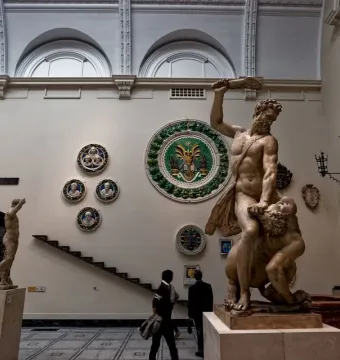
September 2010 © Txllxt TxllxT · CC BY-SA 4.0
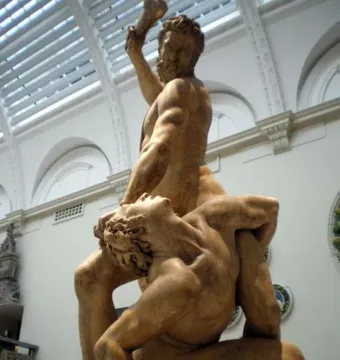
© art_traveller · CC BY-SA 2.0 uk
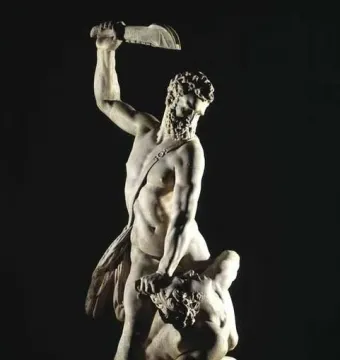
© VAwebteam · CC BY-SA 3.0
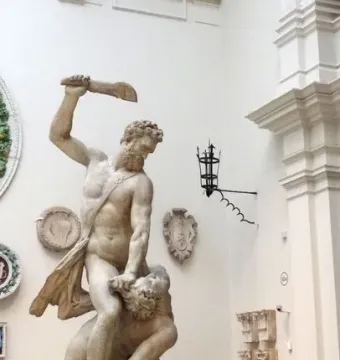
July 2015 © Stephen Gidley · CC BY 2.0
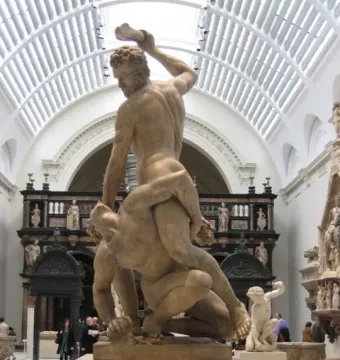
© Alison Bean · Public domain
Identification | |
| Title | Samson Slaying a Philistine |
| Type | Marble sculptural group |
| Style | Mannerism |
| Date | c. 1562 |
| Original title | Sansone che uccide un filisteo |
Creator | |
| Artist | Giambologna (1529–1608) |
| Patron | Francesco I de' Medici |
Historical context | |
| Workshop location | Giambologna's workshop in Florence |
| Subject | Samson fighting and killing a Philistine with the jawbone of a donkey |
| Biblical source | Judges 15:14–19 in the Old Testament |
| Place of creation | Florence |
| Original intended location | A fountain in Florence, possibly the Villa di Castello or the area in front of the Palazzo Vecchio |
| Commission context | Commissioned around 1562 for a fountain in Florence |
Physical characteristics | |
| Height | 210 cm |
| Weight | 1160 kg |
| Surface finish | Smoothly polished marble surface |
| Anatomical treatment | Detailed musculature and anatomy |
Materials | |
| Material | Marble, carved from a single block |
Technique | |
| Composition | Spiral, all-round composition designed to be viewed from multiple angles |
| Technique | Use of contrapposto and figura serpentinata to create three-dimensionality and naturalism |
Appearance | |
| Action depicted | Samson strikes with the jawbone of a donkey to deliver the fatal blow |
| Visual effect | Very dynamic, with twisting bodies and a strong sense of movement and energy |
| Depicted figures | Samson dominating a kneeling Philistine |
| Expression of Samson | Angry, focused, and determined |
| Expression of the Philistine | In pain, desperation, fear, and terror |
Iconography and meaning | |
| Interpretation | A dramatic struggle scene emphasizing Samson's strength and the Philistine's helplessness; also read as a metaphor for political dominance |
| Symbolic meaning | Samson represents righteous power, while the Philistine represents chaos |
Location and ownership | |
| Gift to Spain | Given in 1601 by Ferdinando I de' Medici to the Duke of Lerma |
| Later location in England | York House, London; later Hovingham Hall, Yorkshire |
| Subsequent ownership | After arriving in England, it passed to the Duke of Buckingham and then changed hands three more times |
| Gift to the Prince of Wales | In 1623, Philip IV of Spain gave it to the Prince of Wales, later Charles I of England, during his visit to Spain for marriage negotiations |
| Provenance | Sent as a gift to Spain, where it was placed in the gardens of the Palacio de la Ribera in Valladolid |
| Acquisition year | 1954 |
| Museum inventory number | A.7-1954 |
| Current location | Victoria and Albert Museum, London |
History and restoration | |
| Condition history | Exposed to the weather for about three centuries, but the original fineness is still preserved |
| Inscription | On the front of Samson's belt is an inscription reading "IO ... BELGAE ...." |
Significance | |
| Historical significance | One of Giambologna's earliest monumental works and first works to gain wide acclaim; considered a major work of Mannerism |
| Reception | Often copied, influential in Renaissance and later art, and highly admired in England |
| Influence | Its expressiveness influenced later Baroque artists such as Bernini |
| Uniqueness note | The only significant work by Giambologna to have left Italy |