
Togatus Barberini
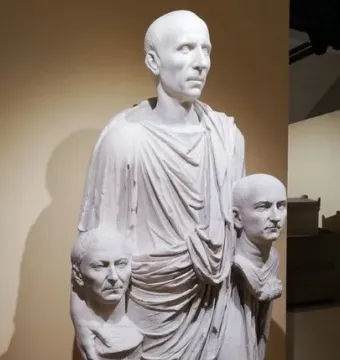
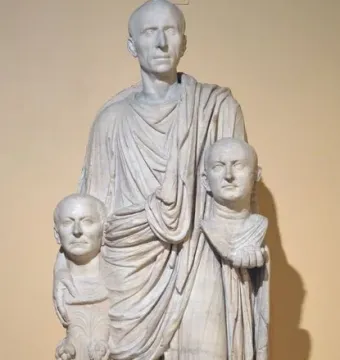
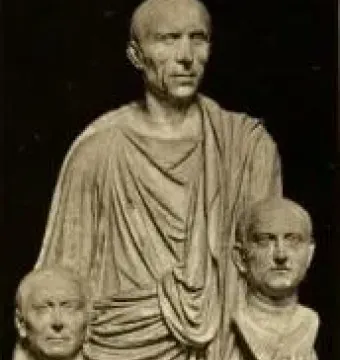
Togatus Barberini is a Roman marble sculpture dating to the 1st century BC. It depicts a Roman patrician in a toga, shown full-length while holding the busts of his deceased ancestors in his hands. Very little is known about the sculpture, including the identity of the figure it represents. It is thought to reflect a Roman custom of sculpting busts and death masks of the deceased, especially the illustrious ancestors of patrician families. The work also suggests the pride and history of the family behind it. The sculpture is now in the Centrale Montemartini.
© Carlo Dell'Orto · CC BY-SA 4.0
© Carole Raddato · CC BY-SA 2.0
· Public domain
Identification | |
| Title | Togatus Barberini |
| Type | Roman togatus statue |
Historical context | |
| Date | 1st century BC to early Imperial period, probably around the time of Augustus |
| Historical context | Preserves Republican portrait traditions in an early Imperial context |
Creator | |
| Creator | Unknown |
Discovery and provenance | |
| Nickname origin | Named Barberini because it was once part of the Barberini collection |
| Former location | Capitoline Museums |
| Current collection history | The head was later combined with the torso while the figure was in the Barberini collection |
Location and ownership | |
| Inventory number | Inv. I.56 |
| Current location | Centrale Montemartini, Rome, Italy |
Physical characteristics | |
| Pose | Full-length figure |
| Clothing | Wearing a toga over a tunic |
| Attributes held | Two ancestral portrait busts or masks, one in each hand |
| Drapery arrangement | The toga forms three groups of rounded folds at the chest, knees, and lower edge |
| Subject | An unknown Roman patrician or senator |
Materials | |
| Material | Marble |
| Head material | White marble |
| Body material | Yellow marble |
Technique | |
| Portrait bust support | One bust is supported by a palm trunk base |
| Head-body relation | The head and torso were made separately and are not original to each other |
| Material analysis | Analyses indicate the head and body are not part of the same sculpture |
History and restoration | |
| Restoration | The nose, ears, and rear edge of the toga were restored later |
| Head restoration dispute | Some scholars think the head was added in a 17th-century restoration, but this is disputed |
| Alternative fabrication hypothesis | Another possibility is that the torso and head were separately commissioned and assembled in antiquity |
Iconography and meaning | |
| Depicted subject | A Roman man holding ancestral portraits |
| Iconography | Depicts a toga-clad elite Roman figure with ancestral busts or masks, emphasizing noble lineage and high status |
| Interpretation | Usually read as a reference to the Roman custom of preserving ancestral death masks or busts in elite families |
| Social meaning | The ancestral masks symbolize family antiquity, honor, and status |
| Toga symbolism | The toga is a symbol of Roman citizenship |
| Iconographic significance | A rare example of this iconography |
| Possible identity | Suggested identifications include Brutus, Julius Caesar, a sculptor, a Julio-Claudian, or an unnamed Roman senator or patrician |
| Right bust identification | The right-hand bust is thought to represent a high-ranking military man, possibly a general |
| Ancestral portrait dating | The left bust is usually dated to c. 20–15 BC and the right bust to c. 50–40 BC |
| Stylistic character | The ancestral heads reflect Republican portrait traditions, with the right-hand head rendered more naturalistically |
Significance | |
| Interpretive significance | Evidence for the cult of ancestors and the tradition of preserving masks |
| Cultural significance | Expresses family pride and the importance of lineage |