
Venus Tauride
Venus Tauride, also called the Venus of Tauris, is a 1.67 m high sculpture of Aphrodite now housed in the Hermitage Museum. Named after the Tauride Palace in St Petersburg, where it was kept from the late eighteenth century to the mid-nineteenth, it shows the goddess rising from her bath beside a column with drapery. The sculpture lost both arms in antiquity, and her nose has been restored, but it is otherwise complete, including an ancient hairstyle and an ankle bracelet on her left ankle. Long thought to be a Roman copy, it is now considered a Greek original from the 3rd or 2nd century BC.
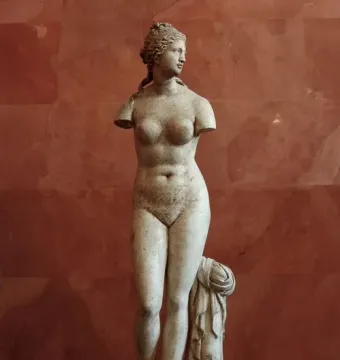
August 2006 © Sergey Sosnovskiy · CC BY-SA 2.0
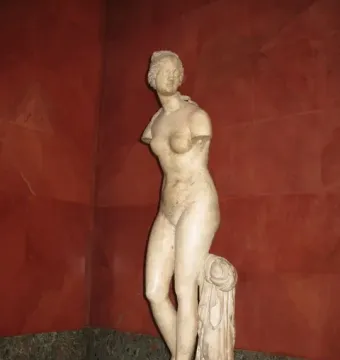
August 2008 © Yair Haklai · CC BY-SA 3.0
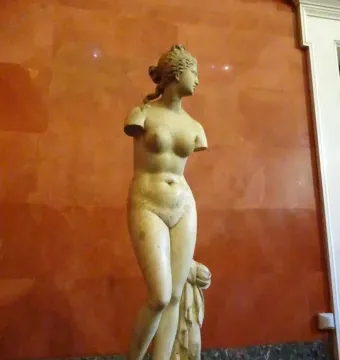
August 2016 © Fotodar · CC BY-SA 4.0
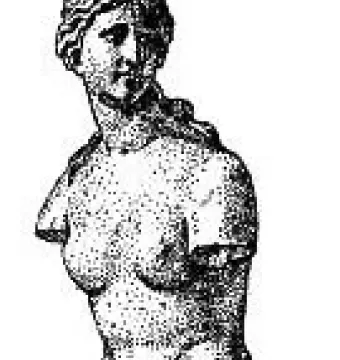
1927 © Unknown authorUnknown author · Public domain
Identification | |
| Title | Venus Tauride |
| Russian title | Венера Таврическая |
| Type | marble statue |
| Subject | Aphrodite (Venus) |
| Sculptural type | Venus Pudica |
| Alternative name | Venus of Tauris |
Historical context | |
| Date | 3rd or 2nd century BC; disputed, with some researchers proposing a Roman or Roman-era copy as late as the 2nd century AD |
| Dating basis | Mannerist proportions suggesting the work is secondary |
Creator | |
| Artist | Unknown sculptor |
| Related original | Possibly based on the Aphrodite of Knidos, especially the Capitoline Venus type; original by Praxiteles, dated 350–330 BC |
| Relationship to model | Inspired by the model but does not follow it strictly |
Discovery and provenance | |
| Initial attempted transfer | A peasant had offered it to the Czar's agent |
| Arrival in Russia | 1720 |
| Exchange context | The Russians had just conquered it |
| Exchange location | Revel (today Tallinn) |
| Papal decision | Pope Clement XI initially vetoed the exportation, then agreed after the proposed exchange involving the relics of Saint Bridget of Sweden |
| Historical significance in Russia | The first classical sculpture seen in Russia; the first ancient female statue in Russia; it marked the beginning of the imperial collection of ancient sculpture |
| Acquisition | Ceded by Pope Clement XI to Peter I in Rome in 1718 after protracted diplomatic negotiations; according to another version, it was presented to Peter I as thanks for allowing Catholic missionaries to travel to China through Russian territory |
| Former collection | Collection of Cardinal Alessandro Albani |
| Additional attachment evidence | Holes filled with plaster suggest that other details had once been attached |
| Condition when found | Found without hands; the broken-off head was excavated nearby; the shins and part of the supporting stump were also broken off |
| Discovery context | Found during excavations |
| Discovery place | Vicinity of Rome |
| Discovery date | 1718 or February 1719; exact date unknown |
Physical characteristics | |
| Height | 1.67 m |
| Size | Life-size |
| Condition | Otherwise complete, but with lost arms and a restored nose |
| Missing parts | Arms were lost in antiquity |
| Preserved details | An elaborate ancient hairstyle with locks falling onto the shoulders, and an original ankle bracelet on the left ankle |
Materials | |
| Material | Marble |
Appearance | |
| Stylistic character | Calm, restrained, generalized, and more refined in beauty than the model; less sensual and less coquettish than the Venus de' Medici |
| Stylistic features | Well-proportioned, fully nude, slender in build, with small head, short torso, geometrized breasts, sensual fullness of the hips, a high waist, elongated legs, a slender neck, and exceptionally soft modeling of the forms |
| Posture | The figure is inclined, with a turn of the torso and head |
| Associated object | A column beside her, with her towel or clothing draped over it |
| Depiction | The goddess is shown rising from or standing after her bath |
Iconography and meaning | |
| Meaning | Aphrodite/Venus emerging from her bath, in a Venus Pudica pose |
| Comparisons | Closer in inner meaning to the Venus of Knidos; contrasted with the Venus de' Medici |
Location and ownership | |
| Former location | Tauride (Tavrichesky) Palace in St Petersburg |
| Current location | The New Hermitage, Hermitage Museum, St. Petersburg |
| Name origin | Named after the Tauride Palace in Saint Petersburg, where it was kept for a long time |
History and restoration | |
| Restoration | Restored in Rome by Bartolomeo Cavaceppi, who reattached the head and made new hands later removed; her nose has also been restored |
| Later restorations | In 1824–1827 Vasily Ivanovich Demut-Malinovsky added new hands; they were removed in 1850 |
| Later movements | Installed in the Summer Garden in 1720, later moved to the Grotto of the Summer Garden, probably to Tsarskoye Selo, then reportedly to Mikhailovsky Castle in 1796, to the Tauride Palace in 1801, to the Academy of Arts in 1824–1827, back to the Tauride Palace in 1827, and to the New Hermitage in 1852 |
| Security and reception | Guarded by a sentry in the Summer Garden; Peter I had courtiers take turns kissing it; contemporaries described it as highly valued, beautiful though somewhat damaged; critics objected to the display of naked pagan gods |
| Historical note | The statue may have been in Tsarskoye Selo until after 1777, but another version says it was never there |
Other | |
| Legend | An inscription on the pedestal preserved the legend that Peter I exchanged the statue for the relics of Saint Bridget of Sweden with Pope Clement XI in 1719 |
| Inscription | A brass ring on the plinth bore an inscription ordered by Nicholas I: 'To Emperor Peter I, Pope Clement XI gave this as a gift in 1719' |