
Hermes of Aegium
Hermes of Aegium is a life-size marble statue of the Greek god Hermes, messenger of the gods. It was discovered in Aigio, Achaia, around the middle of the 19th century and is now kept in the National Archaeological Museum in Athens. Carved from Pentelic marble, the statue stands 171 cm tall and is a Roman-period work with features linked to Lysippan influence. Hermes is shown standing in a clear contrapposto, with his weight on the left leg and the right leg relaxed and bent. A chlamys falls from his left shoulder, and he holds a pouch in his right hand and a missing caduceus in his left. The sculpture is notable for its exceptionally good state of preservation.
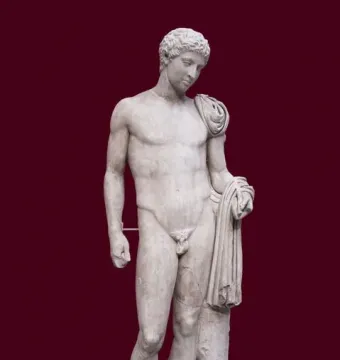
October 2015 © Jebulon · CC0
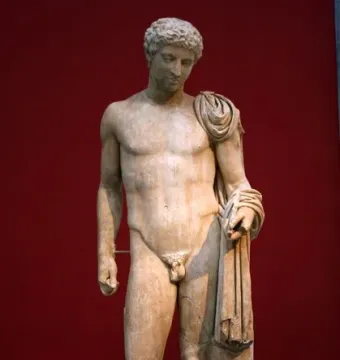
November 2009 © G.dallorto · Attribution
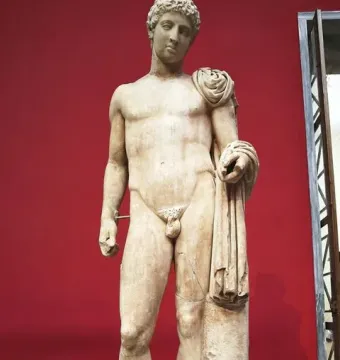
March 2018 © George E. Koronaios · CC BY-SA 4.0
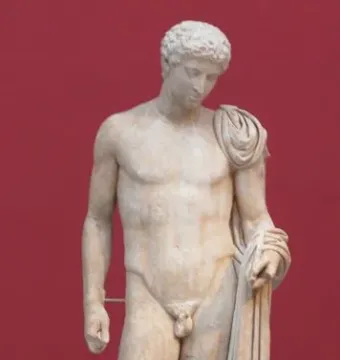
January 2009 © Tilemahos Efthimiadis · CC BY 2.0
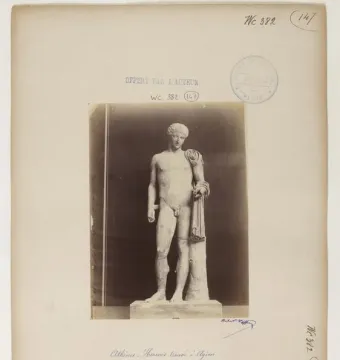
© Vaffier, Hubert (1834-1897). Photographe. Donateur · Public domain
Identification | |
| Title | Hermes of Aegium |
| Greek title | Ερμής του Αιγίου |
| Original-language title | Hermes de Egión |
| Type | Statue |
| Subject | Hermes, the Greek messenger god |
Historical context | |
| Date | Augustan period, late 1st century BC to early 1st century AD |
| Period | Roman period |
| Historical context | Created during the reign of Augustus |
| Probable function | Funerary sculpture |
Creator | |
| Stylistic influence | Lysippan influence |
Discovery and provenance | |
| Discovery location | Aigio (ancient Aegium), Achaea, Peloponnese, southern Greece |
| Discovery date | 1860 |
| Name origin | Named after Aegium, where it was found |
| Acquisition | Purchased by the archaeological society |
| Purchase price | 12,000 drachmas |
| Accession number | 241 |
| Condition when found | Nearly intact and in excellent state of preservation |
Physical characteristics | |
| Condition | Nearly intact, with minor damage |
| Condition of attributes | The upper part of the bag is missing; the caduceus is not preserved |
| Height | 171 cm |
| Hair | Short, tousled hair carved as crescent-shaped locks framing the face low on the forehead |
| Head | Idealized, with strong features and tilted to the left |
| Pose | Standing in contrapposto, with weight on the left leg; right leg relaxed, bent at the knee, and drawn slightly to the side and back |
| Scale | Life-size |
Materials | |
| Material | Pentelic marble |
| Support material | Marble |
Appearance | |
| Drapery | A chlamys hangs from the left shoulder, wrapped around the left arm, and drapes over the support |
| Support | Tree-trunk form |
| Right-hand attribute | Bag |
| Left-hand attribute | Caduceus |
| Facial features | Hard features |
Comparisons | |
| Comparison | Has affinities with the Hermes of Atalanti and the Hermes of Andros |
Significance | |
| Quality assessment | Considered of inferior quality, especially compared with the Hermes of Andros |