
Friesentor Madonna
Friesentor Madonna is a sculpture of the Virgin Mary with the Child Jesus, dated to around 1370–1380 and attributed to a local artist. It is regarded as one of the finest and earliest examples of the beautiful Madonnas, a devotional sculptural type that became especially popular in Central Europe in the first half of the 15th century. Its style has been linked to the sculptures of the St. Peter portal at the south entrance of Cologne Cathedral, associated with the Parler circle. The work is stylistically distinct in its softer treatment of drapery and greater emphasis on flesh tones. It is currently exhibited in the Schnütgen Museum in Cologne, Germany.
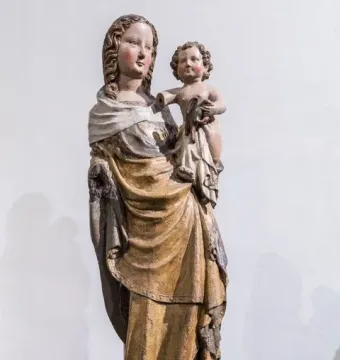
December 2024 © Raimond Spekking · CC BY-SA 4.0
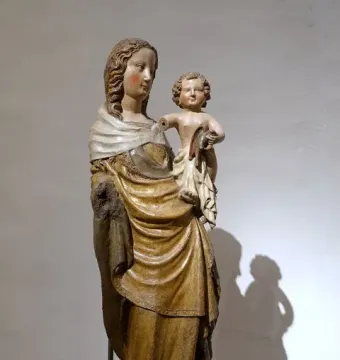
November 2015 © Daderot · Public domain
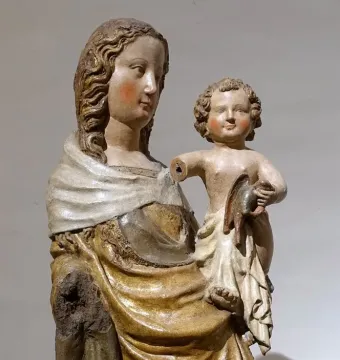
November 2015 © Daderot · Public domain
Identification | |
| Title | Friesentor Madonna |
| Alternative name | Friesentor Virgin |
| Alternative name | Madonna of the Friesentor Tower |
| Alternative name | Madonna della torre dei Frisoni |
| Type | Sculpture |
| Type | Madonna and Child statue |
| Iconographic type | Beautiful Madonna |
| Subject | Virgin Mary holding the Christ Child upright in her arms |
| Alternative name | Madonna of the Frisians' Tower |
Historical context | |
| Style | Refined and idealized |
| Art-historical context | A sculptural genre popular in Central European sculpture in the first half of the 14th century |
| Date | circa 1370–1380 |
| Stylistic / historical context | Beautiful Madonnas were most widespread in Central Europe in the first half of the 15th century |
| Stylistic origin | Central Europe |
| Stylistic period | 15th century |
Creator | |
| Attribution | Attributed to a local artist or sculptor |
Discovery and provenance | |
| Museum transfer | Moved to the museum in an unspecified century |
| Source status | Unverified sources |
| Original location fate | The gate was demolished in 1882 |
| Name origin | Named for its presumed original location at the Friesentor |
| Original location note | According to tradition, the statue came from the Friesentor |
| Original location | The Friesentor, an old city gate in Cologne |
Location and ownership | |
| Current location | Schnütgen Museum, Cologne, Germany |
| Display status | On exhibit |
Materials | |
| Material | Walnut wood |
Physical characteristics | |
| Missing parts | Both the Virgin and the Christ Child are missing the right forearm |
| Surface finish | Original polychromy survives, but is faded |
| Condition | Overall in good condition; relatively well preserved |
| Clothing and drapery | The Virgin's mantle drapes delicately over her shoulders, ends at the knee, and bunches at the left hip beneath the Child, exposing the tunic; the cloth lies close to the body with waving, flat folds and tubular folds concentrated at the left hip under the Child |
| Pose | An upright Virgin and Child with a distinct S-curve body |
Function | |
| Function | Exclusively devotional statue; not a reliquary and contains no space for relics |
Appearance | |
| Depiction style | Refined and idealized depiction of the Virgin and Child |
| Stylistic features | The drapery is handled less directly, and the flesh tones are more strongly emphasized |
Significance | |
| Historical significance | One of the oldest examples of the Beautiful Madonnas |
| Art-historical significance | One of the best and most valuable examples of the Beautiful Madonnas |
| Artistic comparison | Stylistically related to the sculptures of the portal of Saint Peter at the south entrance of Cologne Cathedral, attributed to the Parler circle and preserved at Kolumba in Cologne; those works are contemporary but belong to a different artistic context |