
Madonna di Trapani
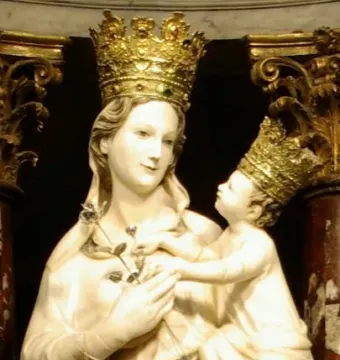
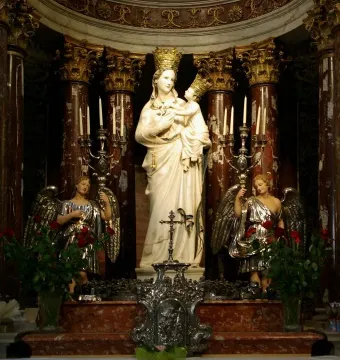
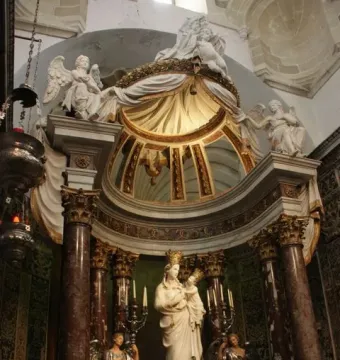
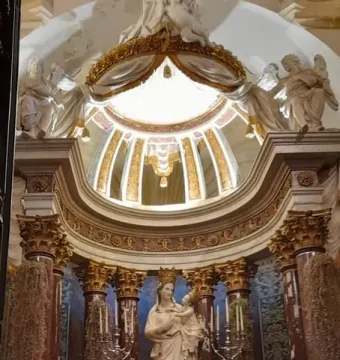
Madonna di Trapani is a statue of Mary attributed to the medieval Italian sculptor Nino Pisano. It is housed in a chapel in Trapani, at the far western tip of Sicily. The statue’s origins are uncertain, as much of the early history was lost when the Carmelite convent’s archives were destroyed during a plague. Traditions variously say it came from Jerusalem or Cyprus and was carried by ship before reaching Trapani by miraculous means. Documentary evidence places the statue in the basilica by 1345, and probably earlier, around 1342. In the 18th century, it was crowned after local devotion and reports of miracles, and later became patroness of the city.
September 2023 © Civa61 · CC0
October 2012 © Berthold Werner · CC BY-SA 3.0
November 2015 © Civa61 · CC BY-SA 3.0
October 2016 © Davide Mauro · CC BY-SA 4.0
May 2023 © Pugliesig · CC BY-SA 4.0
Identification | |
| Title | Madonna di Trapani |
| Alternative name | Madone de Trapani |
| Type | Marble statue of the Madonna and Child |
| Subject | Virgin Mary and Child Jesus |
Creator | |
| Attribution | Attributed to Nino Pisano, with more recent attribution also extending to the workshop of Andrea Pisano |
Historical context | |
| Later status | Named patron saint of the city a few decades after the crowning |
| Basilica date | 1342 |
| Probable date of arrival | Probably around 1342; another tradition places its arrival in the city after 1290 |
| Historical attestation | Its presence is attested in the basilica in 1345 and again in 1428 |
| Early ownership tradition | Said to have belonged to a Pisan Templar knight |
| Legend of arrival in Trapani | Tradition says it was brought to Trapani by an angel after a shipwreck, or that it was transported there after an ox-cart stopped in front of the Carmelite convent |
| Origin traditions | Disputed: some traditions place its origin in Jerusalem, others in Cyprus, Syria, or a commission by a Pisan patron for Sicily |
Discovery and provenance | |
| Location in early records | Placed in the Carmelite convent and attested in the basilica at Trapani |
| Probable commission | Likely commissioned by a Pisan patron from Nino Pisano for placement in Sicily, probably on the patron's own possession |
| Archival loss | Mid-15th-century epidemic led the Carmelite convent to burn furniture, books, and writings, destroying earlier archives about the statue |
Physical characteristics | |
| Detailing | Remarkable fineness of detail for the period |
| Crowns | Both Mary and the Child are crowned in gold; an argent crown on the Madonna's head is documented in 1428 |
| Clothing | Tunic, large folded mantle, and veil |
| Gaze | The Virgin looks toward the viewer or the faithful; the Child looks at his mother's face |
| Size | Life-size |
| Height | 165 cm |
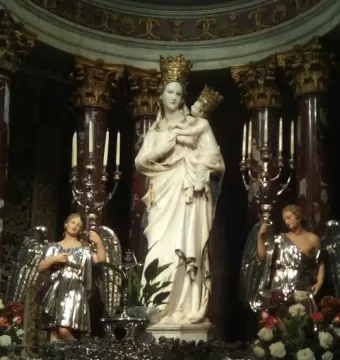
| Pose | The Virgin stands with the Child Jesus on her left side, her right hand extended toward him, her head slightly inclined |
Materials | |
| Statue material | Marble, probably Parian marble (also described as Naxian marble) |
| Replica material | Alabaster from quarries in the Trapani area |
Technique | |
| Replica production | Reduced alabaster replicas were produced by artisan workshops in Trapani from the end of the 16th century onward, with participation from workshops of the Gagini and Tipa families |
Location and ownership | |
| Religious affiliation | Carmelite |
| Treasury location | The treasury with gifts and ex votos is kept in the former convent, now the Agostino Pepoli Regional Museum |
| Original location | A chapel of the cathedral in Trapani |
| Current location | Basilica santuario di Maria Santissima Annunziata, Trapani, Sicily, Italy |
History and restoration | |
| Crowning | The statue was crowned in St. Peter's Basilica on 14 March 1734 and re-crowned on 10 August 1935 by order of Pius XI |
| Crowning authorization | Permission to crown was granted in the 1730s |
| Crown maker | Giacomo Gardini, a Roman goldsmith |
| Restoration | Conservative restoration carried out in 2003 by the Opificio delle Pietre Dure of Florence |
| Processions | Carried in procession 23 times; first in 1527 and last in 1954, after which a wooden copy was used for processions |
| Festival and devotion | A 15-day devotional period begins on 1 August and ends on 16 August with Mass, a pontifical service, a procession, and fireworks at the port |
Significance | |
| Patronage | Principal patron of the Diocese of Trapani and co-patron of the city of Trapani |
| Veneration | Venerated in Trapani province and also in Messina, Palermo, Palagonia, Capaci, Carini, Cinisi, Mussomeli, Santa Lucia del Mela, Tonnarella, Terrasini, Marseille, Tunis, and parts of Spain, especially southern Spain |
| Related chapels and shrines | Dedicated chapels or shrines exist in Cagliari, Genoa, Tenerife, Seville, Orense, and La Goulette |
| Devotional importance | The production of alabaster replicas is regarded as one of the most important historical, artistic, and devotional phenomena in Sicily |