
Yazılıkaya
Yazılıkaya is a former Hittite sanctuary that was created mainly in the 13th century BC. It lies about two kilometres northeast of the former capital Hattusa, near Boğazkale in Turkey’s Çorum Province. The sanctuary’s natural rock chambers A and B are open to the sky and have wall heights of between two and twelve metres. Their reliefs show two processions of male and female members of the Hittite pantheon, as well as the presumed builder, Great King Tudhaliya IV. In front of the chambers stood temple-like buildings, of which the foundations remain. The site was used for cultic activities during the Hittite Empire and has been part of the UNESCO World Heritage List since 1986.
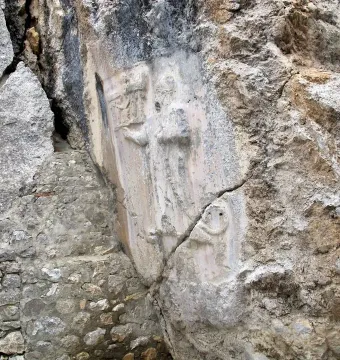
March 2013 © Murat Özsoy 1958 · CC BY-SA 4.0
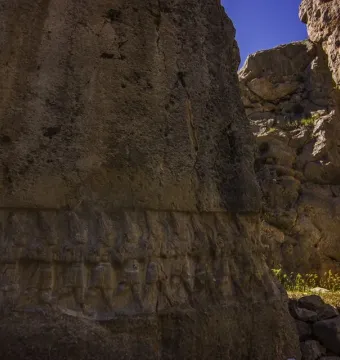
May 2022 © Alfinkedisi · CC BY-SA 4.0
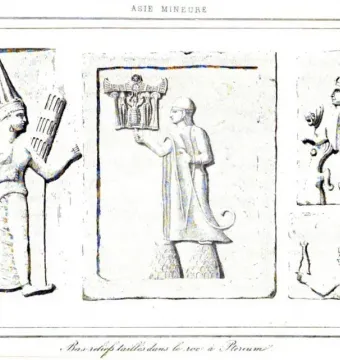
1862 © Charles Texier · Public domain
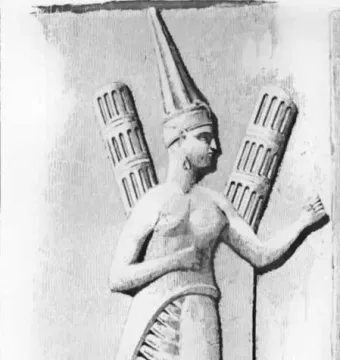
1862 © Charles Texier · Public domain
May 2019 © Ingeborg Simon · CC BY-SA 3.0
Identification | |
| Title | Yazılıkaya |
| Type | Hittite rock sanctuary and relief complex |
| Alternative name | Midas City |
Historical context | |
| Function | Sanctuary and holy site used for cultic rituals, including possible funerary cult rituals for the dynasty |
| Original function | Place of worship used from at least the 16th century BC; Early Bronze Age use is unproven |
| Main period of creation | Mainly during the reign of Tudhaliya IV in the 13th century BC, with most reliefs dated to the late 13th century BC and some parts predating him in the 15th century BC |
| Later remodeling | The site was rearranged and the side chamber was repeatedly rebuilt until the end of the Hittite Empire; lion-headed demons were added at the entrance near the end of the Hittite period |
| Cultural context | Hittite |
Creator | |
| Presumed builder | Great King Tudhaliya IV |
Discovery and provenance | |
| Original name | Unknown; there is no direct textual reference in the tablets found in Ḫattuša |
| Inscription language and script | Hurrian names and other Hurrian words written in Hittite (Luwian) hieroglyphs |
| Inscriptions content | The inscriptions contain the names of gods and other Hurrian words |
| Excavation evidence for use | Hittite pottery and a wall in front of the chambers suggest cult gatherings there from about the 15th century BC onward |
| Decipherment of inscriptions | The inscriptions were deciphered and read by Emmanuel Laroche in 1952–1969 |
| Discovery | Discovered by Charles Texier in 1838 and investigated in 1838–1839 |
| Earliest finds | Objects from the Early Bronze Age, dating to the 3rd millennium BC, were found there |
Physical characteristics | |
| Number of chambers | Two main chambers |
| Modern access | A modern road from the entrance of Ḫattuša leads to a parking area in front of the site, with another road from Boğazkale joining halfway |
| Access route | In Hittite times, a processional road led from the Great Temple of Ḫattuša to the sanctuary; it is no longer present but can be reconstructed from the landscape |
| Associated structures | Temple-like forestructures once stood in front of the chambers; only the foundations remain |
| Wall height | Between 2 and 12 meters |
| Chambers | Two main roofless chambers, A and B, with a side chamber C and an additional Chamber D |
| Setting | An open-air sanctuary formed by naturally carved rock chambers and gorges in a rocky massif on the north side of Akçadağ Tepesi, in the Halys region and Bozok Plateau |
| Location | Near Ḫattuša, the former capital of the Hittite Empire, about 2 km northeast of the city, in Çorum Province, Turkey, near Boğazkale |
Materials | |
| Relief material | Rock |
Technique | |
| Technique | Rock-cut bas-relief |
Appearance | |
| Chamber B | A smaller, narrower chamber with fewer but larger and better preserved reliefs |
| Entrance figures | Lion-headed demons were carved at the entrance to the side chamber |
| Side chamber contents | The side chamber contains images of unnamed gods and demons |
| Chamber B iconography | A procession of twelve deities and other figures, including an enigmatic sword god and depictions associated with Tudhaliya IV |
| Chamber A | The largest chamber, with a procession of gods meeting at the center; male deities are on one side and female deities on the other |
| Tudhaliya IV depiction | Tudhaliya IV is depicted three times with royal attributes; in one scene he is embraced by Sharruma |
| Chamber A iconography | The procession includes Teshub standing on mountain gods, Hebat standing on a panther or lion, Sharruma, Alanzu, a granddaughter, Ea, and Shaushka with attendants |
| Reliefs depict | Processions of Hittite deities, including male and female figures, the supreme couple Teshub and Hebat, Tudhaliya IV, and other gods and demons |
| Preserved features | Monoliths, rock carvings, and imposing gateways are preserved |
| Composition | The sanctuary consists of a central chamber, an attached temple-like area, and a side chamber |
Iconography and meaning | |
| Religious imagery | The reliefs show the gods of the Hittite pantheon and Hittite religious syncretism, including Hurrian and Mesopotamian deities |
| Interpretations | Proposed functions include a New Year or spring festival sanctuary, a funerary cult site for Tudhaliya IV, a ḫuwaši sanctuary, a place with calendrical or astronomical function, and possibly a transit-tax collection point; the site was also proposed as a calendar or cosmic model |
| Possible ritual use | Possibly used for New Year or spring festival ceremonies, though the ritual content remains unclear |
| Possible astronomical function | A 2019 interpretation proposed that the site served as a lunisolar time-keeping device, with carvings marking lunar and solar movement |
| 2021 interpretation | A 2021 study proposed that the sanctuary depicted the cosmos with earth, sky, and underworld and cyclical processes such as day and night, lunar phases, and summer and winter |
| Alternative 2021 interpretation | The supreme deities in Chamber A may refer to the northern stars, while Chamber B may represent the netherworld |
| Calendar interpretation | One theory interprets the twelve gods as lunar months, the thirty male gods as days of the lunar month, and the nineteen goddesses as 19 years, corresponding to the Metonic cycle |
Location and ownership | |
| Protected area | Included in the Boğazköy-Alacahöyük National Park |
| Associated ancient city | Ḫattuša |
| UNESCO status | Listed as part of the UNESCO World Heritage site of Ḫattuša since 1986 |
| Part of | The archaeological site of Ḫattuša |
History and restoration | |
| Historical use | Used as a cult site during the Hittite Empire and later by the last Hittite kings for funerary cult rituals |
| Earliest known use | At least from the late 16th century BC |
| Main construction period | The main structures, inscriptions, sculptures, and reliefs were created during the reign of Tudhaliya IV, c. 1250–1220 BC |
| Age of side chamber | The side chamber is the oldest part of the sanctuary and predates Tudhaliya IV |
| Later modifications | The side chamber was rebuilt repeatedly until the end of the Hittite Kingdom |
| Archaeological route context | The ancient processional road left the lower city through an undiscovered gate, crossed the stream, passed Osmankayası, and ended beside the rock massif |
| Burials | Burials were found in fissures on the outer side and in a passage to Chamber B; they are dated to the Hittite imperial period |
| Chamber D find | A pig embryo buried in a bowl and fixed with nails was found in Chamber D, suggesting purification rites |
Significance | |
| Art historical significance | Rock reliefs are a prominent and generally the most important group within Hittite art |
| Artistic significance | Yazılıkaya is considered the most significant example of a monumental style combining Hurrian and Luwian South Anatolian elements |
| Historical influence | This style continued in the art of southern Asia Minor and Syria after the destruction of the Hittite Empire |