
Artemision Bronze
Artemision Bronze, also known as Zeus or Poseidon from Artemision, is an ancient Greek bronze statue of a nude bearded man discovered in the Aegean Sea near Cape Artemision in 1927. It dates to around 460–450 BCE and belongs to the early Classical period. The figure stands in a wide stance with his head turned toward his outstretched left arm and his right arm drawn back, originally holding an object that is now lost. The statue is 2.09 meters tall, with copper-inlaid eyebrows and mouth and separately inserted eyes. It is currently on display in the National Archaeological Museum in Athens. Scholars continue to debate whether it represents Poseidon or Zeus, and the artist is unknown, though some attribute it to Kalamis.
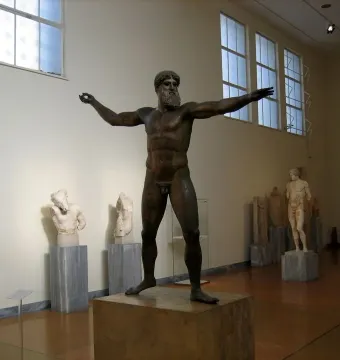
December 2006 © User:Mountain · Public domain
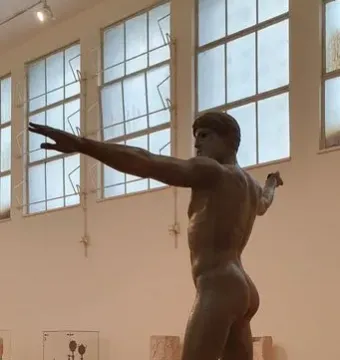
April 2024 © Yair-haklai · CC BY-SA 4.0
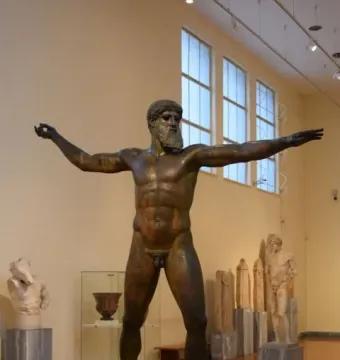
November 2021 © Jean Housen · CC BY-SA 4.0
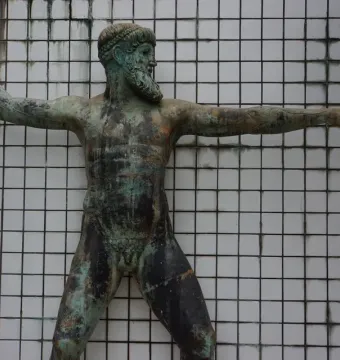
© lienyuan lee · CC BY 3.0
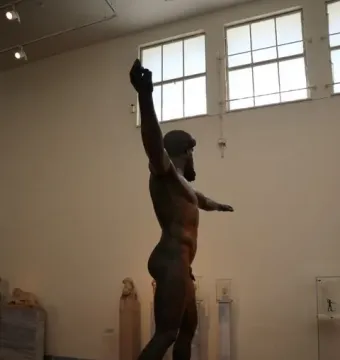
April 2018 © George E. Koronaios · CC BY-SA 4.0
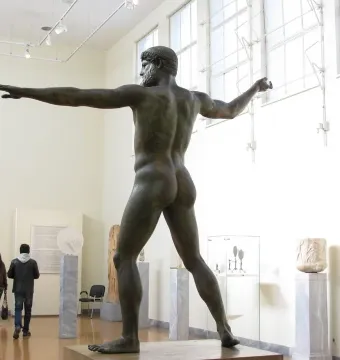
January 2009 © Tilemahos Efthimiadis · CC BY 2.0
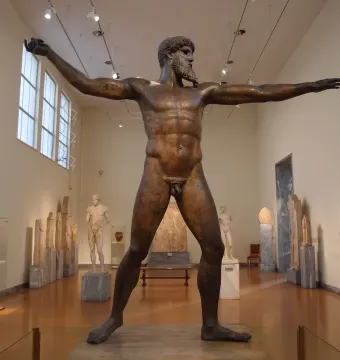
December 2013 © Ryunpos · CC BY-SA 4.0
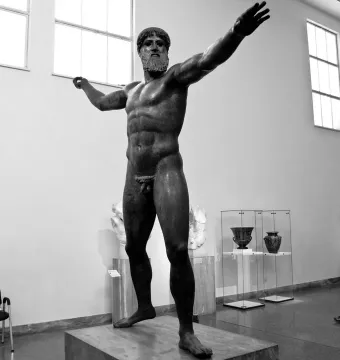
August 2011 © Gisele Porcaro · CC BY 2.0
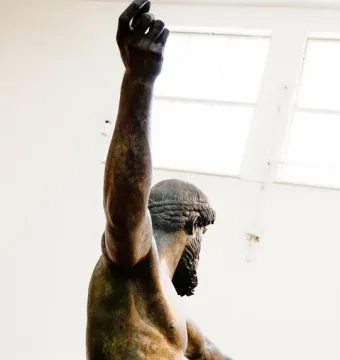
July 2014 © KARL-SEBASTIAN SCHULTE · CC BY 2.0
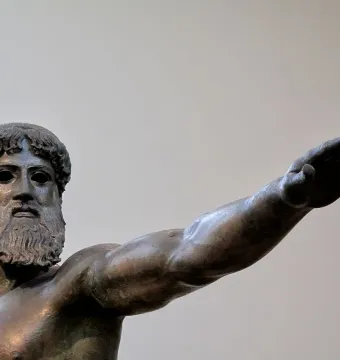
June 2010 © Francisco Anzola · CC BY 2.0
Identification | |
| Title | Artemision Bronze |
| Alternative names | Poseidon of Artemision; Zeus of Artemision; The God from Cape Artemision; God from the Sea; God of Cape Artemision; Bronze of Artemision; Poseidon from Cape Artemision; Cronide of Cape Artemision; God of Artemision |
| Type | Ancient Greek bronze statue; sculpture of a man; monumental Greek sculpture; standing figure |
Creator | |
| Artist / sculptor | Unknown; some scholars attribute the sculpture to Kalamis; possible sculptors considered: Onata of Aegina, Pythagoras of Rhegium, or Calamis |
Historical context | |
| Date | c. 480–470 BC; circa 460–450 BC; 5th century BC; circa 460 BC |
| Period | Early Classical period; transition between Archaic and Classical Greek art; severe style |
| Style | Severe style |
Discovery and provenance | |
| Discovery location | Off Cape Artemision, north of Euboea, Greece; found in the Aegean Sea near Cape Artemision; recovered from the sea off Cape Artemision in northern Euboea; found in a shipwreck area near Cape Artemision |
| Discovery date | 1926; 1927; 1928 (for the remainder of the statue / excavation / recovery) |
| Discovered by | Fishermen from Skiathos; sponge divers; the Greek navy |
| Discovery context | Found in or near a shipwreck; the statue was aboard a ship that sank off Cape Artemision; found with the Artemision Jockey / Jockey of Artemision / Horse and Rider from Cape Artemision |
| Shipwreck date | Unknown; stated as 2nd or 1st century BC; around 200 BC; at the earliest in the mid-2nd century BC; early 1st century CE Roman ship; possibly Roman |
| Shipwreck cargo / context | A heterogeneous cargo; cargo and works of Greek art en route to Rome; it is still unclear whether the statue was aboard the vessel |
| Recovery and excavation | The left arm was found separately in 1926; the rest of the statue was recovered in 1928; underwater excavations were conducted without safety precautions; exploration was abandoned after a diver died of decompression sickness and was never resumed |
| Associated finds | The Artemision Horse; the Jockey of Artemision; remains of a sunken boat and some objects from it; bronze fragments |
| Inventory number | 15161 |
Location and ownership | |
| Museum status | A highlight of the museum's collections; one of the most important sculptures in the National Archaeological Museum, Athens |
| Current location | National Archaeological Museum, Athens |
Physical characteristics | |
| Height | 2.09 m; 2.10 m; about 209 cm; slightly over lifesize; larger than life-size |
| Width | Large; exact measurement not given |
| Condition / completeness | One of the few large Greek bronzes still preserved complete; one of the very few original bronze works that have survived to the present; original ancient Greek bronze, not a later copy; one of the few surviving Greek bronze figures from the 5th century BC; one of the rare original bronze statues preserved today |
| Construction and inlay | Eyebrows and mouth inlaid with copper; eyebrows originally inset with silver; eyes originally probably made of glass and inserted separately; eye sockets originally empty, probably inset with bone; lips originally inset; nipples originally inset with copper |
| Material | Bronze |
Appearance | |
| Depicted figure | A nude, bearded man in mature age; a god; a thunder-god and king of gods (if Zeus) |
| Pose | Standing in a wide stance; head turned toward the outstretched left hand; right arm drawn back; poised to throw a weapon; at the moment of pause, with the action just beginning; taking a stride; sweeping arm movement; still resting on both feet, though dynamism is beginning to appear; frontality and statism already abandoned |
| Missing right-hand attribute | The original object has not survived; possibly a trident, thunderbolt, or spear; if Zeus, a thunderbolt; if Poseidon, a trident; sometimes described as a weapon thrown or about to be thrown |
Iconography and meaning | |
| Comparative works | The Charioteer of Delphi; the two Riace warriors; comparable to the Charioteer of Delphi as a roughly contemporaneous bronze |
| Scale | Its height matches the usual Greek scale for representing gods; typical male figures about 1.80 m; typical heroes 1.90 m |
| Subject identification | Disputed: most often identified as Poseidon; some scholars identify it as Zeus; some literature leaves the god unnamed; scholarly view remains divided; most scholars presently think it is Zeus |
| Counterarguments to Poseidon identification | A trident would obscure the face in profile, which was likely the most important view; a throwable trident seems strange; an unusually short trident has been proposed; the figure was found in the Mediterranean, but this is not reliable evidence because it was on a ship |
| Evidence for Poseidon identification | The lost right-hand object could have been a trident; a coin of Poseidonia shows Poseidon in a very similar pose preparing to throw a trident; the open position of the hand and fingers seems more suitable for a trident than a thunderbolt |
| Evidence for Zeus identification | Iconographic parallels with vase painting and smaller solid bronze figurines of Zeus; comparative poses in surviving statuettes of Zeus launching his thunderbolt; Zeus is typically depicted with his arm raised and lightning bolt overhead in the same position as the statue |
Significance | |
| Historical significance | One of the few large Greek bronzes still preserved complete; one of the very few original bronze works that have survived to the present; one of the rare original bronze statues preserved today |
| Cultural significance | The statue's head is an icon of Hellenic culture |
| Depictions in modern media | Greek 500-drachma postage stamp, 1954–1977; 1,000-drachma banknote, first issued in 1970 and replaced in 1987 |