
Sarcophagus of Constantina
The Sarcophagus of Constantina is a Roman sarcophagus from the first half of the 4th century, made for Constantina, daughter of Emperor Constantine the Great, who died in 354. It is carved from red porphyry and measures 225 cm high, 233 cm long, and 155 cm wide. The sarcophagus was originally placed in a mausoleum founded by Constantia on the Via Nomentana. Between 1467 and 1471 it was moved to the Basilica of St. Mark in Rome, and in 1790 it was transported to the Vatican, where it entered the Vatican Museums. It rests on four lion-shaped feet designed by Francesco Antonio Franzoni and is decorated with acanthus garlands, putti gathering grapes, two peacocks, and a lamb.
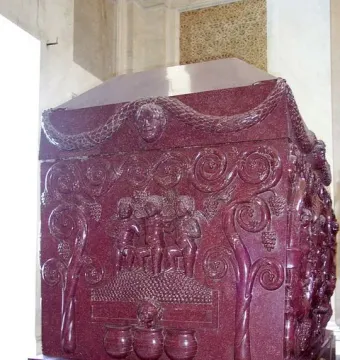
· CC BY-SA 2.0
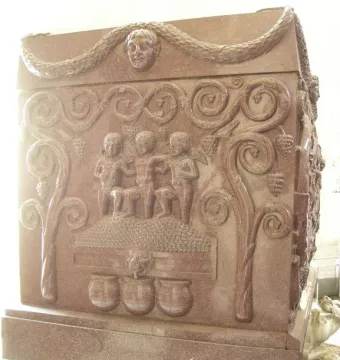
April 2010 © sailko · CC BY-SA 3.0
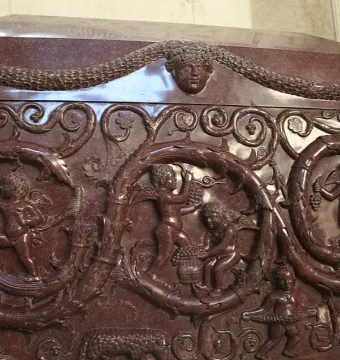
September 2011 © Jean-Pol GRANDMONT · CC BY-SA 3.0
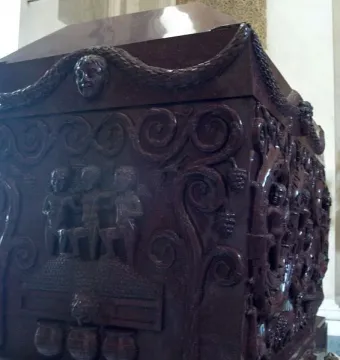
May 2011 © MiguelHermoso · CC BY-SA 3.0
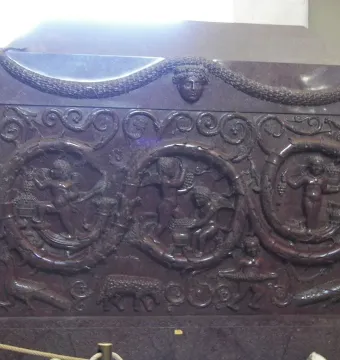
April 2008 © Wknight94 · CC BY-SA 3.0
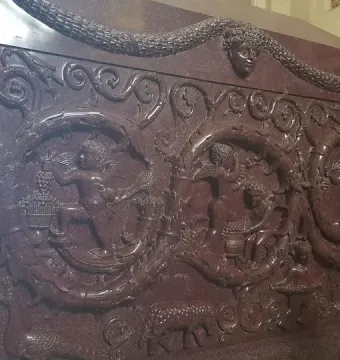
April 2017 © Jamie Heath · CC BY-SA 2.0
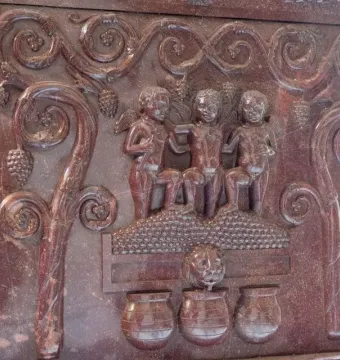
April 2022 © Fabrizio Garrisi · CC BY-SA 4.0
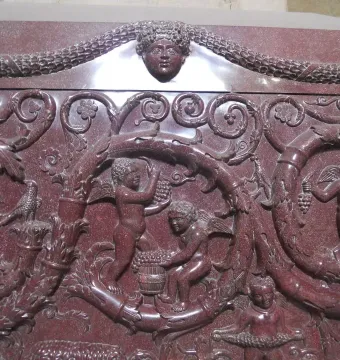
March 2010 © Erik Drost · CC BY 2.0
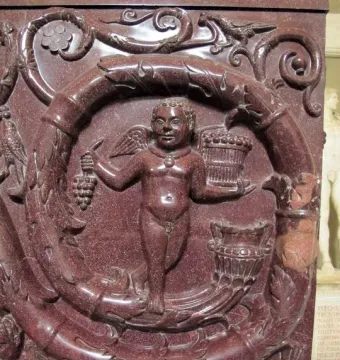
© Sailko · CC BY-SA 3.0
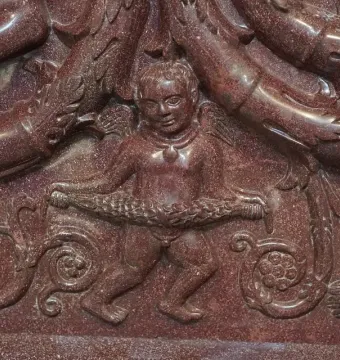
June 2022 © Fabrizio Garrisi · CC BY-SA 4.0
Identification | |
| Title | Sarcophagus of Constantina |
| Alternative names | Sarcophagus of Constance; Costanza (Italian) |
| Type | Roman sarcophagus; ancient sarcophagus; sarcophagus; massive sarcophagus |
Historical context | |
| Date | First half of the 4th century; between 337 and 354; around 340 |
| Intended recipient | Constantina (or Constance), daughter of Emperor Constantine I / Emperor Constantine the Great |
| Date of death of intended recipient | 354 |
| Art-historical context | It fits within the transition of Late Antique art toward new anti-classical forms that would lead to medieval art |
Creator | |
| Production context | Eastern workshops and artists |
Discovery and provenance | |
| Original location | A mausoleum founded by Constans on Via Nomentana; from the church of Santa Costanza in Rome; from the church of Santa Costanza |
| Later locations | Basilica of St. Mark, Rome (between 1467 and 1471); Vatican Museums (Museo Pio-Clementino) |
| Transfer to Vatican | 1790; moved on a cart drawn by 40 oxen |
| Placement in original setting | Placed in a niche opposite the entrance |
| Associated burial | Used as the burial place of Constantina; Constantina, daughter of Constantine I, was buried there |
| Related monumental context | Mausoleum of Santa Costanza; mausoleum at the Basilica of Sant'Agnese fuori le mura (of Constantinian foundation); very similar to Helena's mausoleum on the ancient Via Labicana |
Physical characteristics | |
| Chest profile | Unprofiled |
| Lid shape | Four sloping sides and a high rim; four sloping sides |
| Dimensions | 225 cm high; 233 cm long; 155 cm wide; 2.25 metres high |
Materials | |
| Material significance | Porphyry was reserved for the imperial court since the 3rd century; a stone reserved for the imperial court since the unspecified date in the text |
| Material | Red porphyry; porphyry; hard porphyry |
Technique | |
| Decorative technique | Relief carving |
| Support | Placed on four lion-shaped feet; designed by Francesco Antonio Franzoni (1734–1818) |
Appearance | |
| Main decorative motif | Rich relief decoration of cupids (putti); garlands of acanthus; putti gathering grapes; vine-harvest cupids |
| Upper register decoration | Vine tendrils form complex scrolls across the entire upper register; complex vine spirals decorate the entire upper register and frame scenes with putti |
| Lid decoration | Garlands supported by protomes; garlands supporting busts |
| Side decoration | Cupids pressing grapes; grape must flows from a lion-protome basin used as a vat and fills one of three aligned receptacles; vine-harvest cupids in the center within vegetal wreaths; the lower part shows various animals; vine tendrils decorate the side borders of the smaller sides and frame the central scenes on the long sides |
| Figures | Cupids; three cupids; cupids with flower crowns |
| Animal motifs | Two peacocks and a lamb; peacocks and sheep |
Iconography and meaning | |
| Mausoleum imagery | The same theme was repeated in the mosaics of the annular vault of the mausoleum, creating a continuous dialogue between different materials and artistic techniques; mosaics of Santa Costanza with vine tendrils and harvesting putti |
| Symbolism | Surface decorated with motifs derived from pagan art, especially Dionysian cult imagery, reinterpreted in a new Christian context; the sculpture combines pagan and Christian symbolism, especially in its vine-harvest theme and animal imagery; the pagan theme was not yet fully assimilated into Christianity and is typical of that historical period |
| Sheep and lamb symbolism | Sheep symbolize Christians; sheep and lambs refer to sacrifice |
| Peacock symbolism | The peacock is associated with resurrection because it changes plumage in spring and was believed to have incorruptible flesh capable of overcoming death; peacocks symbolize Juno and, as queen of the gods, imperial women |
| Funerary symbolism | The vine-harvest theme in funerary art is ancient and linked to Dionysian cults; the grape, by dying, could create something better, wine, just as humans do |
History and restoration | |
| Historical use of nearby work | The sarcophagus of Constantina's sister Helena has not survived; the sarcophagus of her sister Constantina, Elena, mentioned nearby, is not preserved |
| Literary references | Mentioned in a passage of the Liber Pontificalis and in one of the texts of the Roman historian Ammianus Marcellinus; cited in a passage of the Liber Pontificalis and in one by Ammianus Marcellinus |
| Comparative works | Compared with the Sarcophagus of Helena, about twenty years earlier, it retains classical inspiration in composition but shows bulkier figures, simplified volumes, and greater calligraphic detail, especially in vegetal elements; there are possible comparisons with two very close works, one preserved in Istanbul and one in Alexandria, Egypt; very similar works, one preserved in Istanbul and another in Alexandria, Egypt |
Other | |
| Description | An enormous sarcophagus |