Aphrodite, Pan and Eros
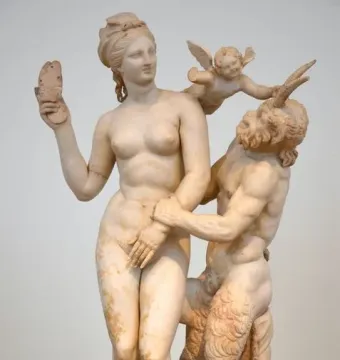
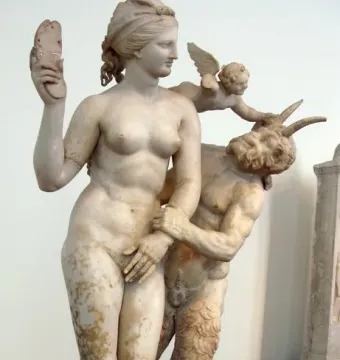
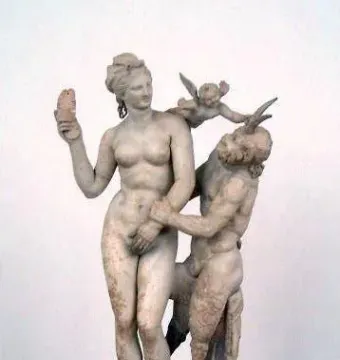
Aphrodite, Pan and Eros is a Hellenistic statue group in marble, about 1.55 metres high, now in the National Archaeological Museum in Athens. Found in 1904 in the House of the Poseidoniasts of Berytos on Delos, it is made of Parian marble and is dated to around 100 BC. The group shows the nude Aphrodite, partly undressed for bathing, confronted by the rustic god Pan, whose animal nature is emphasized by horns, shaggy features, and goat legs. A small winged Eros hovers between them, trying to push Pan away. Several parts were later restored, including sections of the arms, legs, and horns, and the original base preserves a Greek inscription dedicating the work to the native gods.
April 2014 © Carole Raddato · CC BY-SA 2.0
March 2009 © Tilemahos Efthimiadis · CC BY-SA 2.0
© Unknown artistUnknown artist · CC BY-SA 3.0
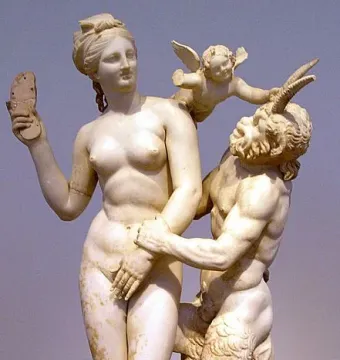
© Marsyas · CC BY 2.5
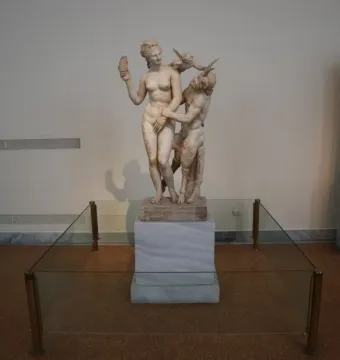
March 2018 © George E. Koronaios · CC BY-SA 4.0
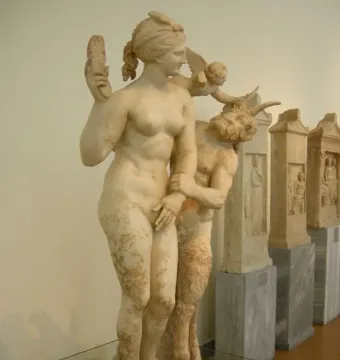
June 2008 © sailko · CC BY 2.5
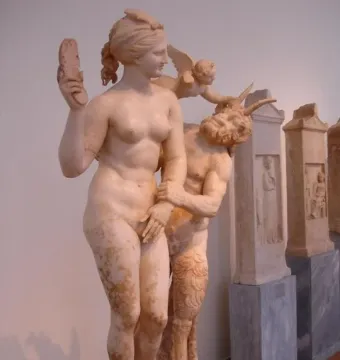
© Krelian99 · CC BY-SA 3.0
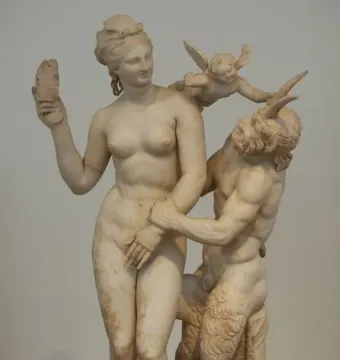
June 2010 © Aleksandr Zykov · CC BY-SA 2.0
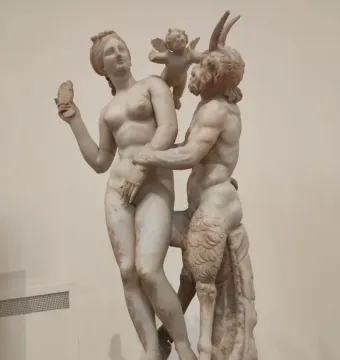
September 2025 © Soghomon Matevosyan · CC BY-SA 4.0
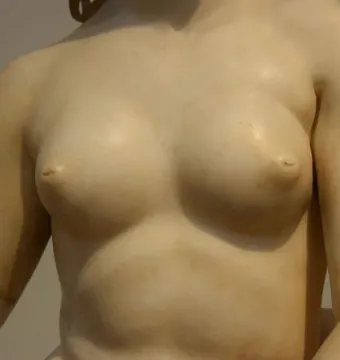
November 2021 © Jean Housen · CC BY-SA 4.0
Identification | |
| Title | Group of Aphrodite, Pan and Eros |
| Type | Hellenistic sculptural group; group statue; sculptural group; ancient marble Greek sculpture |
Historical context | |
| Date | ca. 150 BC; around 100 BC; 1st century BC |
| Style | Hellenistic; late Hellenistic sculpture; Hellenistic Rococo; characteristic example of Hellenistic rococo |
Creator | |
| Artist | Dionysius |
Discovery and provenance | |
| Date of foundation of discovery site | before 152 BC |
| Basis for attribution/date | an inscription |
| Poseidoniasts of Beirut | Merchants who worshipped Poseidon and came from Berytus (modern Beirut); worshippers of the sea-god Poseidon; traders, shipowners, and warehousemen; mostly merchants, shipowners, and warehousemen |
| Discovery place | House of the Poseidoniasts of Berytos, Delos; Poseidoniasts' Compound, on the island of Delos; island of Delos; Delos, from the establishment of the Poseidoniasts of Berytus; a room of the Hall of the Guild of the Poseidoniasts; one of the rooms of the headquarters of the Poseidoniasts of Beirut |
| Discovery date | 1904; early twentieth century |
Location and ownership | |
| Current location | National Archaeological Museum of Athens; Archaeological National Museum, Athens, in Hall 30; Room 30 of the NAMA |
| Museum inventory number | 3335 |
| Gallery location | Room 30 |
Physical characteristics | |
| Height | 1.55 meters; 1.55 m; 1.55 m tall including the large base |
| Scale | slightly smaller than lifesize; slightly under life-size; life-size |
| Base | Original plinth and flat rectangular statue base preserved; rectangular base of the statue group survives; solid base |
Materials | |
| Material | Marble; Parian marble |
Technique | |
| Display setting | Mounted on a gray marble pedestal and surrounded by a glass barrier |
Appearance | |
| Eros | Small winged Eros floating/hovering between the figures at about Aphrodite's shoulder height and slightly above Pan's head; identified as Aphrodite's son; serene smile |
| Pan | Smaller pastoral/nature god shown in profile beside Aphrodite; horned and goat-legged with two long pointed horns, a fur-covered/hairy face, furry or hairy legs ending in goat hooves, and a muscular body with prominent veins; leans on or is supported by a tree-trunk support covered with animal skin; left leg attached to the support up to the buttocks; left arm reaches for or seizes Aphrodite; smiling lewdly or with a wild grimace |
| Aphrodite | Nude, frontally depicted goddess of beauty and love; weight on right leg; left leg relaxed/bent; head turned left; hair tied up in waves or neatly braided and gathered with a scarf/band above the parting; wearing only a sandal on the right foot while the left foot is bare; right arm raised holding a sandal; left hand covers her pubic triangle/genitals |
Iconography and meaning | |
| Scene description | Pan seizes Aphrodite's left wrist or arm as she undresses for a bath; she covers her nudity and threatens him with a sandal; Eros pushes back Pan's horns or grasps one of them to protect his mother |
| Aphrodite's attitude | Impassive, cheerful, humorous, not frightened; possibly preparing for a bath |
| Pan's condition | Out of control; attempting to embrace or woo Aphrodite and involve her in sexual acts; his phallus is no longer preserved and is assumed to have been erect |
| Eros's role | Protects his mother from Pan by pushing him away or grabbing his horn |
| Interpretation | Contrast between heroic or Apollonian nudity represented by Aphrodite and wild, animal, Dionysian nudity represented by Pan |
| Aphrodite's role | Goddess of love and desire |
| Pan's identifying attribute | Goat legs; traditional attribute |
| Subject | Pan attempting to seduce or sexually harass Aphrodite, while Eros helps repel him |
History and restoration | |
| Inscription | The base bears a Greek inscription on the base; text reads: 'Dionysios son of Zenon, grandson of Theodoros, from Berytos/Beirut, benefactor, for himself and his children, to the ancestral gods' |
| Inscription interpretation | The statue was dedicated by Dionysios of Berytos as a benefaction to the ancestral gods for himself and his children |
| Dedication purpose | As benefactor, for himself and his children, to the ancestral gods |
| Dedicator | Dionysios of Berytos, son of Zenon, grandson of Theodoros |
| Condition at discovery | Several parts were broken when found |
| Support structure | Tree trunk support; essential support of the statue; supports Pan and contributes to the stability of the whole group; a hunting stick or lagobolon rests on it or at its foot |
| Missing or restored parts of Pan | Right leg and horns were reattached |
| Missing or restored parts of Eros | Both legs and the left arm were broken off and later reattached; the right arm is missing |
| Missing or restored parts of Aphrodite | Right arm and upper part of the head were broken off and later reattached; three fingers of the left hand and the middle finger of the right hand were lost and replaced or supplemented with plaster; right arm of Aphrodite was reattached; upper part of the head was reattached; three fingers of Aphrodite's left hand and the middle finger of her right hand were modern plaster additions |
Significance | |
| Later citation | Jeff Koons cited the sculpture group in his work Antiquity 1 |