
Avarice and Lust
Avarice and Lust is a sculpture by the French artist Auguste Rodin, conceived between 1885 and 1887. It depicts two of the seven deadly sins and forms part of Rodin’s sculptural group The Gates of Hell, where it is placed in the lower section of the right door. The work may have been inspired by Victor Hugo’s poem After a Reading of Dante. The composition combines the torso of a falling man, whose very long arms encircle a woman who partly covers his face, while he tries to seize a few coins. The man represents greed, with his body derived from The Falling Man, but with altered arms, a new head, and new hair. Lust is represented by the female figure, based on a 1888 drawing by Rodin titled Skeleton Embracing a Woman.
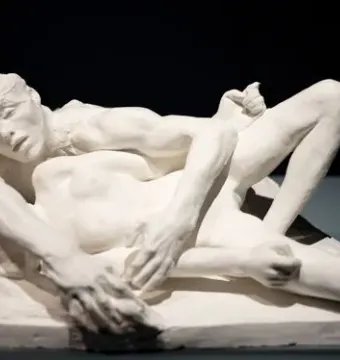
May 2024 © PMRMaeyaert · CC BY-SA 4.0
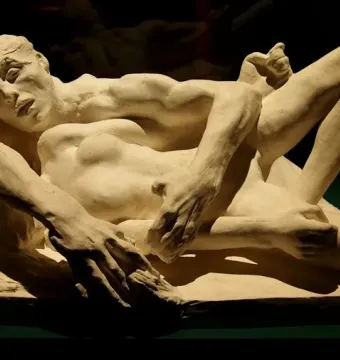
September 2024 © Ikmo-ned · CC BY-SA 4.0
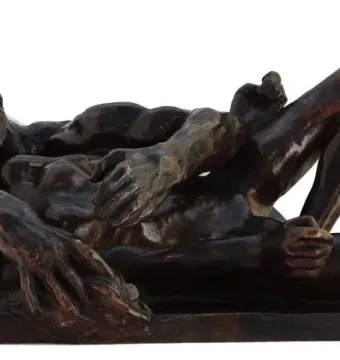
© Auguste Rodin · Public domain
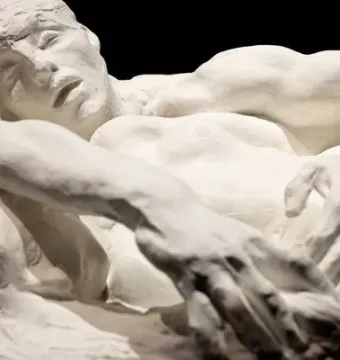
May 2024 © PMRMaeyaert · CC BY-SA 4.0
Identification | |
| Title | Avarice and Lust |
| Spanish title | Avaricia y Lujuria |
| Type | Sculpture |
| French title | L'Avarice et la Luxure |
Creator | |
| Artist | Auguste Rodin |
| Artist nationality | French |
Historical context | |
| Location within The Gates of Hell | Lower part of the right door |
| Date conceived | 1885–1887 |
| Part of larger work | The Gates of Hell |
Iconography and meaning | |
| Female figure | A woman partially covering her face while offering her body; she represents lust |
| Male figure | A falling man with extremely long arms that encircle the woman, reaching for coins; he represents greed |
| Main figures | A falling man and a woman |
| Associated quote | "Et la luxure immonde, et l'avarice infâme, Tous les manteaux de plomb dont peut se charger l'âme!" |
| Possible literary inspiration for the name | Victor Hugo's poem After a Reading of Dante (Après une lecture du Dante) |
| Themes | Avarice, lust, greed |
| Subject | Two of the seven deadly sins: avarice and lust |
Physical characteristics | |
| Composition | Made of several parts |
| Male figure modifications | Arms positioned differently, with a new head and new hair |
Materials | |
| Male figure source body | Torso of The Falling Man |
| Female figure source | Based on an 1888 drawing by Rodin titled Skeleton embracing a woman |
Location and ownership | |
| Related work | The Falling Man |